The Sea Monsters of the Renaissance Naturalists: When Science and Terror Shared the Same Page
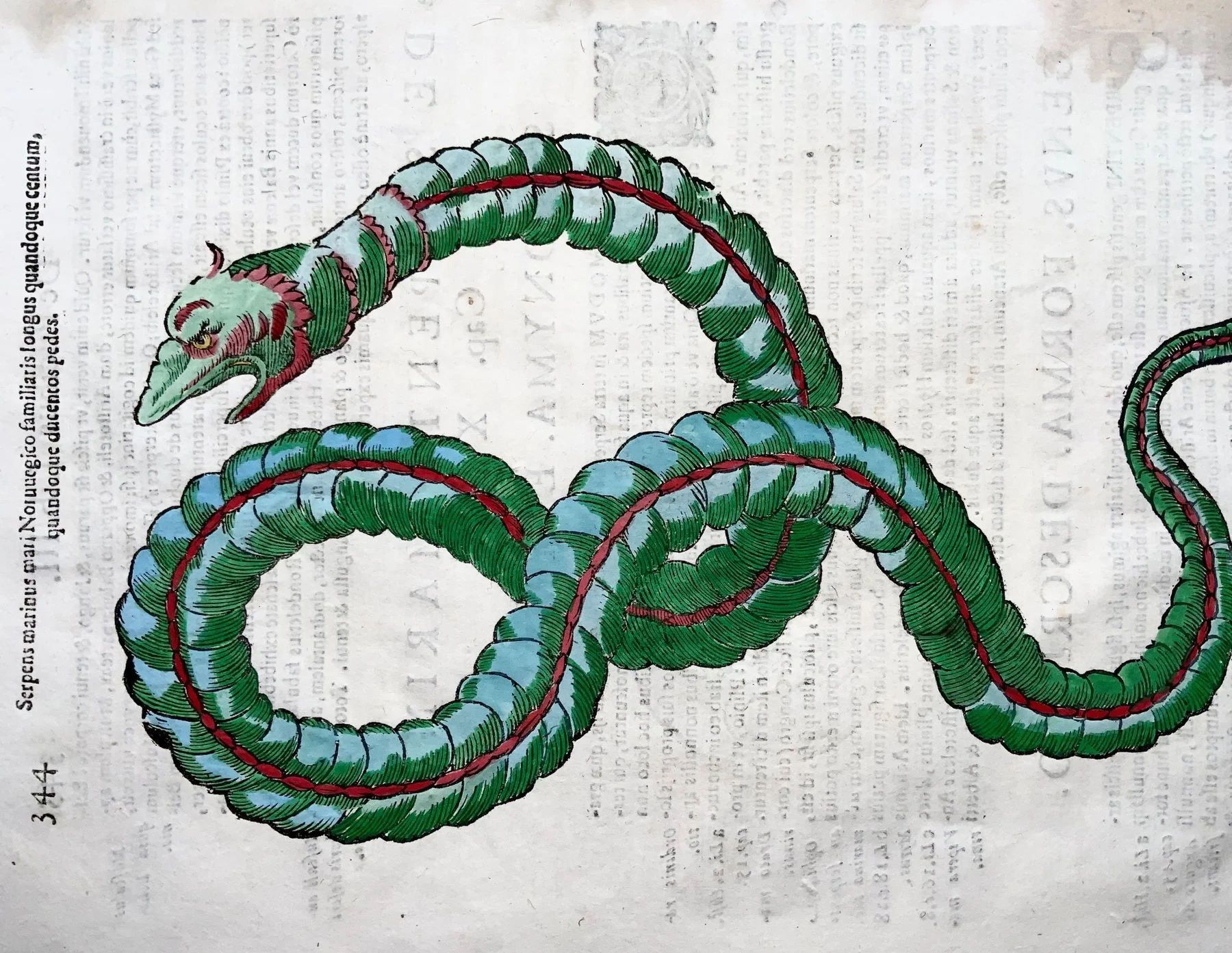
Norwegian Sea Dragon / Serpent (Serpens Marinus)
From De Piscibus
Ulisse Aldrovandi, engraved by Cristoforo Coriolano Bologna: Nicolaus Tebaldini, 1638
Hand-coloured woodcut on folio leaf Woodcut printed to verso, text to recto
Description
This folio woodcut depicts the Norwegian sea serpent — captioned Serpens marinus mari Norruegico familiaris longus quandoque centum, quandoque ducentos pedes: the sea serpent familiar to the Norwegian Sea, sometimes one hundred feet long, sometimes two hundred. It is one of the great monster images of the Renaissance natural history tradition, and among the most arresting woodcuts in Aldrovandi's De Piscibus, published posthumously in Bologna in 1638.
Where the Serpens marinus on the facing sheet coils in a tight heraldic loop, the Norwegian sea serpent spreads across the entire page in a vast, sinuous figure-of-eight — a creature of altogether different character and scale. This is the leviathan of northern waters, the creature that Olaus Magnus had described in his Historia de Gentibus Septentrionalibus a century earlier and that had passed into the repertoire of every serious natural historian as the definitive sea monster of the Northern Ocean. Aldrovandi cites Olaus Magnus directly on the recto: the creature is said to reach two hundred feet in length, to be familiar to Norwegian fishermen, to raise its coils above the mast-height of sailing ships, and to capsize vessels when provoked.
The text on the recto, paginated 343 and headed De Piscibus Lib. III, opens Chapter XXIV — De Serpente Marino — with sections on synonymy and etymology, drawing on Aristotle, Pliny, Rondelet, Belon, and Saluianus to establish the creature's place in the natural order. Aldrovandi distinguishes carefully between the true sea serpent and related creatures including the Ophidion, the Myrus, and the Vipera marina, situating this Norwegian monster at the apex of the category.
Coriolano's woodcut gives the creature a physical specificity that goes far beyond generic serpent imagery. The body is composed of alternating segments — pale blue ventral scales separated by deep green dorsal ridges, with a vivid crimson spine line running continuously from head to the whip-thin black tail tip. The head is genuinely dragonlike: bearded with pink gill frills, wide-jawed, with a yellow eye and an expression of alert menace. The overall impression is not of a symbol but of a documented creature — something seen, or at least reported by credible witnesses, and rendered as faithfully as the woodcut medium allowed.
The sheet has been hand coloured with exceptional boldness. The alternating blue and green of the body segments, the continuous red spine, and the carefully detailed head create a chromatic scheme that is both naturalistic in its ambition and spectacular in its effect. The coloring is period-consistent and very well preserved across the sheet.
Condition
Some staining to one margin. Some colour show-through to recto. Please view all images carefully.
Bibliographic References
Nissen, Zoologische Buchillustration (ZBI) 70
Nissen, Fischbücher 7
Westwood & Satchell 3
Huber 56
Details
Medium: Hand-coloured woodcut
Format: Folio leaf, text to recto
Date: 1638
Dimensions: 13.8 × 9.1 inches (35 × 23.2 cm)
Status: Available
For most of human history, the ocean terrified people. Sailors who ventured into deep water did so knowing that things lived there capable of capsizing ships and swallowing crews whole. This was not superstition. This was the informed consensus of educated men, built on centuries of eyewitness testimony from fishermen, navigators, naval officers, and coastal priests who had no reason to lie and every reason to be believed.
The monsters were real. The reports were real, the fear was real, and the creatures that generated both were real enough that the greatest natural historians of the sixteenth and seventeenth centuries devoted thousands of pages to documenting them. Ulisse Aldrovandi, Conrad Gesner, Guillaume Rondelet, Olaus Magnus, Jan Jonston: these were physicians, professors, and encyclopaedists who applied the full apparatus of Renaissance scholarship to the question of what lived in the sea. And what they concluded was that the sea contained things that should frighten you.
The prints they produced to illustrate those conclusions are among the most extraordinary objects in the history of natural history publishing. They are scientific documents. They are also some of the most visually compelling images of monsters ever made.
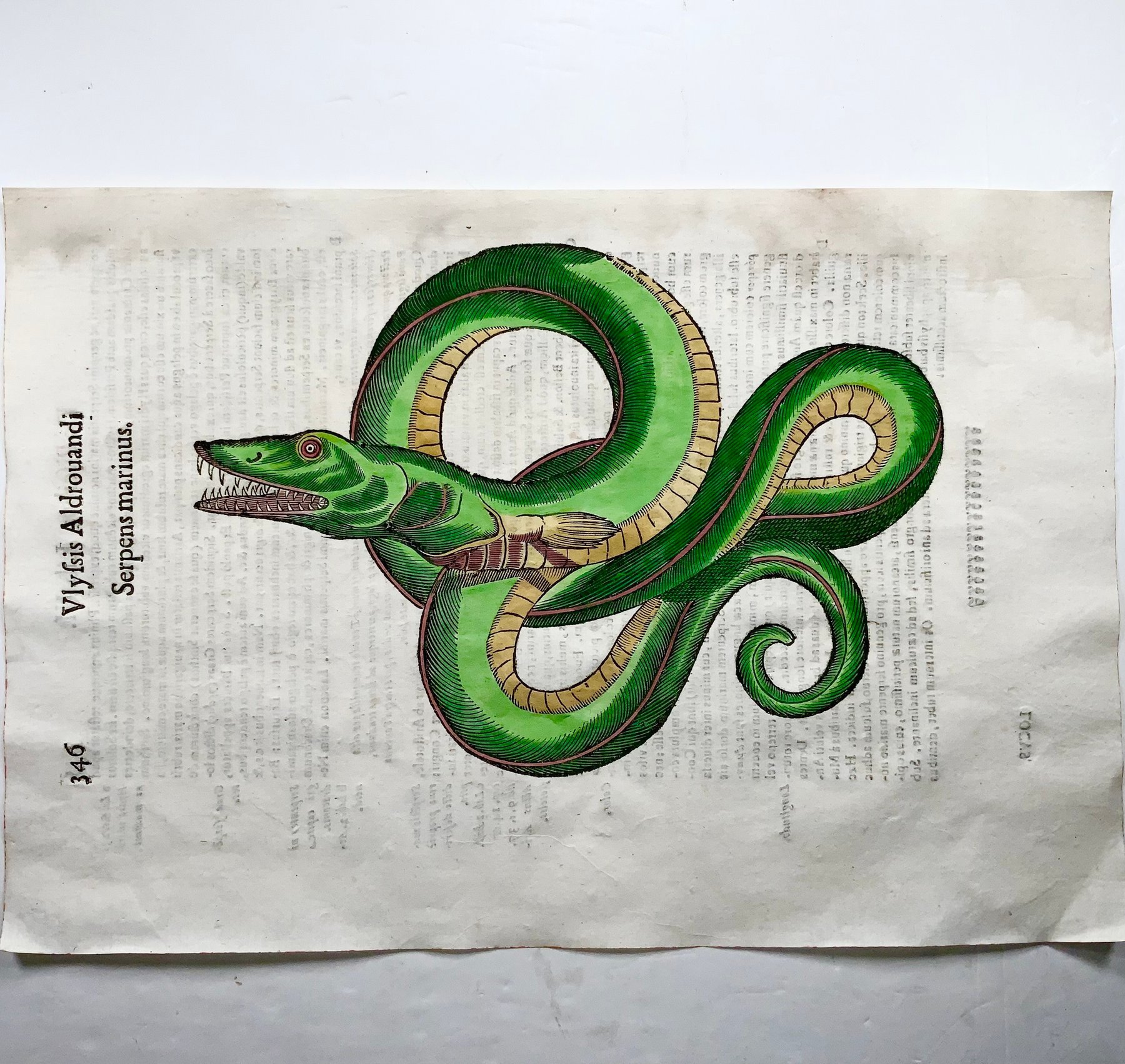
Sea Serpent (Serpens Marinus)
From De Piscibus
Ulisse Aldrovandi, engraved by Cristoforo Coriolano Bologna: Nicolaus Tebaldini, 1638
Hand-coloured woodcut on folio leaf Woodcut printed to verso, text to recto
Description
This folio woodcut of the Serpens marinus — the sea serpent — is one of the most dramatically composed images in Aldrovandi's De Piscibus, published posthumously in Bologna in 1638. The creature fills the entire page in a great coiling double loop, its toothed jaw open, its red eye fixed, its body resolved into an almost heraldic symmetry of interlocking curves. It is simultaneously a natural history document and one of the most visually arresting images produced by the Renaissance press.
The text on the recto, paginated 345 and headed De Piscibus Lib. III, opens the chapter on the sea serpent in earnest — citing Pliny, Aristotle, Solinus, and Rondelet on the nature, habitat, and physical characteristics of the creature. Aldrovandi notes Pliny's report of marine serpents eighty cubits long encountered off the coast of Persia, recounts Aristotle's comparison of the Serpens marinus with the conger eel in color and body form, and carefully distinguishes between the true sea serpent and related creatures. The text is a summation of everything Renaissance natural philosophy had assembled on the subject — classical, medieval, and contemporary — and the image facing it renders that accumulated authority in a single unforgettable form.
The woodcut was cut by Cristoforo Coriolano, the Nuremberg-born engraver whom Aldrovandi singled out for particular praise, noting that his cuts were of such elegance that they resembled copper engravings. The present image bears out that assessment: the cross-hatching on the scales, the rendering of the ventral fins, and the fluid continuity of the coiling body are achievements of the highest order in the woodcut medium.
The sheet has been hand coloured with exceptional care. The body is rendered in two tones of green — a vivid lime for the dorsal surface, a deeper forest green for the shadows — with warm ochre scaling along the belly, a crimson iris, and a fine mauve outline tracing the outer edge of each coil. The coloring is period-consistent and unusually well-preserved, giving the creature a physical presence that makes the image almost impossible to look away from.
Condition
Some staining to one margin. Some colour show-through to recto. Please view all images carefully.
Bibliographic References
Nissen, Zoologische Buchillustration (ZBI) 70
Nissen, Fischbücher 7
Westwood & Satchell 3
Huber 56
Details
Medium: Hand-coloured woodcut
Format: Folio leaf, text to recto
Date: 1638
Dimensions: Approximately 11.8 × 16.5 inches (30 × 42 cm) — please measure and confirm
Status: Available
Olaus Magnus and the Norwegian Sea
The foundational text for the northern sea monster tradition is Olaus Magnus's Historia de Gentibus Septentrionalibus, published in Rome in 1555. Olaus was a Swedish archbishop, a serious scholar, and a man who had spent considerable time in the northern waters of Scandinavia before his exile to Rome. He was not inventing creatures for dramatic effect. He was documenting what Norwegian fishermen and sailors had told him, cross-referencing their accounts with classical sources, and presenting the results as a contribution to the natural history of the northern world.
What those fishermen told him was extraordinary. The Norwegian Sea, they reported, was home to a serpent large enough to raise its coils above the mast of a sailing ship. The creature was familiar to the coastal communities of Norway in the way that dolphins are familiar to Mediterranean sailors: something seen regularly, something that had predictable behaviors, something that could be avoided if you knew what you were doing and catastrophically dangerous if you did not. Olaus recorded that the creature reached lengths of one hundred feet, sometimes two hundred. He wrote that it could capsize vessels by wrapping itself around the hull. He noted that it was most dangerous when provoked, and that experienced sailors gave it a wide berth.
Norwegian fishermen of the sixteenth century were professionals operating in some of the most demanding waters in the world. The men who fished the deep cold waters between Norway and Iceland, who ran the Lofoten cod fisheries in winter, who navigated the fjords and the open Atlantic in wooden vessels, were not easily frightened. They had seen whales, they had seen basking sharks, they had seen oarfish washed up on beaches the length of two men standing on each other's shoulders. When these men reported a serpent two hundred feet long that could sink a ship, Olaus Magnus believed them. And when Olaus Magnus believed something, Aldrovandi believed it too.
The creature appears in Aldrovandi's De Piscibus, published in Bologna in 1638, engraved by the Nuremberg master Cristoforo Coriolano. The caption beneath the print reads precisely as Olaus had recorded: Serpens marinus mari Norruegico familiaris longus quandoque centum, quandoque ducentos pedes. The sea serpent familiar to the Norwegian Sea, sometimes one hundred feet long, sometimes two hundred.
Look at the print and you understand immediately why sailors feared this creature. The body coils across the entire page in a great figure of eight, segment after segment of alternating blue and green scales with a vivid crimson spine running from the base of the skull to the tip of the tail. The head is dragonlike and bearded, with pink gill frills and a yellow eye fixed in an expression of absolute alertness. The tail ends in a fine black whip. It has the specificity of a creature that someone looked at carefully and tried to render faithfully.
Aldrovandi in his text cites not only Olaus Magnus but Aristotle, Pliny, Rondelet, and Aelian. He distinguishes the Norwegian sea serpent from the Mediterranean Serpens marinus, which he treats in a separate chapter with a separate print. The two creatures are related but distinct: the Mediterranean version coils in a tight heraldic loop, green with ochre belly scales and a crimson eye, smaller and more serpentine in character. The Norwegian version is altogether more massive, more segmented, more architectural in its coiling. Aldrovandi is doing taxonomy. He is sorting species. The monsters have subspecies.
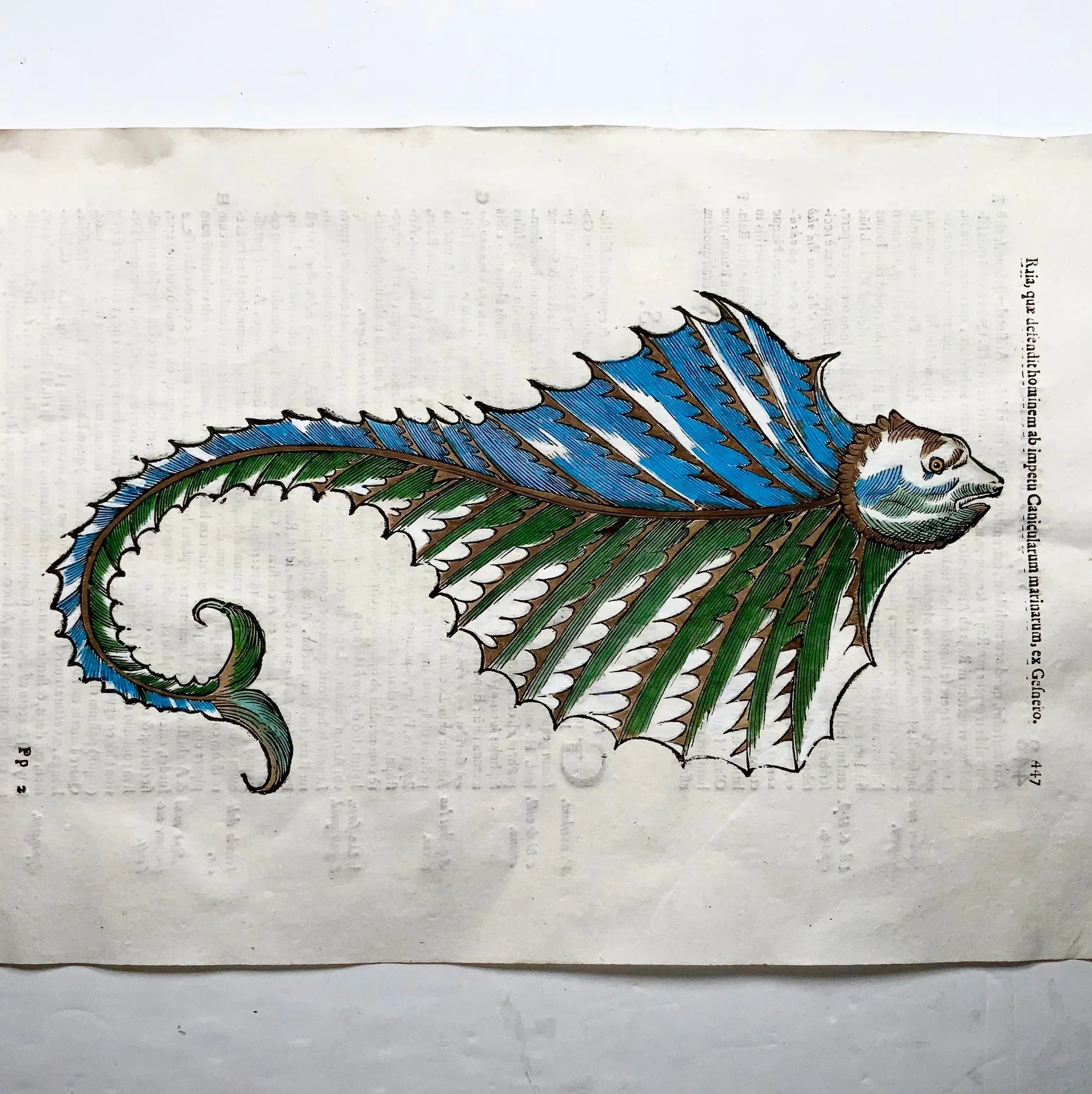
Monster Ray (Raja)
From De Piscibus
Ulisse Aldrovandi, engraved by Cristoforo Coriolano Bologna: Nicolaus Tebaldini, 1638
Hand-coloured woodcut on folio leaf Woodcut printed to recto, text to verso
Description
This extraordinary folio woodcut depicting a fantastical ray originates from De Piscibus, Ulisse Aldrovandi's monumental study of aquatic life, published posthumously in Bologna in 1638 by Nicolaus Tebaldini. The image is among the most visually dramatic in the entire corpus — a creature that occupies the boundary between natural history and myth with complete conviction.
The caption identifies it as Raja, quae defendit hominem ab impetu Caniicularum marinarum, ex Gesnero — a ray said to defend man from the attack of sea dogs, drawn after Conrad Gesner. What Aldrovandi and Coriolano have produced is not a sober anatomical study but something altogether stranger: a creature with vast serrated wings rendered in vivid blue and green, a coiling armoured tail, and a face that is almost mammalian in its expressiveness. It is the ocean as the sixteenth century imagined it — still partly monstrous, still partly uncharted.
The text on the verso, paginated 447–448, opens the chapter Vsus in Cibis — on the culinary uses of rays — and carries the running head Vlysis Aldrouandi, placing this sheet squarely within the scholarly apparatus of one of the great natural history projects of the Renaissance.
Aldrovandi was described by contemporaries — sometimes with admiring irony — as the Pontifex Maximus of natural history, driven by a thoroughness that bordered on the obsessive. While his textual expansiveness invited gentle criticism, the artistic quality of his illustrations was unequivocally praised. Particular acclaim was reserved for his woodcut engraver Cristoforo Coriolano, whose cuts were noted for their exceptional refinement — said to resemble copper engravings in their elegance. The present impression demonstrates this vividly: the line work in the serrated fins and coiling tail is controlled and precise, giving the creature a physical authority that transcends its fantastical subject matter.
The sheet has been hand coloured, with vivid blues and greens applied to the fins and tail, warm brown at the body, and careful white highlighting throughout. The coloring is bold and period-consistent, intensifying the drama of the composition and reinforcing its status as both scientific document and luxury object.
Condition
Minor marginal stain. Minor colour show-through to verso. Please view all images carefully.
Bibliographic References
Nissen, Zoologische Buchillustration (ZBI) 70
Nissen, Fischbücher 7
Westwood & Satchell 3
Huber 56
Details
Medium: Hand-coloured woodcut
Format: Folio leaf, text to verso
Date: 1638
Dimensions: Approximately 11.8 × 8.3 inches (30 × 21 cm)
Status: Available
The Ray That Fought Sharks
Sailors who feared the Norwegian sea serpent also feared something that attacked from below, flat against the seafloor, invisible until it struck. Stingrays and their relatives had been known since antiquity, but the Renaissance natural historians encountered accounts of rays so large and so aggressive that they demanded a separate category entirely.
Aldrovandi's De Piscibus includes a print of what he calls the Raja quae defendit hominem ab impetu Caniicularum marinarum, ex Gesnero: the ray that defends man from the attack of sea dogs, meaning sharks, drawing on the authority of Conrad Gesner. The creature in the print is extraordinary. It has a mammalian face, vast serrated wings in blue and green, and a coiling armored tail that spirals away behind it like a mechanical spring. It is one of the strangest images in the history of natural history illustration, and it was produced as a serious scientific document.
The Ray chapter in Aldrovandi draws on Aristotle's accounts of the Batos, on Pliny's observations of rays in the Mediterranean, on Rondelet's dissections of specimens caught off the French coast, and on Gesner's synthesis of reported encounters from across Europe. What emerges from all of these sources combined is a picture of the ray as a creature of considerable danger, remarkable intelligence, and uncertain classification.
Pliny had described rays capable of bringing down horses that waded into shallow water. The spine of a stingray, he noted, could penetrate armor and kill a man outright if it struck in the right place. Medieval sources added accounts of rays large enough to be mistaken for islands, with sailors anchoring to their backs and making camp before the creature submerged. Ancient sailors regarded the ray with a mixture of respect and terror that is entirely understandable to anyone who has encountered a large specimen in shallow water: the creature is silent, flat, perfectly camouflaged against sand, and capable of delivering a wound that ancient physicians considered potentially fatal.
By the time Aldrovandi synthesized all of this accumulated testimony, the ray occupied a position somewhere between documented natural history and the outer edges of what the Renaissance mind was prepared to believe. The print that Coriolano made to illustrate it resolved that ambiguity by rendering the creature with such specific visual authority that it looks less like an invention and more like a field observation.
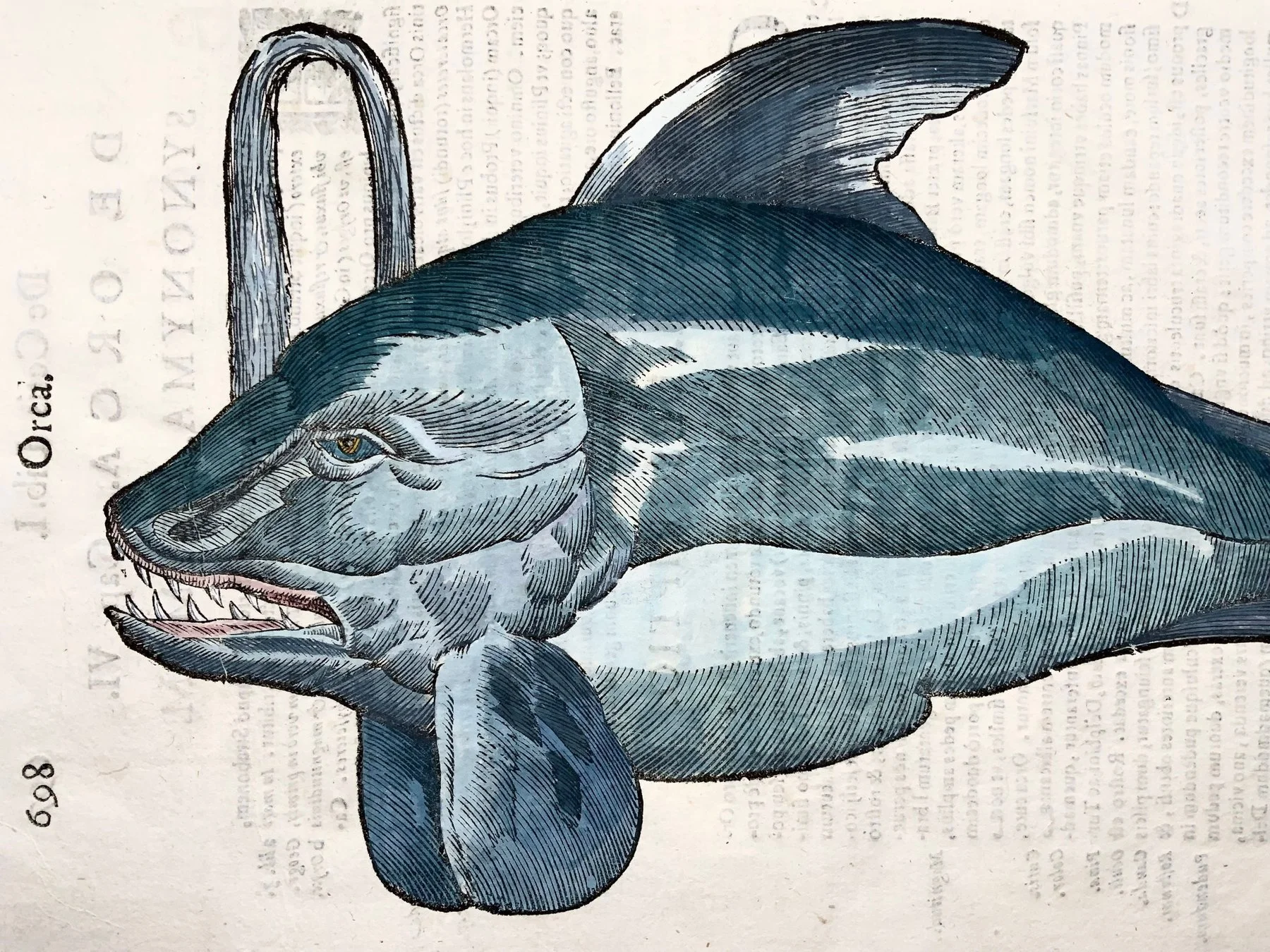
Sea Monster, Whale, Orca
From De Piscibus
Ulisse Aldrovandi, engraved by Cristoforo Coriolano
Bologna: Nicolaus Tebaldini, 1638
Hand-colored woodcut on folio leaf
Woodcut printed to recto
Description
This dramatic folio woodcut depicting a sea monster, whale, and orca originates from De Piscibus, Ulisse Aldrovandi’s monumental study of marine life, published posthumously in Bologna in 1638 by Nicolaus Tebaldini. Among the most compelling images in Aldrovandi’s corpus, the print captures a moment when observation, myth, and classification had not yet fully separated.
Although the central creature represents what we now recognize as an orca, the animal is rendered in a form entirely unlike its modern understanding. In the early seventeenth century, orcas were poorly documented and frequently conflated with whales, sea serpents, and monstrous creatures described in classical and medieval sources. Aldrovandi’s image reflects this uncertainty, presenting the animal as a powerful and unfamiliar force rather than a clearly defined species.
Aldrovandi was described by contemporaries, sometimes with admiring irony, as the supreme authority on natural history for his relentless and exhaustive approach to classification. While his textual expansiveness was occasionally critiqued, the artistic quality of the illustrations in his works has been universally praised. Particular acclaim was given to his woodcut engraver Cristoforo Coriolano, whose cuts were noted for their exceptional refinement, said to resemble copper engravings in their elegance.
The present impression demonstrates this quality vividly. Coriolano’s line work is crisp and controlled, lending authority and presence even to creatures that were only partially understood. The sheet has been hand colored, likely shortly after publication, intensifying the drama of the scene and reinforcing its status as both a scientific illustration and a luxury object. Each hand-colored example is unique, shaped by the individual colorist’s interpretation.
Images such as this are central to the study of early modern science, revealing how knowledge evolved through print. The print stands as a visual record of the moment when real animals still occupied the realm of the monstrous, and when the ocean remained one of Europe’s least understood frontiers.
Condition
Good overall condition. Some color show-through to the verso. Minor marginal marks consistent with age and use. Please view images carefully.
Bibliographic References
Nissen, Zoologische Buchillustration (ZBI) 70
Nissen, Fischbücher 7
Westwood & Satchell 3
Huber 56
Details
Medium: Hand-colored woodcut
Format: Folio leaf
Date: 1638
Dimensions: 13.78 × 9.37 inches (35 × 23.8 cm)
Status: Available
The Orca
The whale and its relatives presented a different problem for Renaissance naturalists. Unlike the sea serpent or the fantastical ray, whales were familiar. They washed up on beaches. They were hunted by Basque and Norwegian whalers who brought back detailed firsthand accounts of creatures that reached eighty feet in length and whose fluke strokes could stove in a ship's hull. The orca in particular occupied a specific and alarming position in the natural history literature: it was not merely large, it was aggressive, it hunted in coordinated groups, and it attacked other whales with what observers described as military tactics.
Coriolano's woodcut of the orca for Aldrovandi's De Piscibus shows a creature of massive, compressed power: a broad dark body with the characteristic markings of the killer whale, mouth open to show rows of teeth, rendered in the full folio format that allows Coriolano's line work to demonstrate the creature's sheer bulk. The text that accompanies it draws on Pliny's description of the Orca, which Pliny had described as the enemy of the whale and the terror of the northern seas.
Roman sources had reported orcas attacking ships in the Bay of Biscay. Medieval chronicles described pods of orcas coordinating to drive whales onto beaches, surrounding them to prevent escape, pressing them under the water to drown them. The Emperor Claudius, according to Pliny, personally led an armed expedition against an orca that had become trapped in the harbor at Ostia, organizing his Praetorian Guard along the harbor walls while flat-bottomed boats attacked the creature with spears. This was not a minor incident reported by an unreliable source. This was the emperor of Rome conducting military operations against a fish.
For sailors of the sixteenth and seventeenth centuries, the orca was the most plausible of the sea monsters because it was the most thoroughly documented. The Norwegian and Basque whalers who worked the northern seas had encountered them repeatedly and brought back consistent accounts. The creature that Aldrovandi and Coriolano depicted was a creature of commerce, of professional maritime risk, of the daily calculations that whalers made about whether to pursue a given quarry or withdraw.
Those whalers understood something that took marine biologists several more centuries to confirm with scientific apparatus: orcas are extraordinarily intelligent, they communicate in complex ways, they teach hunting strategies to their young, and they have been observed coordinating attacks on vessels that they perceived as competition for prey. The Renaissance sailors who reported these behaviors were not exaggerating. They were observing accurately and recording what they saw.
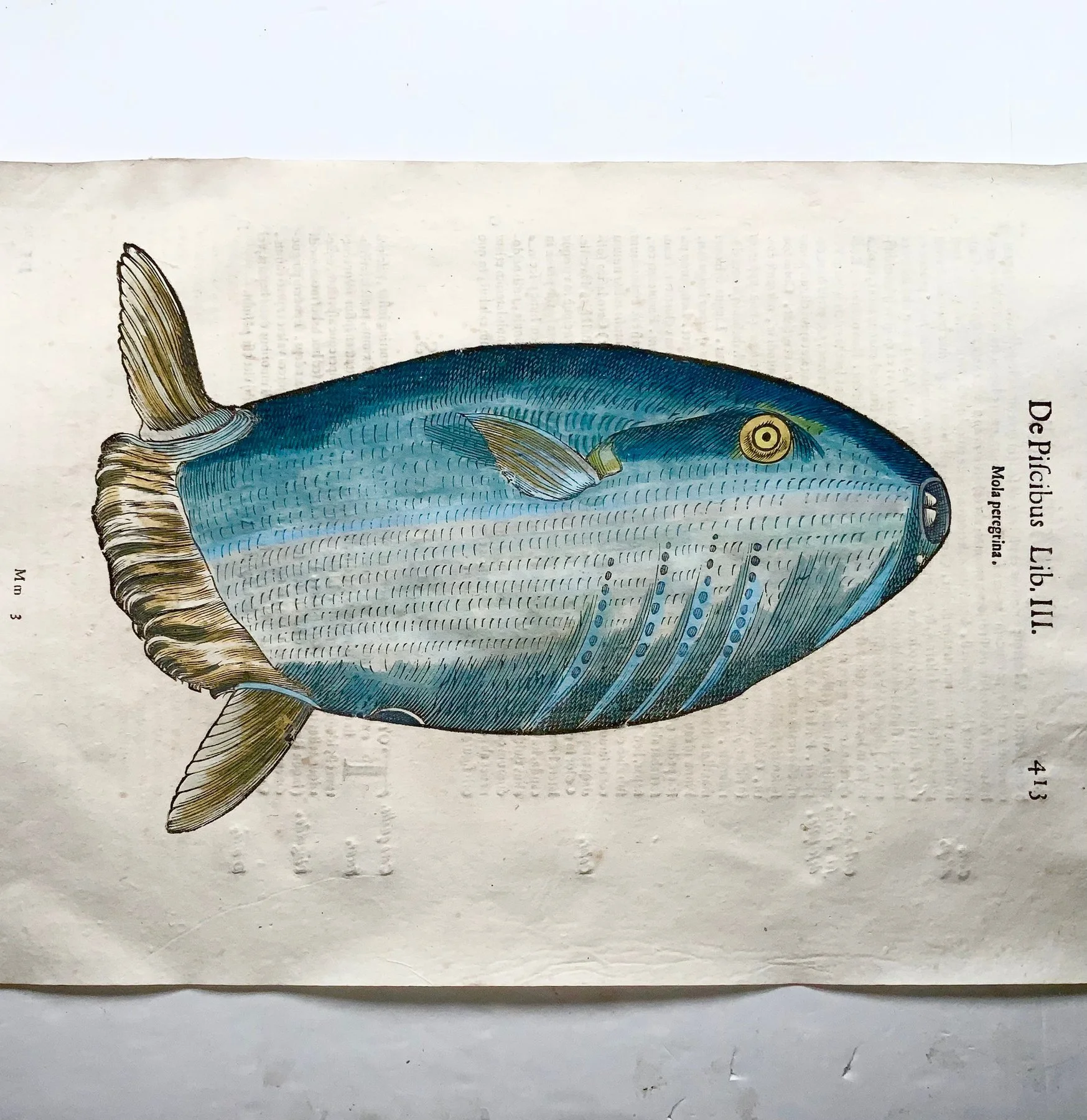
Ocean Sunfish (Mola Peregrina)
From De Piscibus
Ulisse Aldrovandi, engraved by Cristoforo Coriolano Bologna: Nicolaus Tebaldini, 1638
Hand-coloured woodcut on folio leaf Woodcut printed to recto, text to verso
Description
This folio woodcut depicts the ocean sunfish — identified in the marginal caption as Mola peregrina — from Ulisse Aldrovandi's De Piscibus, published posthumously in Bologna in 1638. It is one of the most visually arresting images in the entire work: a creature of almost perfect elliptical form, its vast disc-shaped body filling the page from edge to edge, its tiny fins vestigial against the sheer mass of its body, its golden eye regarding the viewer with an expression of absolute composure.
The ocean sunfish is among the largest bony fish in the world, and its appearance so confounded Renaissance naturalists that Aldrovandi's account on the verso — paginated 414, headed Vlysis Aldrouandi and concluding with the section Vsus Varius — draws on sources from across Europe to make sense of it. He records a specimen observed at Venice in 1552, describes its flesh as harder than that of any other fish, notes that it glows brilliantly at night, and documents its internal anatomy in characteristic detail: a liver and spleen larger than those of a buffalo, a single intestine running the full length of the body, fat so thick it resembled the blubber of a whale. Rondelet, Saluianus, and Gesner are all cited; the fish resisted easy classification and demanded the full apparatus of Renaissance learning to approach.
Coriolano's woodcut meets the challenge with remarkable economy. The sunfish has almost nothing to render — no scales, no elaborate fin structure, no dramatic posture — and yet the image is entirely compelling. The cross-hatching that models the body's bulk, the precise rendering of the tiny dorsal and pectoral fins, the dotted lateral line markings running in vertical columns across the flank, and the perfectly circular golden eye together produce a portrait of this strange creature that is both scientifically exact and strangely beautiful.
The sheet has been hand coloured with exceptional skill. The body grades from deep steel blue at the dorsal surface through graduated mid-blue to pale sky blue at the belly, with the pectoral and caudal fins rendered in warm ochre and grey. The golden iris is a precise circle of gilt. The coloring is period-consistent and very well preserved, giving the image a luminosity that the uncoloured woodcut could not achieve.
Condition
Please view all images carefully for full condition details.
Bibliographic References
Nissen, Zoologische Buchillustration (ZBI) 70
Nissen, Fischbücher 7
Westwood & Satchell 3
Huber 56
Details
Medium: Hand-coloured woodcut
Format: Folio leaf, text to verso
Date: 1638
Dimensions: Approximately 12.4 × 8.7 inches (31.5 × 22 cm) — please measure and confirm
Status: Available
Coriolano and the Art of Making Monsters Credible
None of these prints would carry the authority they do without the specific genius of Cristoforo Coriolano. The Nuremberg born woodcut engraver was singled out by Aldrovandi himself for praise above all his other collaborators. Contemporary assessments of his work noted that his cuts were of such elegance that they resembled copper engravings rather than woodcuts.
A woodcut is made by cutting away wood from a block, leaving raised lines that hold ink. It is a rough medium, suited to bold outlines and broad areas of texture, poorly suited to the fine detail work that distinguishes the best copper engraving. Coriolano solved this problem through extraordinary technical refinement. His cross hatching on the orca's body, his rendering of the sea serpent's segmented scales, his treatment of the ray's serrated wing edges: all of these are achievements that push against the limits of what the woodcut medium should be capable of.
The result is a series of prints that carry the visual authority of observation even when what they depict is beyond observation. When you look at the Norwegian sea serpent, you feel the presence of something that has been carefully looked at. The specificity of the coloring, the precision of the scale rendering, the individuality of the creature's expression: these are the marks of a craftsman working from a model, not inventing freely. Whether the model was a living creature, a preserved specimen, a drawing sent by a correspondent, or a reconstruction assembled from written descriptions, the engraving looks like documentation rather than imagination.
That distinction mattered enormously to the people who bought and read Aldrovandi's encyclopaedia. These were educated men and women who understood the difference between an illustration made from observation and one made from hearsay. Coriolano's technique closed that gap, giving the sea monsters of the northern waters the same visual credibility as the domestic animals and familiar birds that appeared elsewhere in the same volumes.
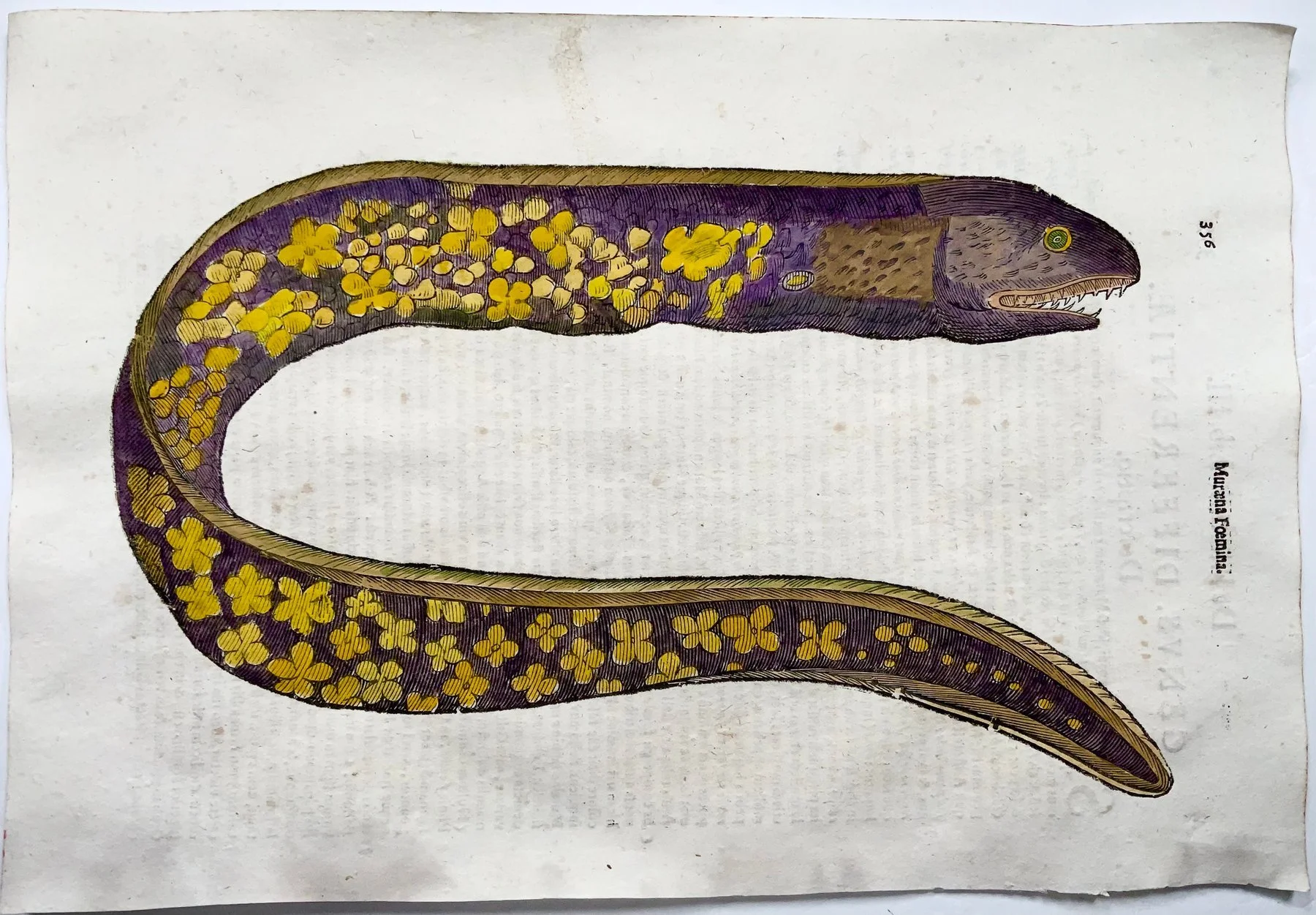
Moray Eel (Muraenidae)
From De Piscibus
Ulisse Aldrovandi, engraved by Cristoforo Coriolano
Bologna: Nicolaus Tebaldini, 1638
Hand-colored woodcut on folio leaf
Woodcut printed to recto
This folio leaf depicting a moray eel (Muraenidae) originates from De Piscibus, part of Ulisse Aldrovandi’s monumental natural-history project dedicated to the systematic study of aquatic life. Published posthumously in Bologna in 1638, the work represents one of the most ambitious attempts of the early modern period to reconcile classical sources, eyewitness observation, and Renaissance scientific inquiry.
The image was engraved by Cristoforo Coriolano, whom Aldrovandi himself praised above all other collaborators. Contemporary and later bibliographers remarked on the exceptional refinement of Coriolano’s woodcuts, noting that their elegance and tonal clarity often rival copper engravings—an extraordinary achievement for the medium. The present impression exemplifies this quality, with a sinuous, carefully articulated figure rendered with both anatomical attention and aesthetic balance.
The sheet has been hand-colored, likely shortly after publication, enhancing the visual impact of the composition and underscoring the luxury status of the volume from which it derives. As with all hand-colored examples, the application of pigment is unique, lending individuality to the print and reinforcing its character as an object made for a discerning early modern audience.
Aldrovandi was regarded by his contemporaries—sometimes with wry admiration—as the “Pontifex Maximus of Natural History,” driven by a near-obsessive thoroughness in cataloging the natural world. While his textual expansiveness was occasionally critiqued, the artistic quality of the illustrations in his works has been consistently and unequivocally praised, securing their place among the most visually compelling scientific images of the Renaissance.
Condition:
Very light age spotting, consistent with the period. Overall well preserved. Please refer to images for details.
References:
Nissen, Zoologische Buchillustration (ZBI) 70
Nissen, Fischbücher 7
Westwood & Satchell 3
Huber 56
Status: Available
Inquiries: Acquisition and exhibition inquiries welcome
What the Sea Gave Back
The natural history monsters of the sixteenth and seventeenth centuries occupy a strange position in the history of human knowledge. They are not purely mythological. They are not purely scientific. They exist in the space between these categories that was, for the Renaissance mind, not a space of confusion but a space of genuine inquiry.
When Aldrovandi documented the Norwegian sea serpent with the same scholarly apparatus he brought to the herring or the cod, he was not being credulous. He was applying the best available methodology to the best available evidence. The eyewitness testimony of Norwegian sailors, filtered through the authority of Olaus Magnus and cross referenced against classical sources, constituted genuine evidence by the standards of Renaissance natural history. The print that Coriolano made to illustrate that evidence was a scientific illustration in the fullest sense: an attempt to render visible something that existed in the world.
That we now know the Norwegian sea serpent was almost certainly a misidentified oarfish, or a large eel viewed from an unusual angle, or occasionally a whale behaving strangely, does not diminish the intellectual seriousness of the men who documented it. It places them in the long tradition of scientists working carefully at the frontier of what is known, making the best possible record of what the evidence suggests, and leaving that record for those who come after.
The sailors who reported these creatures were in the water. They were cold, they were frightened, and they were paying close attention. The naturalists who recorded their testimony were doing what good scholars have always done: taking seriously the observations of people with direct experience of the phenomena under study, and building from those observations toward an understanding of the world.
The prints they made are that record. They are also, four hundred years later, among the most beautiful and genuinely strange images ever committed to paper. The sea serpent coils across its folio page with the confidence of a creature that has been documented. The ray spreads its serrated wings in colors that no living ray has ever displayed. The orca opens its jaw in a darkness that still carries something of the terror it inspired in the men who encountered it at sea and survived to report what they had seen.
These are not decorations. They are dispatches from the edge of the known world, made by men who believed that the edge was worth mapping.
