 Image 1 of 5
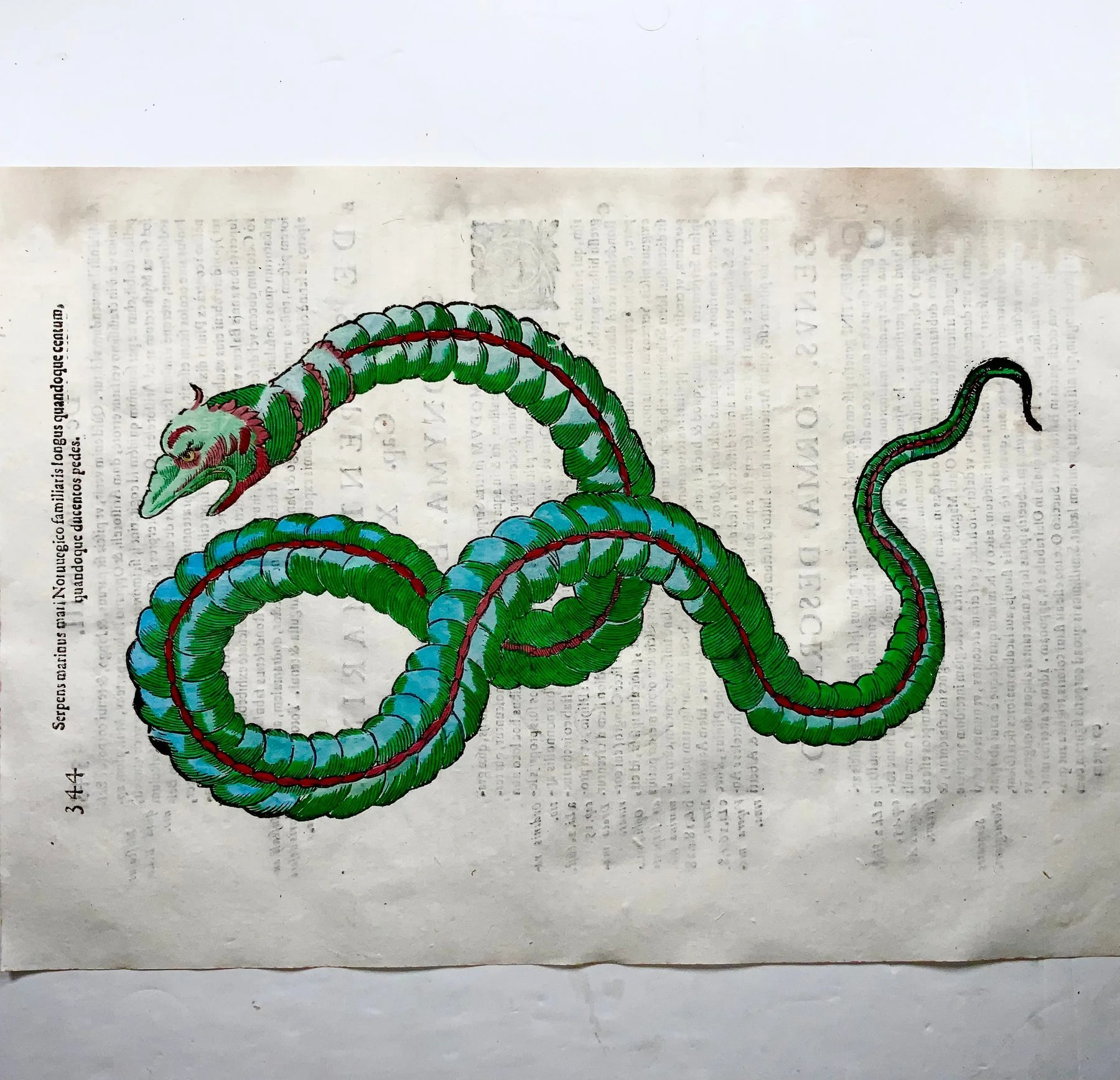 Image 2 of 5
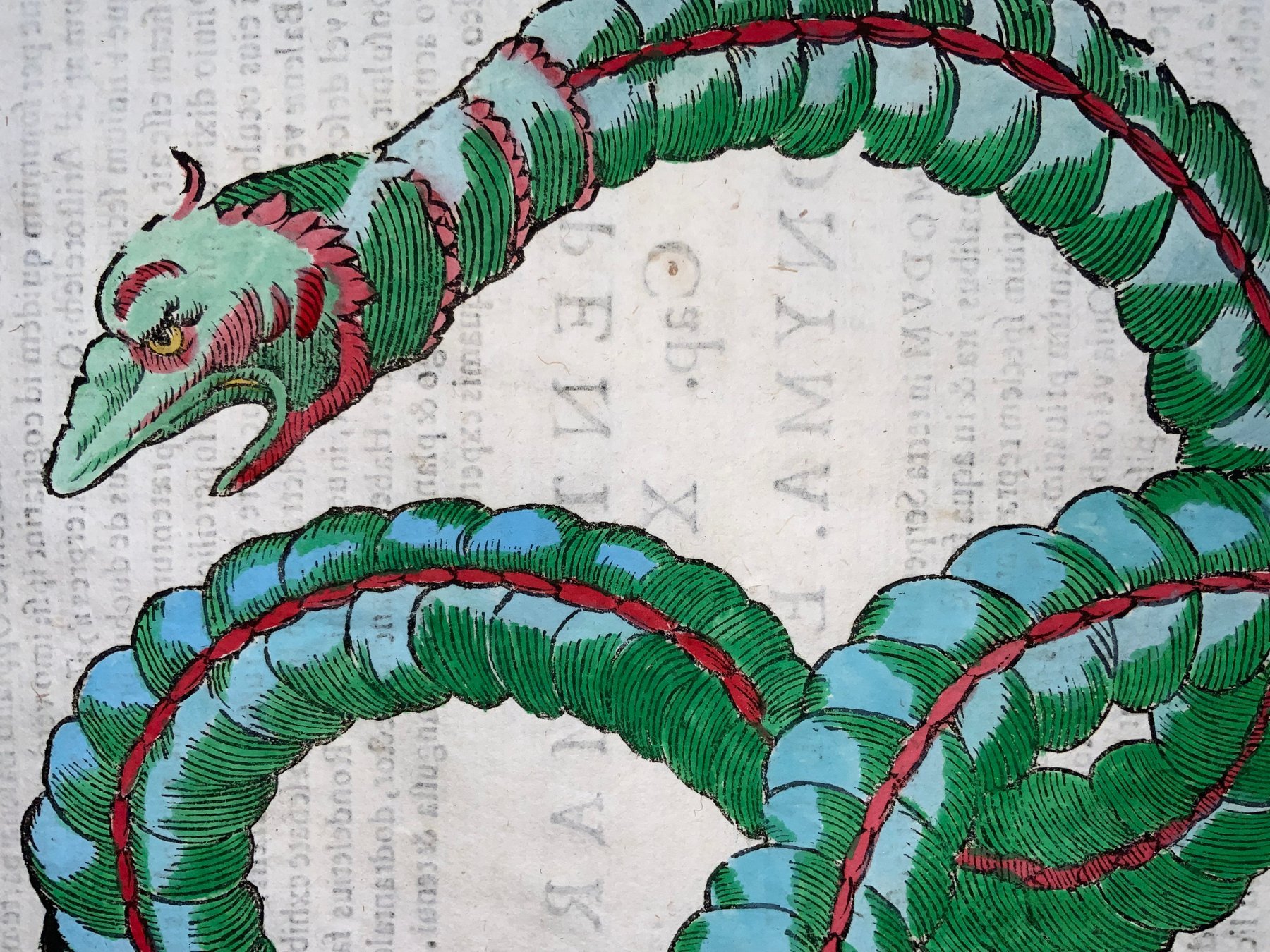 Image 3 of 5
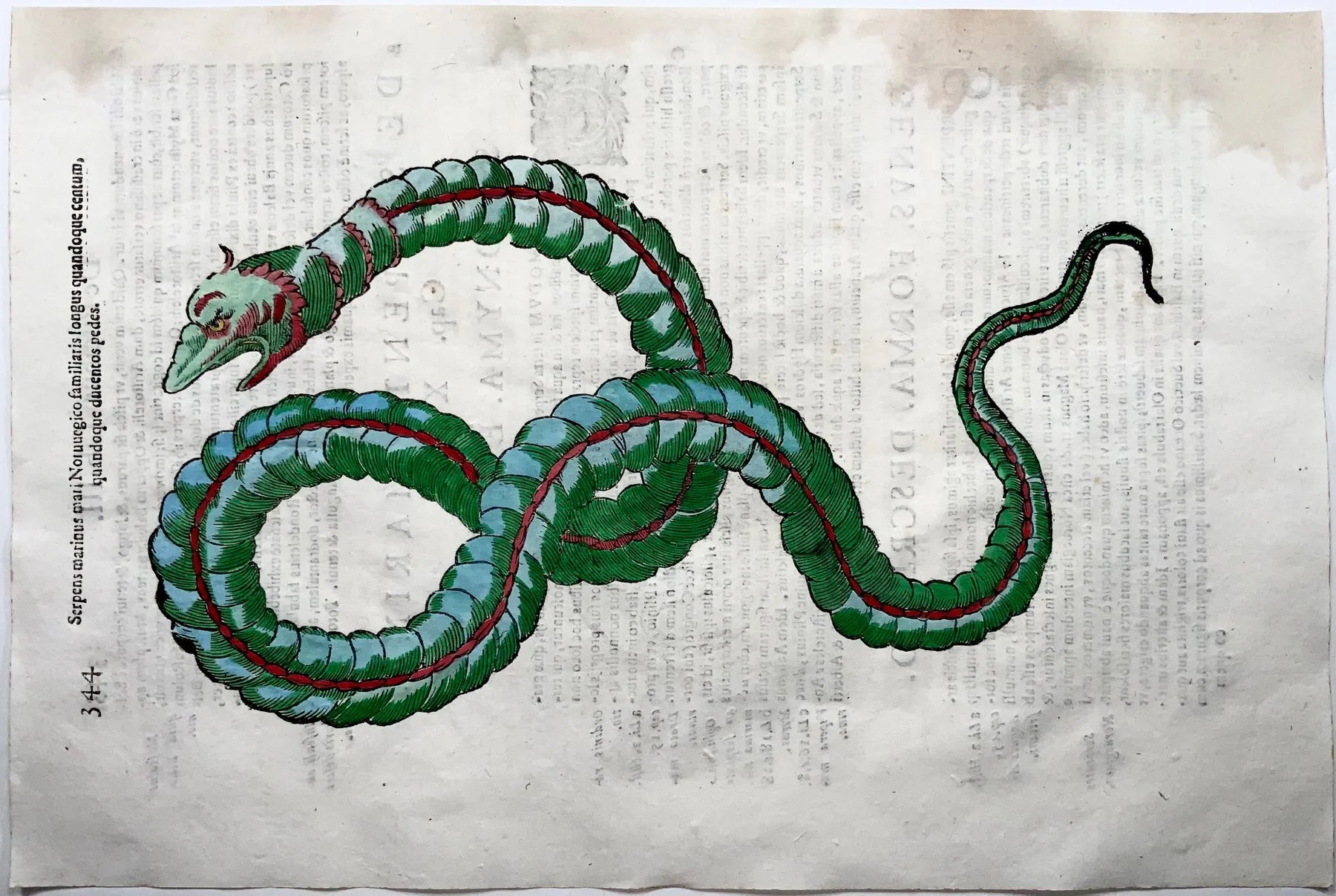 Image 4 of 5
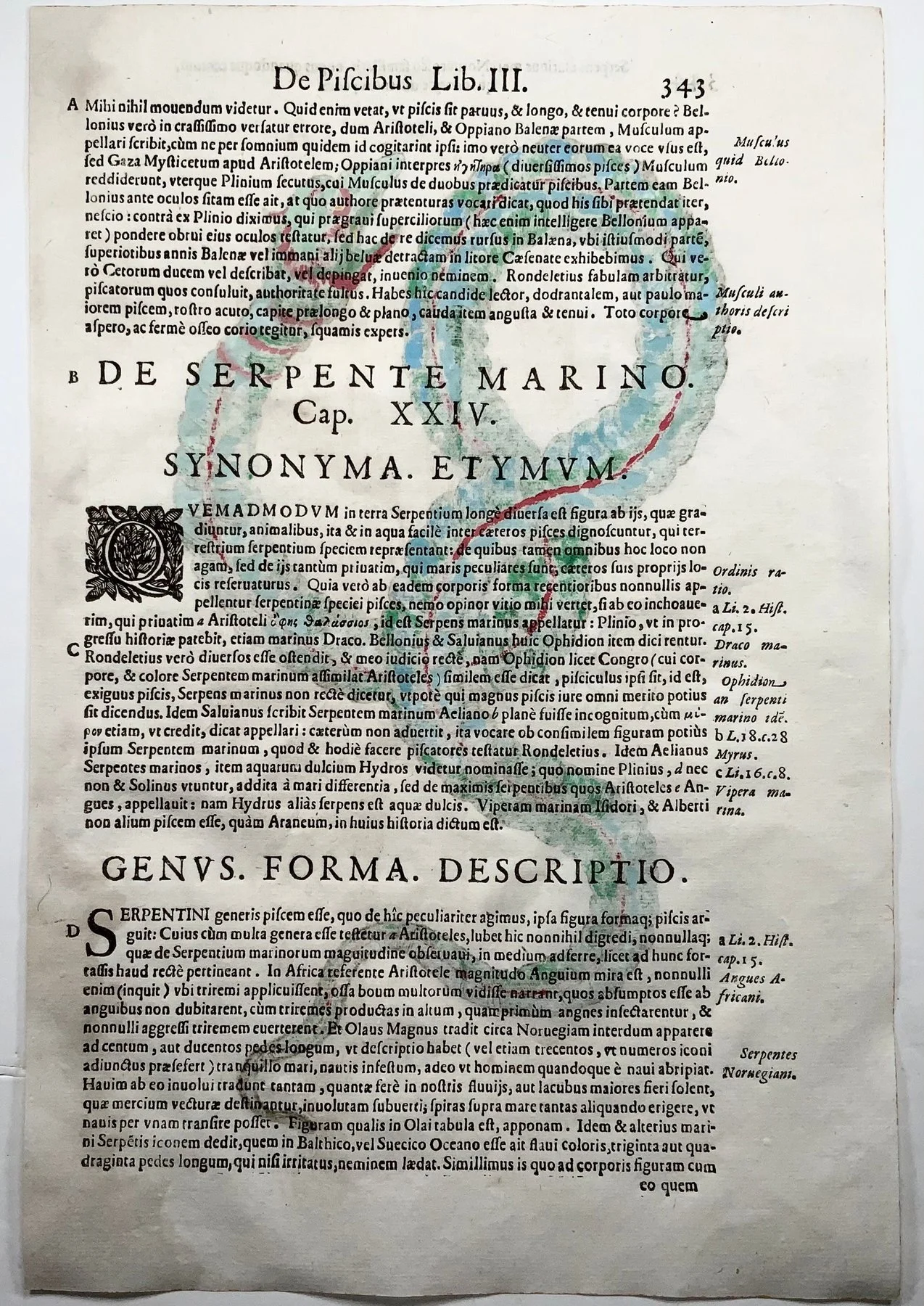 Image 5 of 5
Norwegian Sea Dragon / Serpent (Serpens Marinus)
From De Piscibus
Ulisse Aldrovandi, engraved by Cristoforo Coriolano Bologna: Nicolaus Tebaldini, 1638
Hand-coloured woodcut on folio leaf Woodcut printed to verso, text to recto
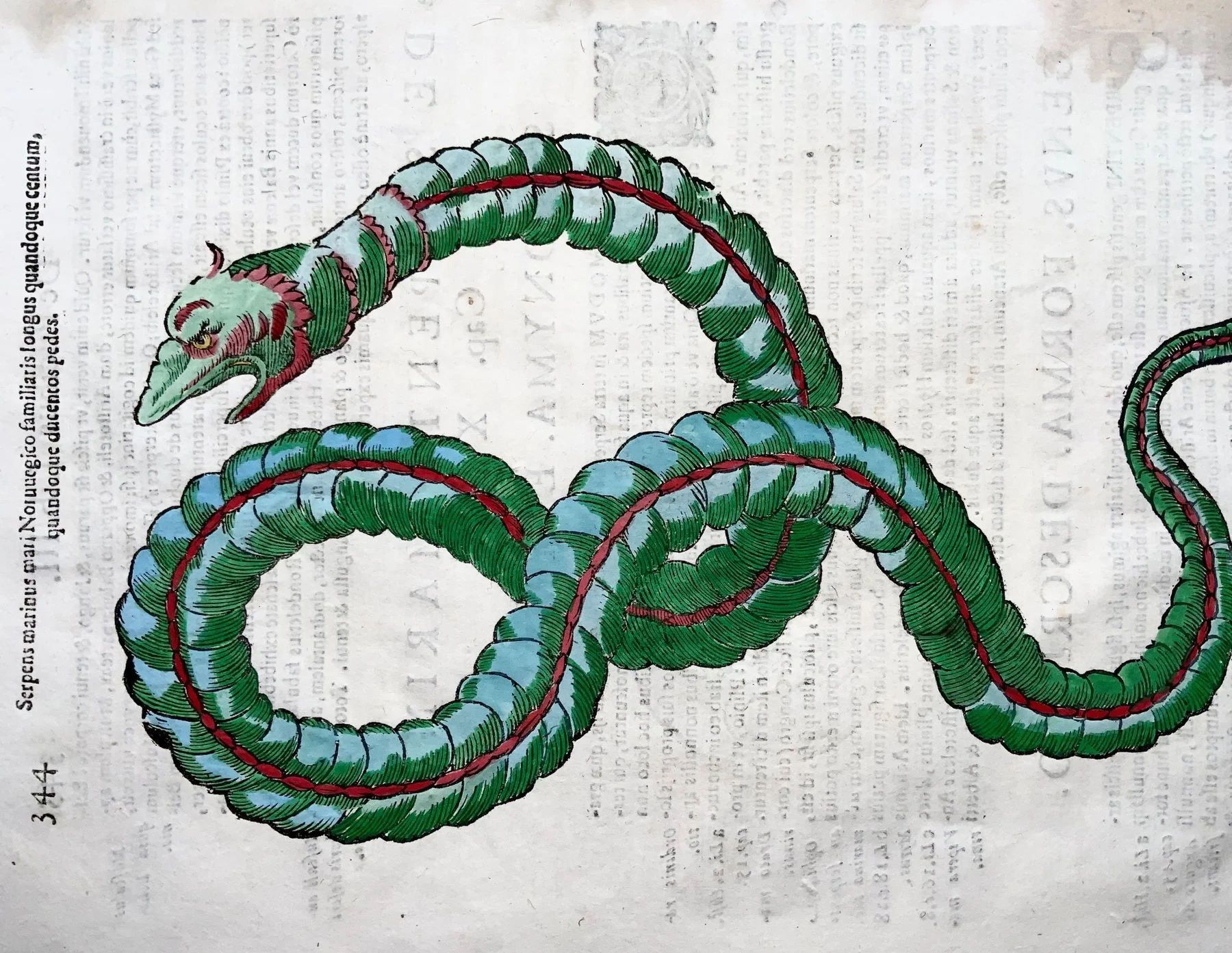
This folio woodcut depicts the Norwegian sea serpent — captioned Serpens marinus mari Norruegico familiaris longus quandoque centum, quandoque ducentos pedes: the sea serpent familiar to the Norwegian Sea, sometimes one hundred feet long, sometimes two hundred. It is one of the great monster images of the Renaissance natural history tradition, and among the most arresting woodcuts in Aldrovandi's De Piscibus, published posthumously in Bologna in 1638.
Where the Serpens marinus on the facing sheet coils in a tight heraldic loop, the Norwegian sea serpent spreads across the entire page in a vast, sinuous figure-of-eight — a creature of altogether different character and scale. This is the leviathan of northern waters, the creature that Olaus Magnus had described in his Historia de Gentibus Septentrionalibus a century earlier and that had passed into the repertoire of every serious natural historian as the definitive sea monster of the Northern Ocean. Aldrovandi cites Olaus Magnus directly on the recto: the creature is said to reach two hundred feet in length, to be familiar to Norwegian fishermen, to raise its coils above the mast-height of sailing ships, and to capsize vessels when provoked.
The text on the recto, paginated 343 and headed De Piscibus Lib. III, opens Chapter XXIV — De Serpente Marino — with sections on synonymy and etymology, drawing on Aristotle, Pliny, Rondelet, Belon, and Saluianus to establish the creature's place in the natural order. Aldrovandi distinguishes carefully between the true sea serpent and related creatures including the Ophidion, the Myrus, and the Vipera marina, situating this Norwegian monster at the apex of the category.
Coriolano's woodcut gives the creature a physical specificity that goes far beyond generic serpent imagery. The body is composed of alternating segments — pale blue ventral scales separated by deep green dorsal ridges, with a vivid crimson spine line running continuously from head to the whip-thin black tail tip. The head is genuinely dragonlike: bearded with pink gill frills, wide-jawed, with a yellow eye and an expression of alert menace. The overall impression is not of a symbol but of a documented creature — something seen, or at least reported by credible witnesses, and rendered as faithfully as the woodcut medium allowed.
The sheet has been hand coloured with exceptional boldness. The alternating blue and green of the body segments, the continuous red spine, and the carefully detailed head create a chromatic scheme that is both naturalistic in its ambition and spectacular in its effect. The coloring is period-consistent and very well preserved across the sheet.
Some staining to one margin. Some colour show-through to recto. Please view all images carefully.
Nissen, Zoologische Buchillustration (ZBI) 70
Nissen, Fischbücher 7
Westwood & Satchell 3
Huber 56
Medium: Hand-coloured woodcut
Format: Folio leaf, text to recto
Date: 1638
Dimensions: 13.8 × 9.1 inches (35 × 23.2 cm)
Status: Available
Norwegian Sea Dragon / Serpent (Serpens Marinus)
From De Piscibus
Ulisse Aldrovandi, engraved by Cristoforo Coriolano Bologna: Nicolaus Tebaldini, 1638
Hand-coloured woodcut on folio leaf Woodcut printed to verso, text to recto
This folio woodcut depicts the Norwegian sea serpent — captioned Serpens marinus mari Norruegico familiaris longus quandoque centum, quandoque ducentos pedes: the sea serpent familiar to the Norwegian Sea, sometimes one hundred feet long, sometimes two hundred. It is one of the great monster images of the Renaissance natural history tradition, and among the most arresting woodcuts in Aldrovandi's De Piscibus, published posthumously in Bologna in 1638.
Where the Serpens marinus on the facing sheet coils in a tight heraldic loop, the Norwegian sea serpent spreads across the entire page in a vast, sinuous figure-of-eight — a creature of altogether different character and scale. This is the leviathan of northern waters, the creature that Olaus Magnus had described in his Historia de Gentibus Septentrionalibus a century earlier and that had passed into the repertoire of every serious natural historian as the definitive sea monster of the Northern Ocean. Aldrovandi cites Olaus Magnus directly on the recto: the creature is said to reach two hundred feet in length, to be familiar to Norwegian fishermen, to raise its coils above the mast-height of sailing ships, and to capsize vessels when provoked.
The text on the recto, paginated 343 and headed De Piscibus Lib. III, opens Chapter XXIV — De Serpente Marino — with sections on synonymy and etymology, drawing on Aristotle, Pliny, Rondelet, Belon, and Saluianus to establish the creature's place in the natural order. Aldrovandi distinguishes carefully between the true sea serpent and related creatures including the Ophidion, the Myrus, and the Vipera marina, situating this Norwegian monster at the apex of the category.
Coriolano's woodcut gives the creature a physical specificity that goes far beyond generic serpent imagery. The body is composed of alternating segments — pale blue ventral scales separated by deep green dorsal ridges, with a vivid crimson spine line running continuously from head to the whip-thin black tail tip. The head is genuinely dragonlike: bearded with pink gill frills, wide-jawed, with a yellow eye and an expression of alert menace. The overall impression is not of a symbol but of a documented creature — something seen, or at least reported by credible witnesses, and rendered as faithfully as the woodcut medium allowed.
The sheet has been hand coloured with exceptional boldness. The alternating blue and green of the body segments, the continuous red spine, and the carefully detailed head create a chromatic scheme that is both naturalistic in its ambition and spectacular in its effect. The coloring is period-consistent and very well preserved across the sheet.
Some staining to one margin. Some colour show-through to recto. Please view all images carefully.
Nissen, Zoologische Buchillustration (ZBI) 70
Nissen, Fischbücher 7
Westwood & Satchell 3
Huber 56
Medium: Hand-coloured woodcut
Format: Folio leaf, text to recto
Date: 1638
Dimensions: 13.8 × 9.1 inches (35 × 23.2 cm)
Status: Available