 Image 1 of 4
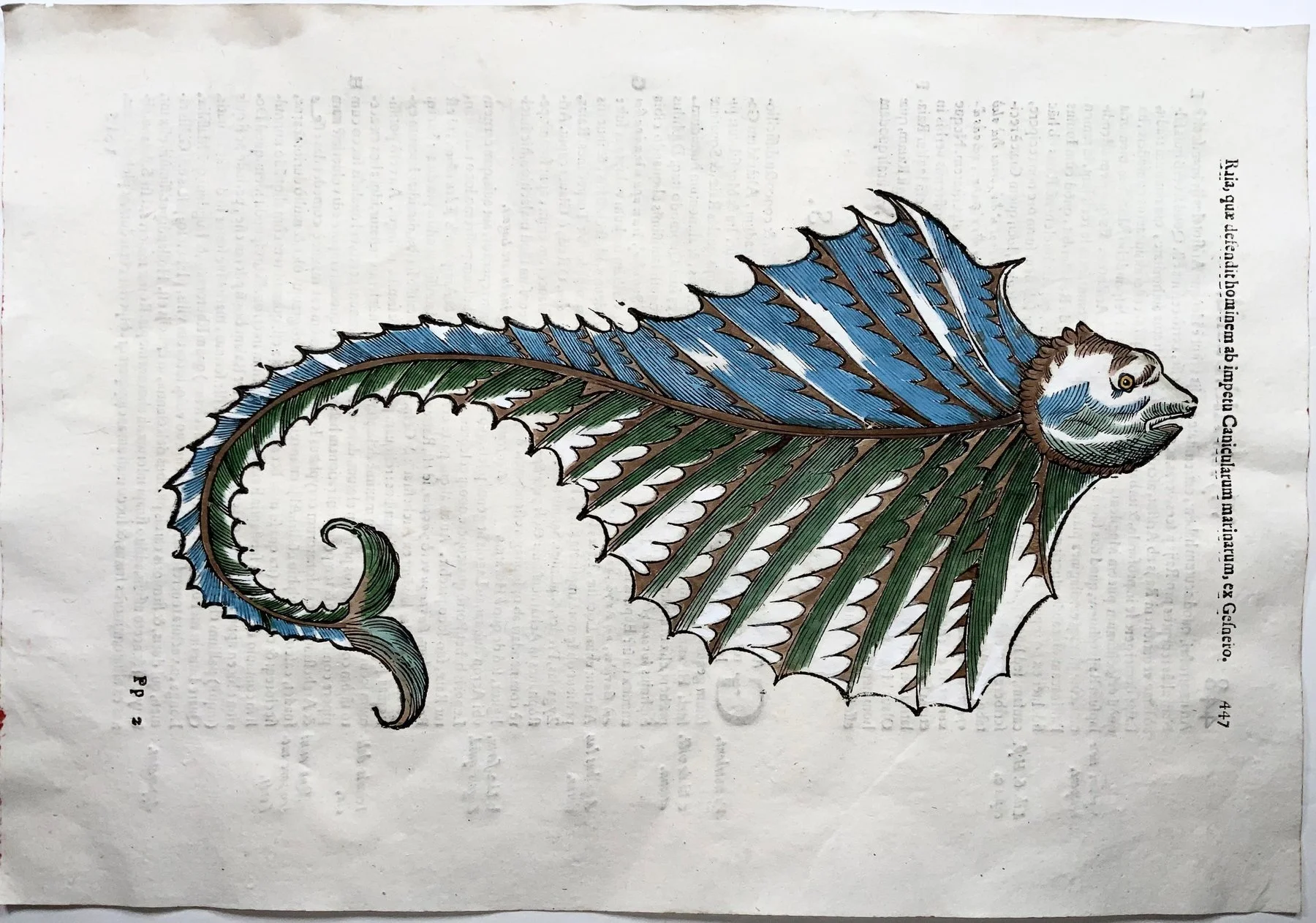 Image 2 of 4
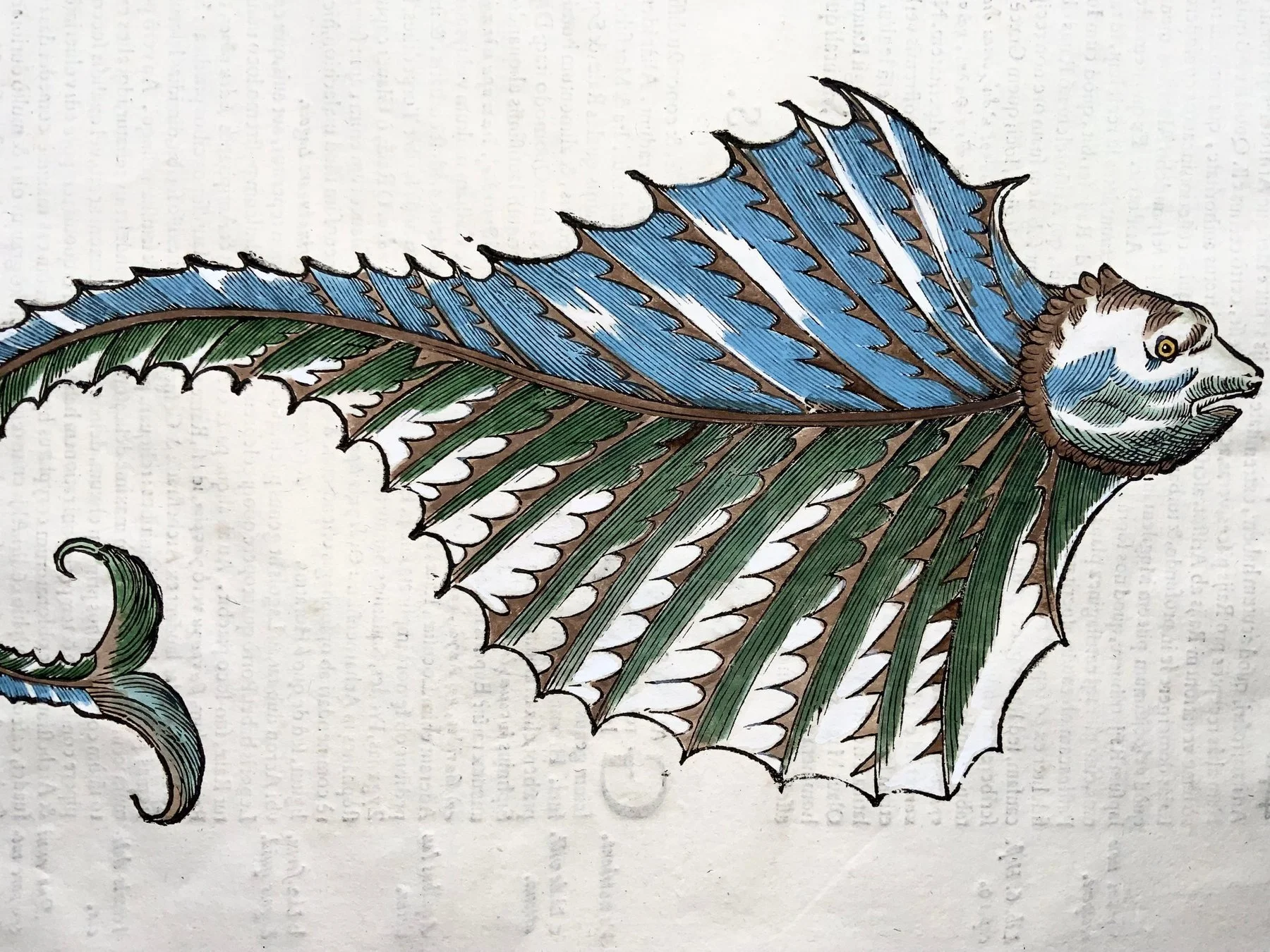 Image 3 of 4
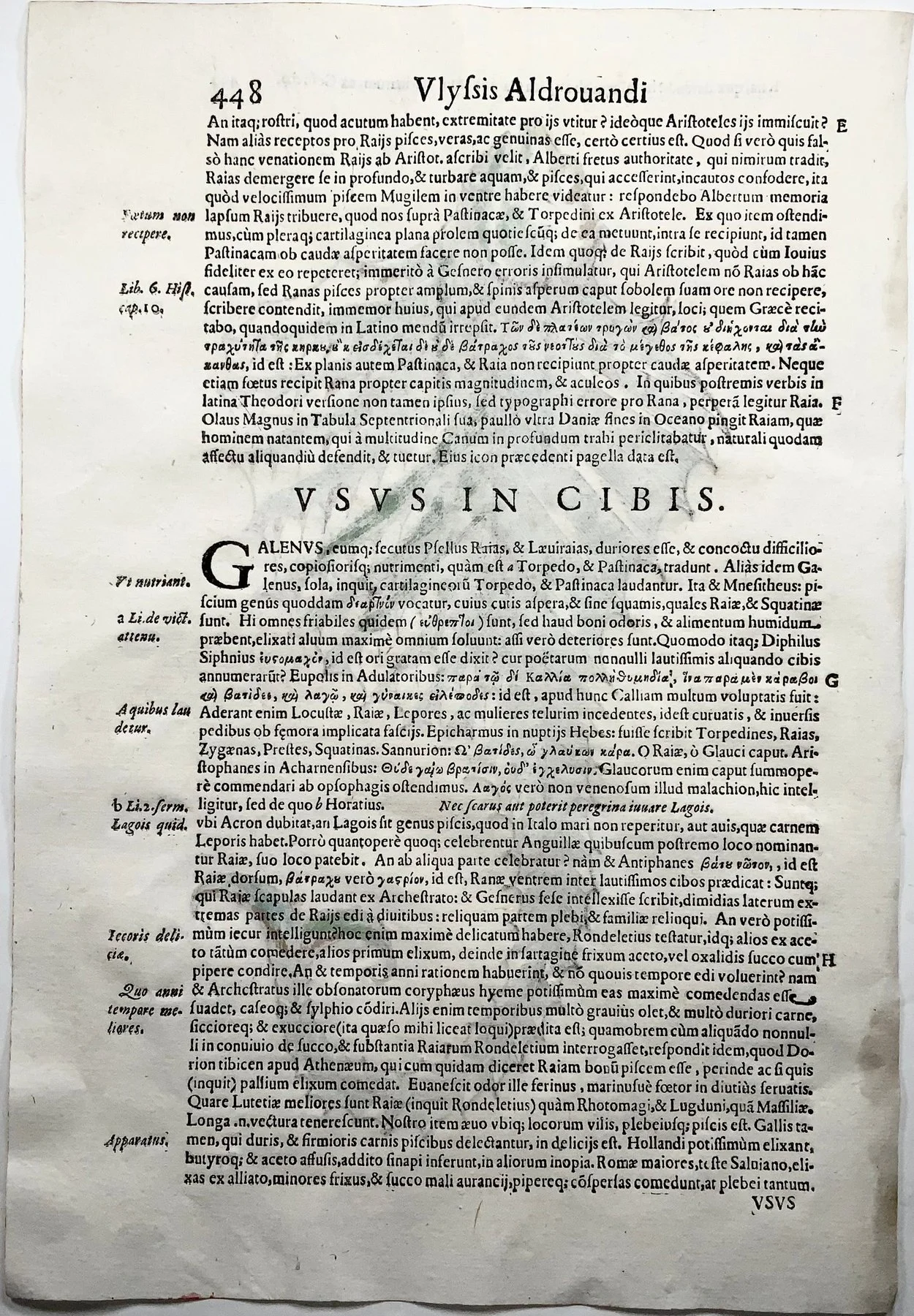 Image 4 of 4
Monster Ray (Raja)
From De Piscibus
Ulisse Aldrovandi, engraved by Cristoforo Coriolano Bologna: Nicolaus Tebaldini, 1638
Hand-coloured woodcut on folio leaf Woodcut printed to recto, text to verso
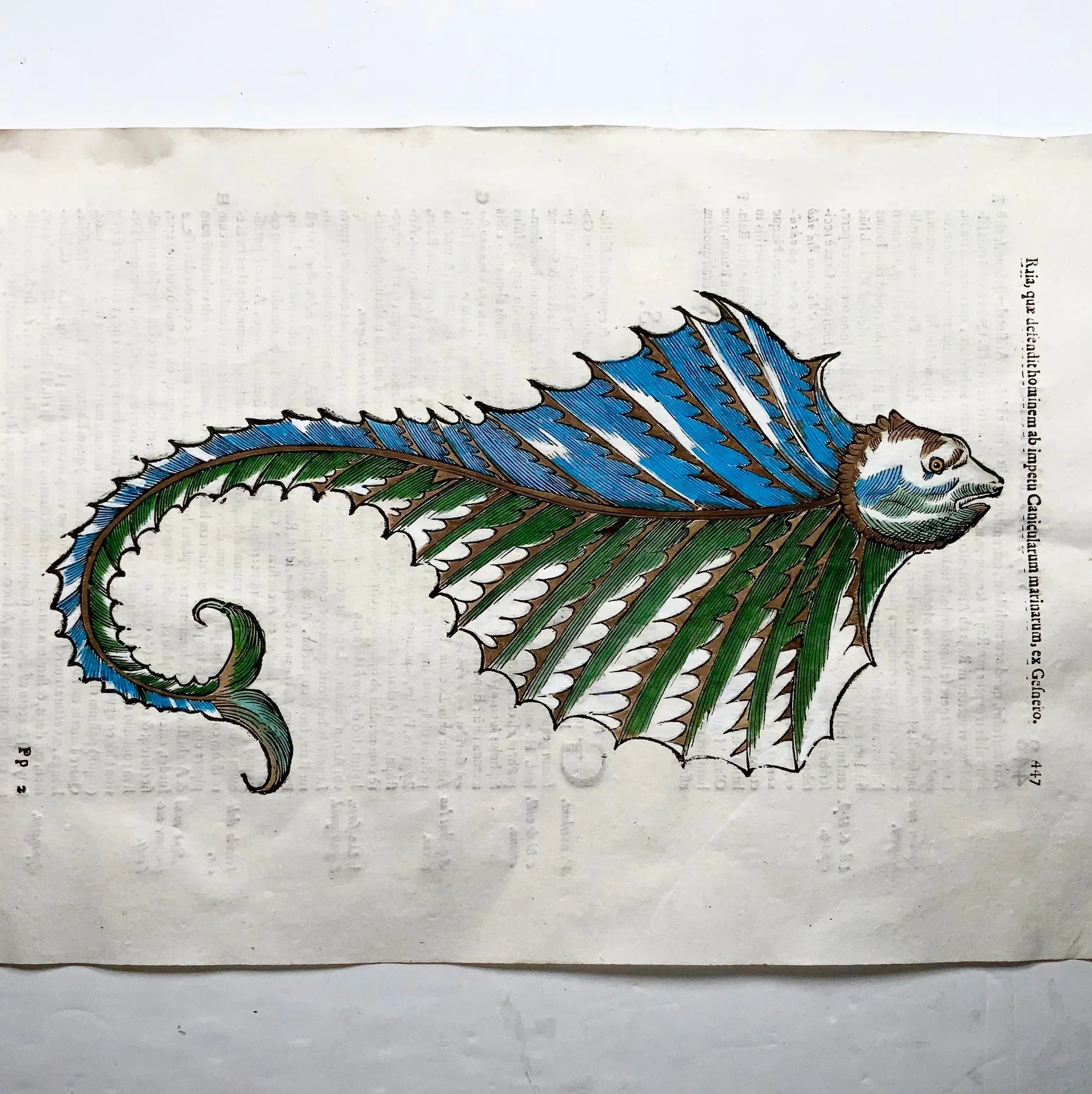
This extraordinary folio woodcut depicting a fantastical ray originates from De Piscibus, Ulisse Aldrovandi's monumental study of aquatic life, published posthumously in Bologna in 1638 by Nicolaus Tebaldini. The image is among the most visually dramatic in the entire corpus — a creature that occupies the boundary between natural history and myth with complete conviction.
The caption identifies it as Raja, quae defendit hominem ab impetu Caniicularum marinarum, ex Gesnero — a ray said to defend man from the attack of sea dogs, drawn after Conrad Gesner. What Aldrovandi and Coriolano have produced is not a sober anatomical study but something altogether stranger: a creature with vast serrated wings rendered in vivid blue and green, a coiling armoured tail, and a face that is almost mammalian in its expressiveness. It is the ocean as the sixteenth century imagined it — still partly monstrous, still partly uncharted.
The text on the verso, paginated 447–448, opens the chapter Vsus in Cibis — on the culinary uses of rays — and carries the running head Vlysis Aldrouandi, placing this sheet squarely within the scholarly apparatus of one of the great natural history projects of the Renaissance.
Aldrovandi was described by contemporaries — sometimes with admiring irony — as the Pontifex Maximus of natural history, driven by a thoroughness that bordered on the obsessive. While his textual expansiveness invited gentle criticism, the artistic quality of his illustrations was unequivocally praised. Particular acclaim was reserved for his woodcut engraver Cristoforo Coriolano, whose cuts were noted for their exceptional refinement — said to resemble copper engravings in their elegance. The present impression demonstrates this vividly: the line work in the serrated fins and coiling tail is controlled and precise, giving the creature a physical authority that transcends its fantastical subject matter.
The sheet has been hand coloured, with vivid blues and greens applied to the fins and tail, warm brown at the body, and careful white highlighting throughout. The coloring is bold and period-consistent, intensifying the drama of the composition and reinforcing its status as both scientific document and luxury object.
Minor marginal stain. Minor colour show-through to verso. Please view all images carefully.
Nissen, Zoologische Buchillustration (ZBI) 70
Nissen, Fischbücher 7
Westwood & Satchell 3
Huber 56
Medium: Hand-coloured woodcut
Format: Folio leaf, text to verso
Date: 1638
Dimensions: Approximately 11.8 × 8.3 inches (30 × 21 cm)
Status: Available
Monster Ray (Raja)
From De Piscibus
Ulisse Aldrovandi, engraved by Cristoforo Coriolano Bologna: Nicolaus Tebaldini, 1638
Hand-coloured woodcut on folio leaf Woodcut printed to recto, text to verso
This extraordinary folio woodcut depicting a fantastical ray originates from De Piscibus, Ulisse Aldrovandi's monumental study of aquatic life, published posthumously in Bologna in 1638 by Nicolaus Tebaldini. The image is among the most visually dramatic in the entire corpus — a creature that occupies the boundary between natural history and myth with complete conviction.
The caption identifies it as Raja, quae defendit hominem ab impetu Caniicularum marinarum, ex Gesnero — a ray said to defend man from the attack of sea dogs, drawn after Conrad Gesner. What Aldrovandi and Coriolano have produced is not a sober anatomical study but something altogether stranger: a creature with vast serrated wings rendered in vivid blue and green, a coiling armoured tail, and a face that is almost mammalian in its expressiveness. It is the ocean as the sixteenth century imagined it — still partly monstrous, still partly uncharted.
The text on the verso, paginated 447–448, opens the chapter Vsus in Cibis — on the culinary uses of rays — and carries the running head Vlysis Aldrouandi, placing this sheet squarely within the scholarly apparatus of one of the great natural history projects of the Renaissance.
Aldrovandi was described by contemporaries — sometimes with admiring irony — as the Pontifex Maximus of natural history, driven by a thoroughness that bordered on the obsessive. While his textual expansiveness invited gentle criticism, the artistic quality of his illustrations was unequivocally praised. Particular acclaim was reserved for his woodcut engraver Cristoforo Coriolano, whose cuts were noted for their exceptional refinement — said to resemble copper engravings in their elegance. The present impression demonstrates this vividly: the line work in the serrated fins and coiling tail is controlled and precise, giving the creature a physical authority that transcends its fantastical subject matter.
The sheet has been hand coloured, with vivid blues and greens applied to the fins and tail, warm brown at the body, and careful white highlighting throughout. The coloring is bold and period-consistent, intensifying the drama of the composition and reinforcing its status as both scientific document and luxury object.
Minor marginal stain. Minor colour show-through to verso. Please view all images carefully.
Nissen, Zoologische Buchillustration (ZBI) 70
Nissen, Fischbücher 7
Westwood & Satchell 3
Huber 56
Medium: Hand-coloured woodcut
Format: Folio leaf, text to verso
Date: 1638
Dimensions: Approximately 11.8 × 8.3 inches (30 × 21 cm)
Status: Available