 Image 1 of 5
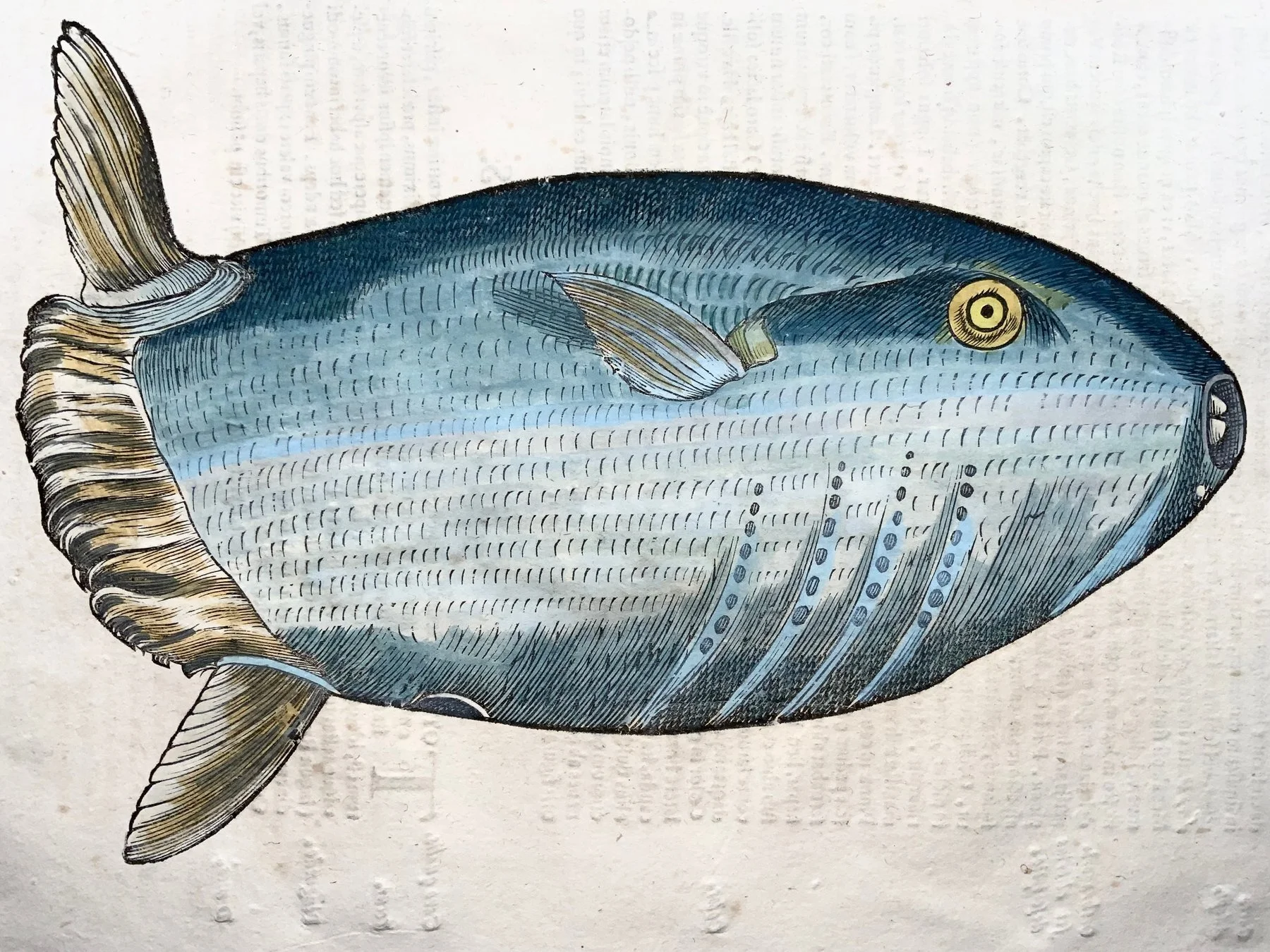 Image 2 of 5
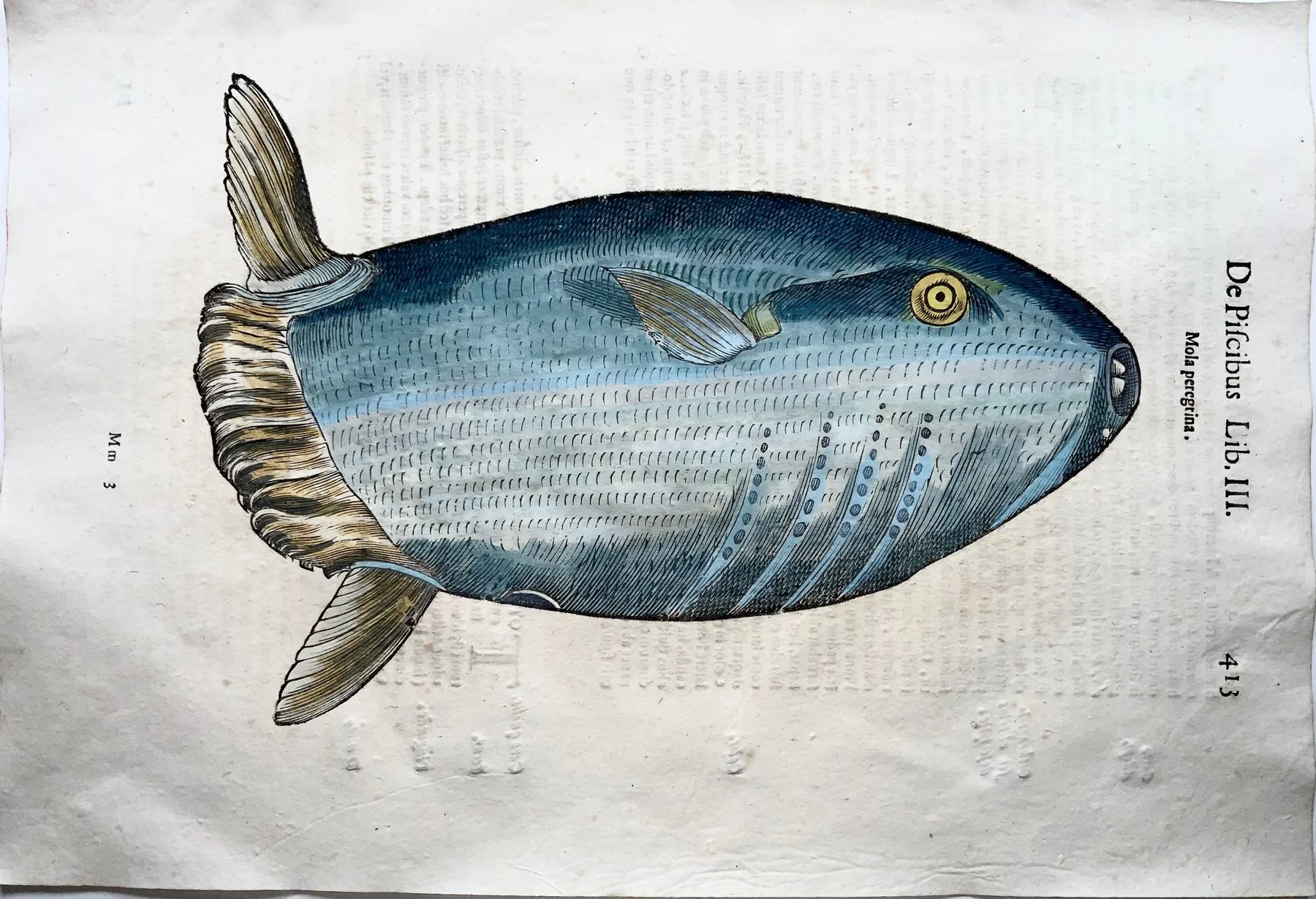 Image 3 of 5
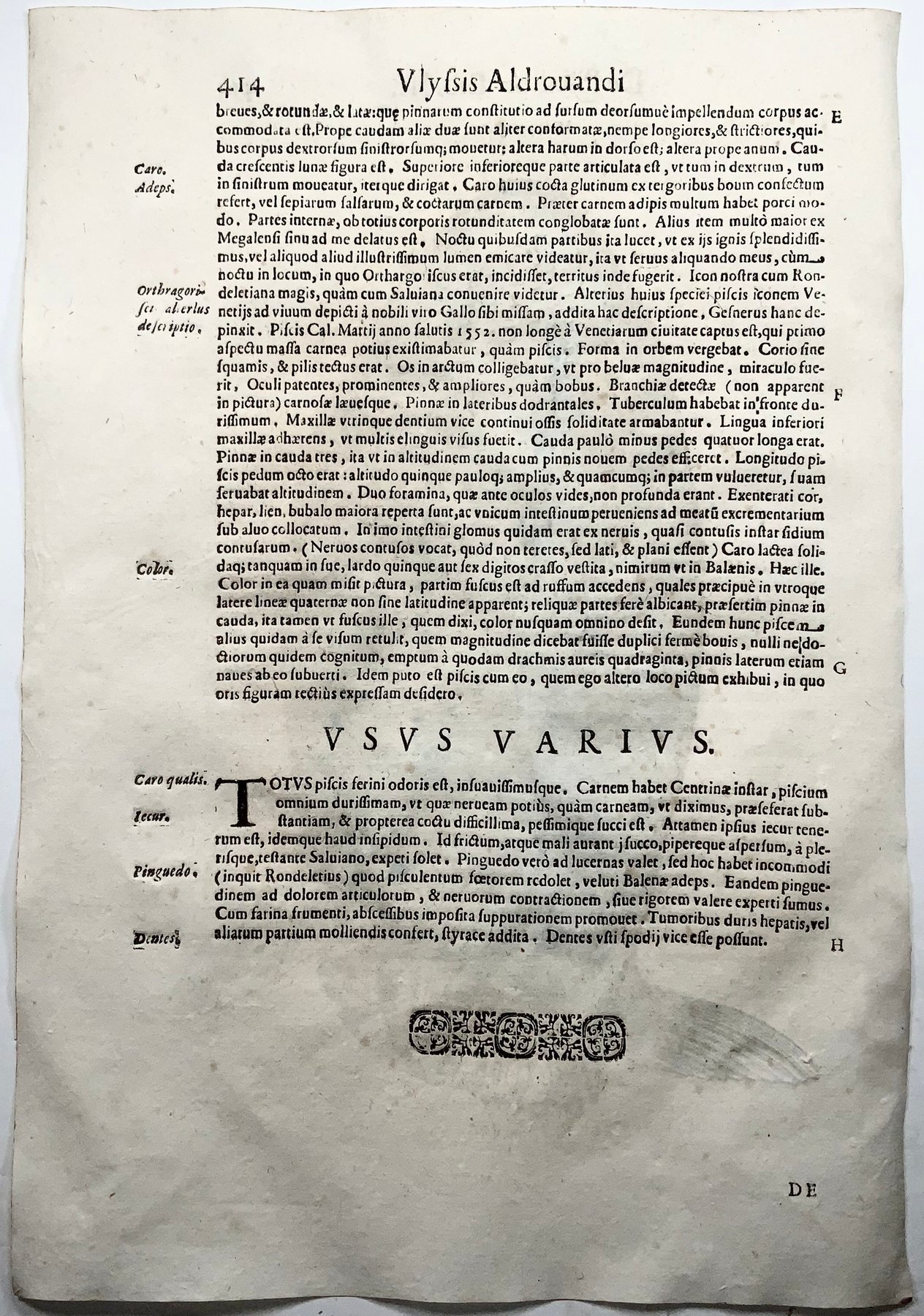 Image 4 of 5
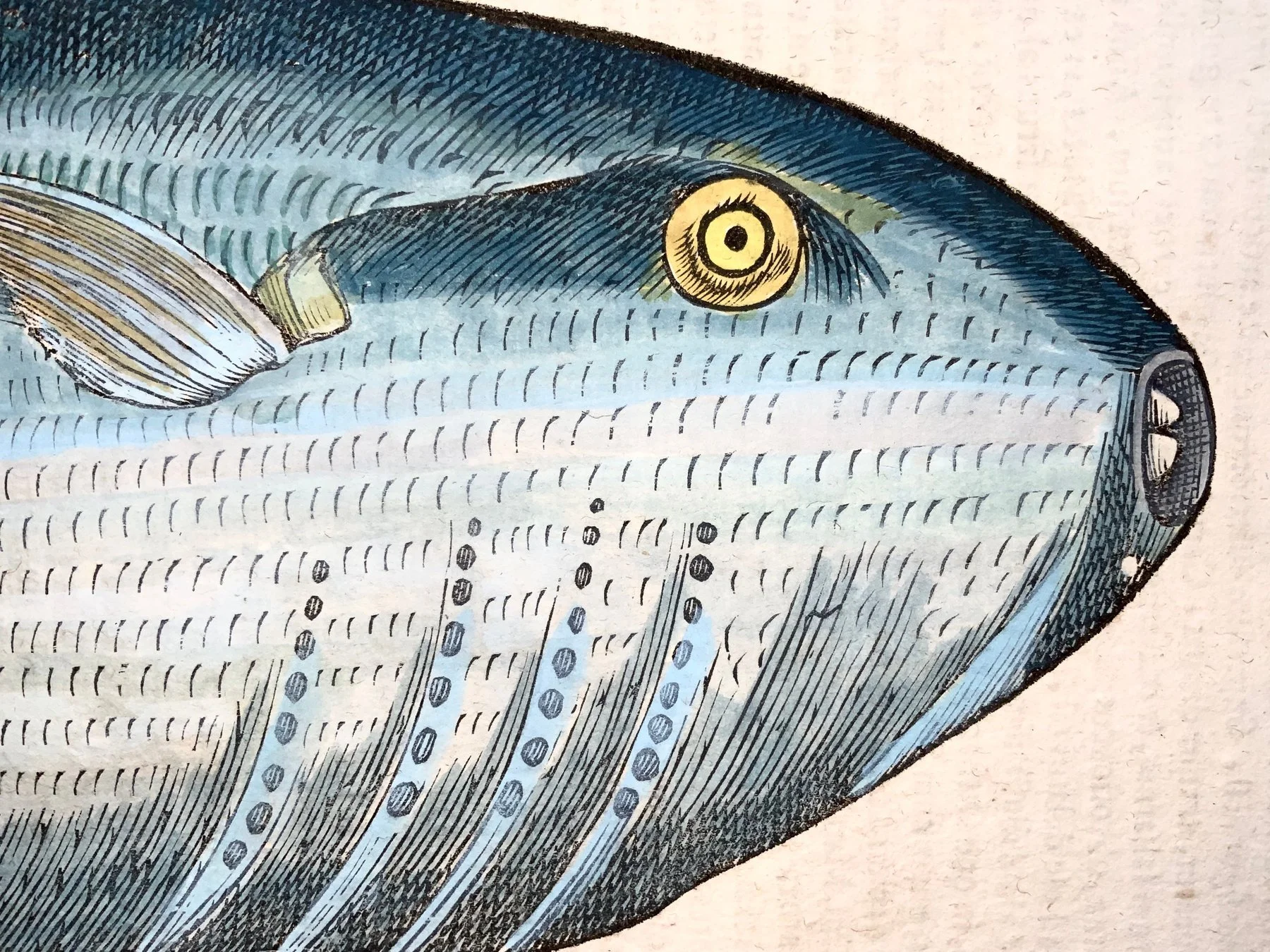 Image 5 of 5
Ocean Sunfish (Mola Peregrina)
From De Piscibus
Ulisse Aldrovandi, engraved by Cristoforo Coriolano Bologna: Nicolaus Tebaldini, 1638
Hand-coloured woodcut on folio leaf Woodcut printed to recto, text to verso
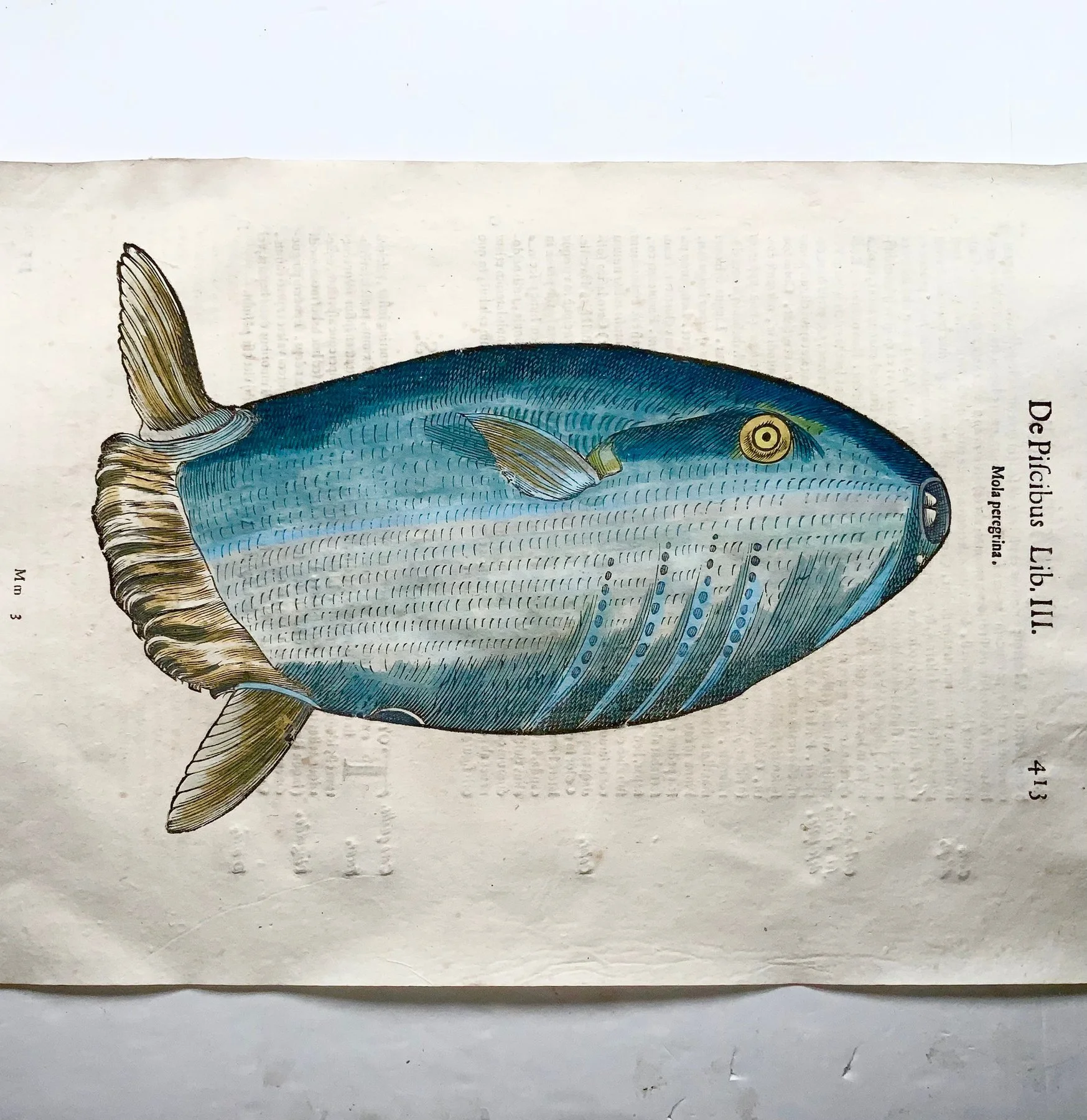
This folio woodcut depicts the ocean sunfish — identified in the marginal caption as Mola peregrina — from Ulisse Aldrovandi's De Piscibus, published posthumously in Bologna in 1638. It is one of the most visually arresting images in the entire work: a creature of almost perfect elliptical form, its vast disc-shaped body filling the page from edge to edge, its tiny fins vestigial against the sheer mass of its body, its golden eye regarding the viewer with an expression of absolute composure.
The ocean sunfish is among the largest bony fish in the world, and its appearance so confounded Renaissance naturalists that Aldrovandi's account on the verso — paginated 414, headed Vlysis Aldrouandi and concluding with the section Vsus Varius — draws on sources from across Europe to make sense of it. He records a specimen observed at Venice in 1552, describes its flesh as harder than that of any other fish, notes that it glows brilliantly at night, and documents its internal anatomy in characteristic detail: a liver and spleen larger than those of a buffalo, a single intestine running the full length of the body, fat so thick it resembled the blubber of a whale. Rondelet, Saluianus, and Gesner are all cited; the fish resisted easy classification and demanded the full apparatus of Renaissance learning to approach.
Coriolano's woodcut meets the challenge with remarkable economy. The sunfish has almost nothing to render — no scales, no elaborate fin structure, no dramatic posture — and yet the image is entirely compelling. The cross-hatching that models the body's bulk, the precise rendering of the tiny dorsal and pectoral fins, the dotted lateral line markings running in vertical columns across the flank, and the perfectly circular golden eye together produce a portrait of this strange creature that is both scientifically exact and strangely beautiful.
The sheet has been hand coloured with exceptional skill. The body grades from deep steel blue at the dorsal surface through graduated mid-blue to pale sky blue at the belly, with the pectoral and caudal fins rendered in warm ochre and grey. The golden iris is a precise circle of gilt. The coloring is period-consistent and very well preserved, giving the image a luminosity that the uncoloured woodcut could not achieve.
Please view all images carefully for full condition details.
Nissen, Zoologische Buchillustration (ZBI) 70
Nissen, Fischbücher 7
Westwood & Satchell 3
Huber 56
Medium: Hand-coloured woodcut
Format: Folio leaf, text to verso
Date: 1638
Dimensions: Approximately 12.4 × 8.7 inches (31.5 × 22 cm) — please measure and confirm
Status: Available
Ocean Sunfish (Mola Peregrina)
From De Piscibus
Ulisse Aldrovandi, engraved by Cristoforo Coriolano Bologna: Nicolaus Tebaldini, 1638
Hand-coloured woodcut on folio leaf Woodcut printed to recto, text to verso
This folio woodcut depicts the ocean sunfish — identified in the marginal caption as Mola peregrina — from Ulisse Aldrovandi's De Piscibus, published posthumously in Bologna in 1638. It is one of the most visually arresting images in the entire work: a creature of almost perfect elliptical form, its vast disc-shaped body filling the page from edge to edge, its tiny fins vestigial against the sheer mass of its body, its golden eye regarding the viewer with an expression of absolute composure.
The ocean sunfish is among the largest bony fish in the world, and its appearance so confounded Renaissance naturalists that Aldrovandi's account on the verso — paginated 414, headed Vlysis Aldrouandi and concluding with the section Vsus Varius — draws on sources from across Europe to make sense of it. He records a specimen observed at Venice in 1552, describes its flesh as harder than that of any other fish, notes that it glows brilliantly at night, and documents its internal anatomy in characteristic detail: a liver and spleen larger than those of a buffalo, a single intestine running the full length of the body, fat so thick it resembled the blubber of a whale. Rondelet, Saluianus, and Gesner are all cited; the fish resisted easy classification and demanded the full apparatus of Renaissance learning to approach.
Coriolano's woodcut meets the challenge with remarkable economy. The sunfish has almost nothing to render — no scales, no elaborate fin structure, no dramatic posture — and yet the image is entirely compelling. The cross-hatching that models the body's bulk, the precise rendering of the tiny dorsal and pectoral fins, the dotted lateral line markings running in vertical columns across the flank, and the perfectly circular golden eye together produce a portrait of this strange creature that is both scientifically exact and strangely beautiful.
The sheet has been hand coloured with exceptional skill. The body grades from deep steel blue at the dorsal surface through graduated mid-blue to pale sky blue at the belly, with the pectoral and caudal fins rendered in warm ochre and grey. The golden iris is a precise circle of gilt. The coloring is period-consistent and very well preserved, giving the image a luminosity that the uncoloured woodcut could not achieve.
Please view all images carefully for full condition details.
Nissen, Zoologische Buchillustration (ZBI) 70
Nissen, Fischbücher 7
Westwood & Satchell 3
Huber 56
Medium: Hand-coloured woodcut
Format: Folio leaf, text to verso
Date: 1638
Dimensions: Approximately 12.4 × 8.7 inches (31.5 × 22 cm) — please measure and confirm
Status: Available