 Image 1 of 5
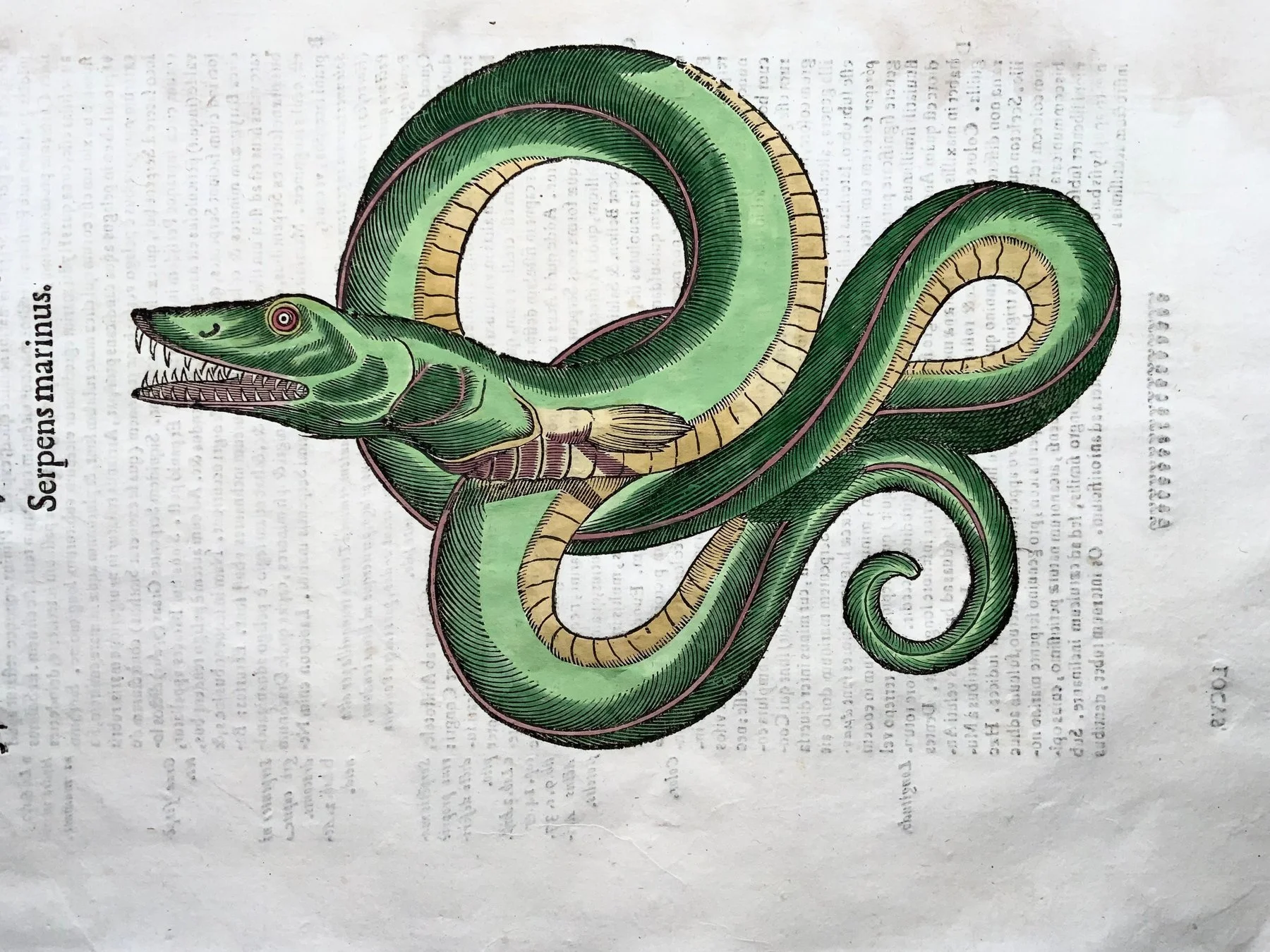 Image 2 of 5
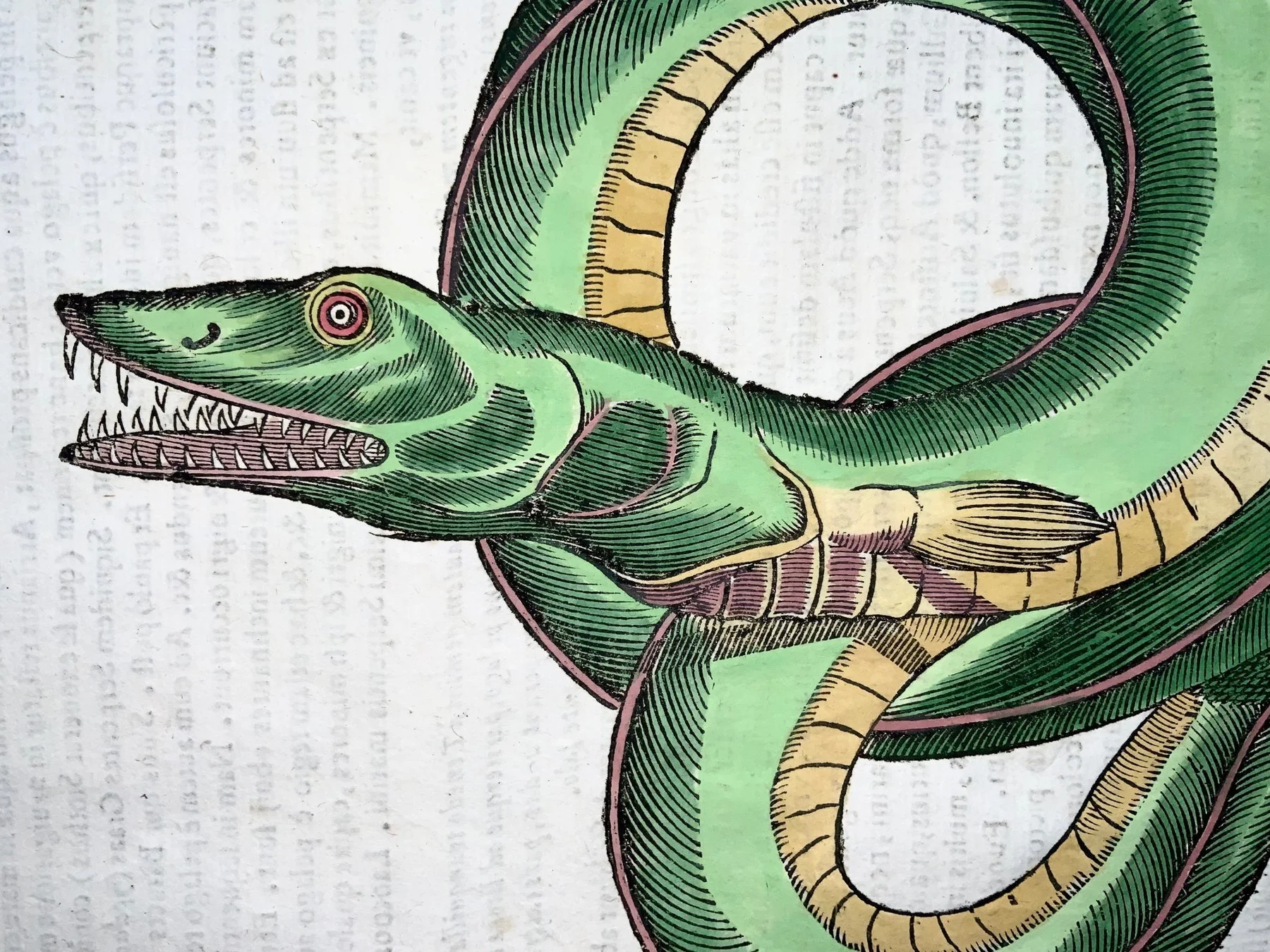 Image 3 of 5
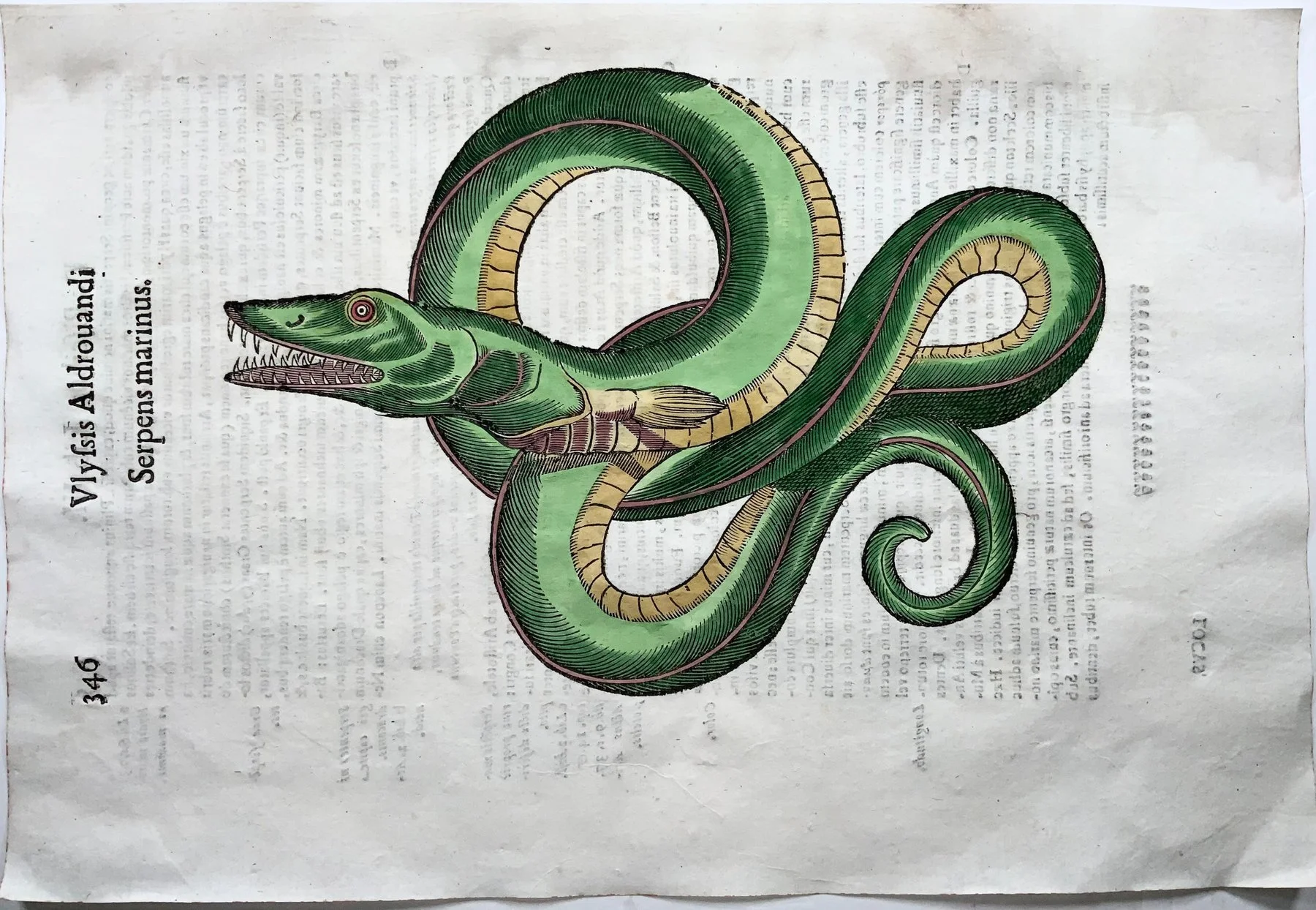 Image 4 of 5
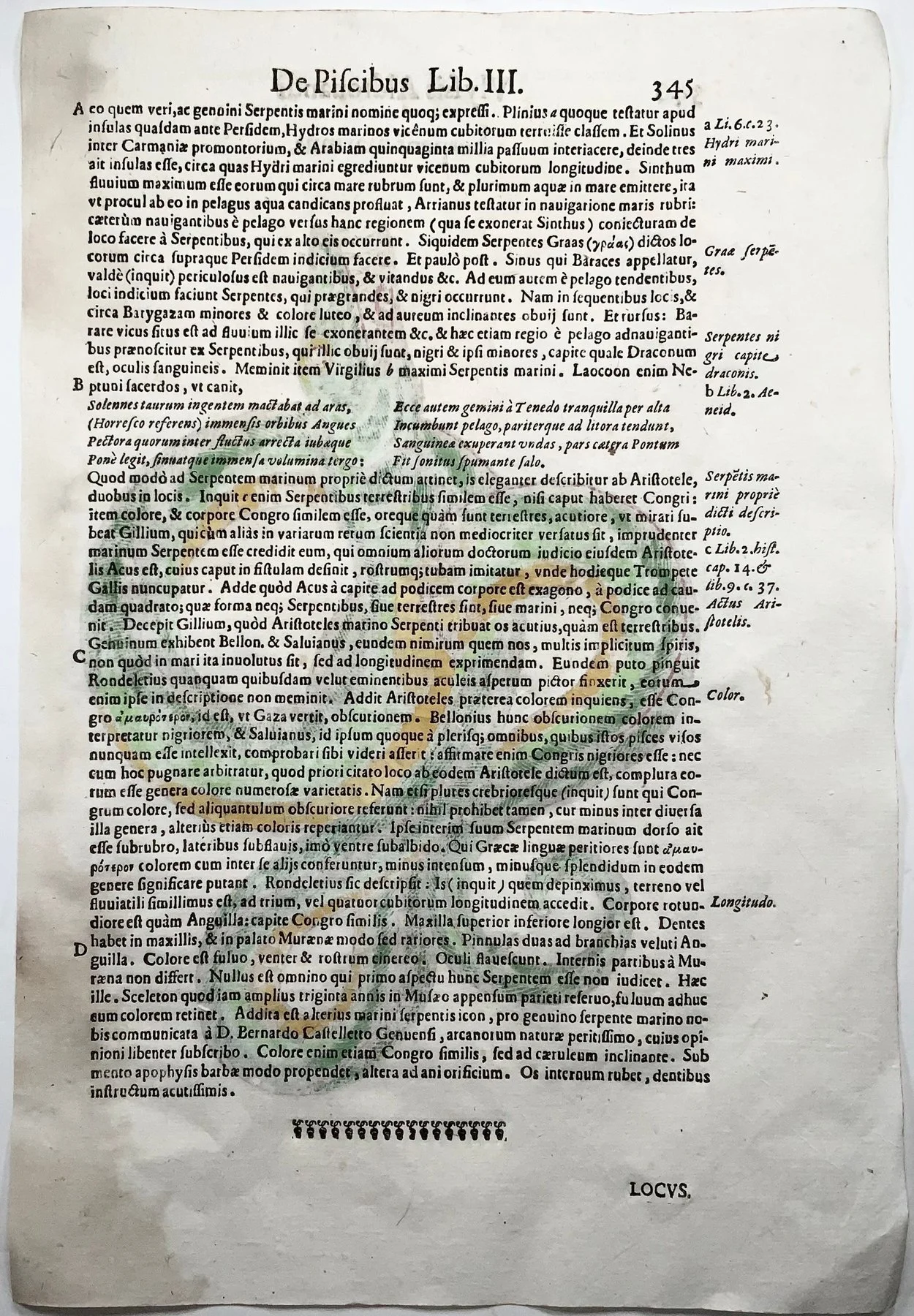 Image 5 of 5
Sea Serpent (Serpens Marinus)
From De Piscibus
Ulisse Aldrovandi, engraved by Cristoforo Coriolano Bologna: Nicolaus Tebaldini, 1638
Hand-coloured woodcut on folio leaf Woodcut printed to verso, text to recto
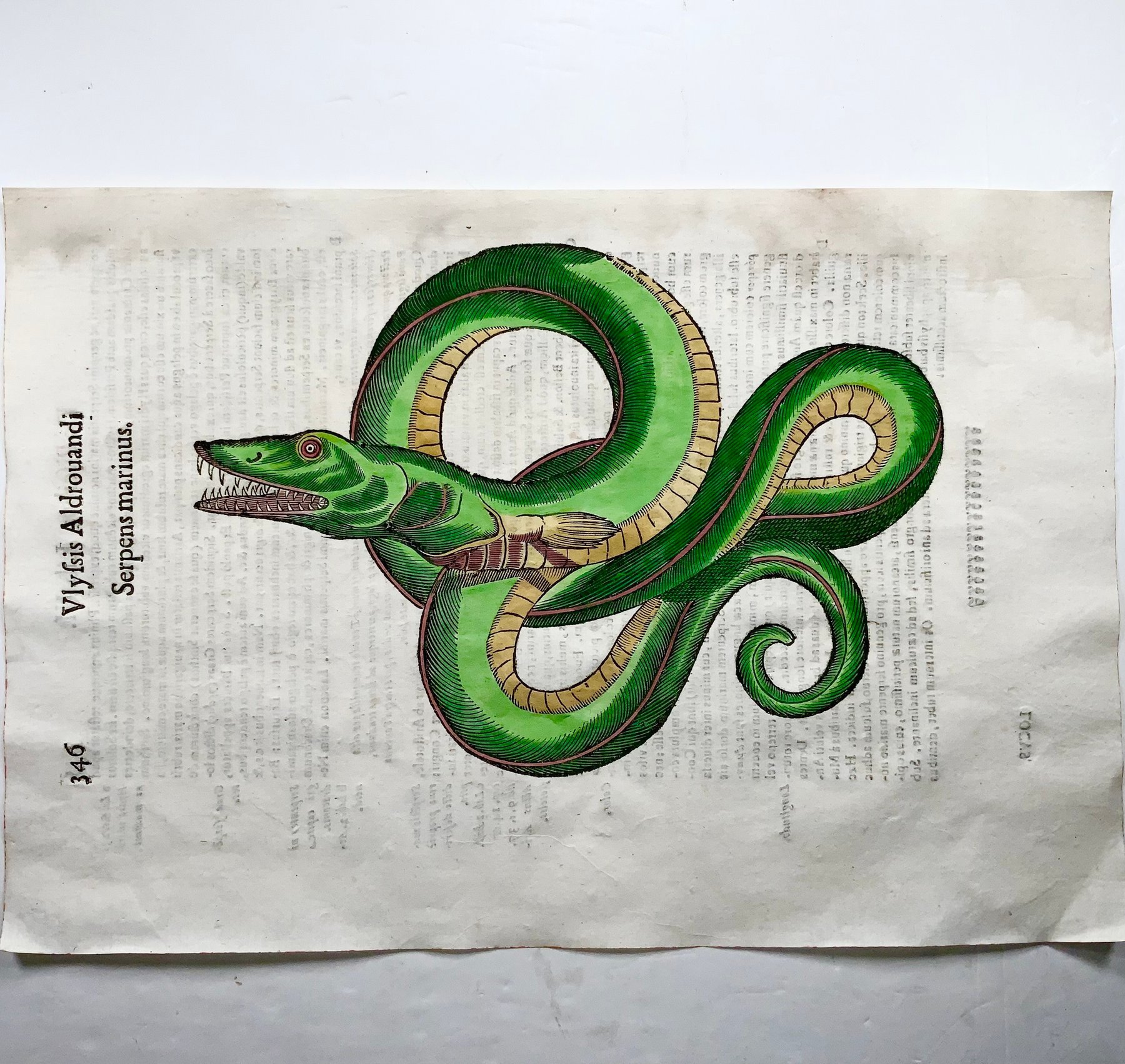
This folio woodcut of the Serpens marinus — the sea serpent — is one of the most dramatically composed images in Aldrovandi's De Piscibus, published posthumously in Bologna in 1638. The creature fills the entire page in a great coiling double loop, its toothed jaw open, its red eye fixed, its body resolved into an almost heraldic symmetry of interlocking curves. It is simultaneously a natural history document and one of the most visually arresting images produced by the Renaissance press.
The text on the recto, paginated 345 and headed De Piscibus Lib. III, opens the chapter on the sea serpent in earnest — citing Pliny, Aristotle, Solinus, and Rondelet on the nature, habitat, and physical characteristics of the creature. Aldrovandi notes Pliny's report of marine serpents eighty cubits long encountered off the coast of Persia, recounts Aristotle's comparison of the Serpens marinus with the conger eel in color and body form, and carefully distinguishes between the true sea serpent and related creatures. The text is a summation of everything Renaissance natural philosophy had assembled on the subject — classical, medieval, and contemporary — and the image facing it renders that accumulated authority in a single unforgettable form.
The woodcut was cut by Cristoforo Coriolano, the Nuremberg-born engraver whom Aldrovandi singled out for particular praise, noting that his cuts were of such elegance that they resembled copper engravings. The present image bears out that assessment: the cross-hatching on the scales, the rendering of the ventral fins, and the fluid continuity of the coiling body are achievements of the highest order in the woodcut medium.
The sheet has been hand coloured with exceptional care. The body is rendered in two tones of green — a vivid lime for the dorsal surface, a deeper forest green for the shadows — with warm ochre scaling along the belly, a crimson iris, and a fine mauve outline tracing the outer edge of each coil. The coloring is period-consistent and unusually well-preserved, giving the creature a physical presence that makes the image almost impossible to look away from.
Some staining to one margin. Some colour show-through to recto. Please view all images carefully.
Nissen, Zoologische Buchillustration (ZBI) 70
Nissen, Fischbücher 7
Westwood & Satchell 3
Huber 56
Medium: Hand-coloured woodcut
Format: Folio leaf, text to recto
Date: 1638
Dimensions: Approximately 11.8 × 16.5 inches (30 × 42 cm) — please measure and confirm
Status: Available
Sea Serpent (Serpens Marinus)
From De Piscibus
Ulisse Aldrovandi, engraved by Cristoforo Coriolano Bologna: Nicolaus Tebaldini, 1638
Hand-coloured woodcut on folio leaf Woodcut printed to verso, text to recto
This folio woodcut of the Serpens marinus — the sea serpent — is one of the most dramatically composed images in Aldrovandi's De Piscibus, published posthumously in Bologna in 1638. The creature fills the entire page in a great coiling double loop, its toothed jaw open, its red eye fixed, its body resolved into an almost heraldic symmetry of interlocking curves. It is simultaneously a natural history document and one of the most visually arresting images produced by the Renaissance press.
The text on the recto, paginated 345 and headed De Piscibus Lib. III, opens the chapter on the sea serpent in earnest — citing Pliny, Aristotle, Solinus, and Rondelet on the nature, habitat, and physical characteristics of the creature. Aldrovandi notes Pliny's report of marine serpents eighty cubits long encountered off the coast of Persia, recounts Aristotle's comparison of the Serpens marinus with the conger eel in color and body form, and carefully distinguishes between the true sea serpent and related creatures. The text is a summation of everything Renaissance natural philosophy had assembled on the subject — classical, medieval, and contemporary — and the image facing it renders that accumulated authority in a single unforgettable form.
The woodcut was cut by Cristoforo Coriolano, the Nuremberg-born engraver whom Aldrovandi singled out for particular praise, noting that his cuts were of such elegance that they resembled copper engravings. The present image bears out that assessment: the cross-hatching on the scales, the rendering of the ventral fins, and the fluid continuity of the coiling body are achievements of the highest order in the woodcut medium.
The sheet has been hand coloured with exceptional care. The body is rendered in two tones of green — a vivid lime for the dorsal surface, a deeper forest green for the shadows — with warm ochre scaling along the belly, a crimson iris, and a fine mauve outline tracing the outer edge of each coil. The coloring is period-consistent and unusually well-preserved, giving the creature a physical presence that makes the image almost impossible to look away from.
Some staining to one margin. Some colour show-through to recto. Please view all images carefully.
Nissen, Zoologische Buchillustration (ZBI) 70
Nissen, Fischbücher 7
Westwood & Satchell 3
Huber 56
Medium: Hand-coloured woodcut
Format: Folio leaf, text to recto
Date: 1638
Dimensions: Approximately 11.8 × 16.5 inches (30 × 42 cm) — please measure and confirm
Status: Available