 Image 1 of 4
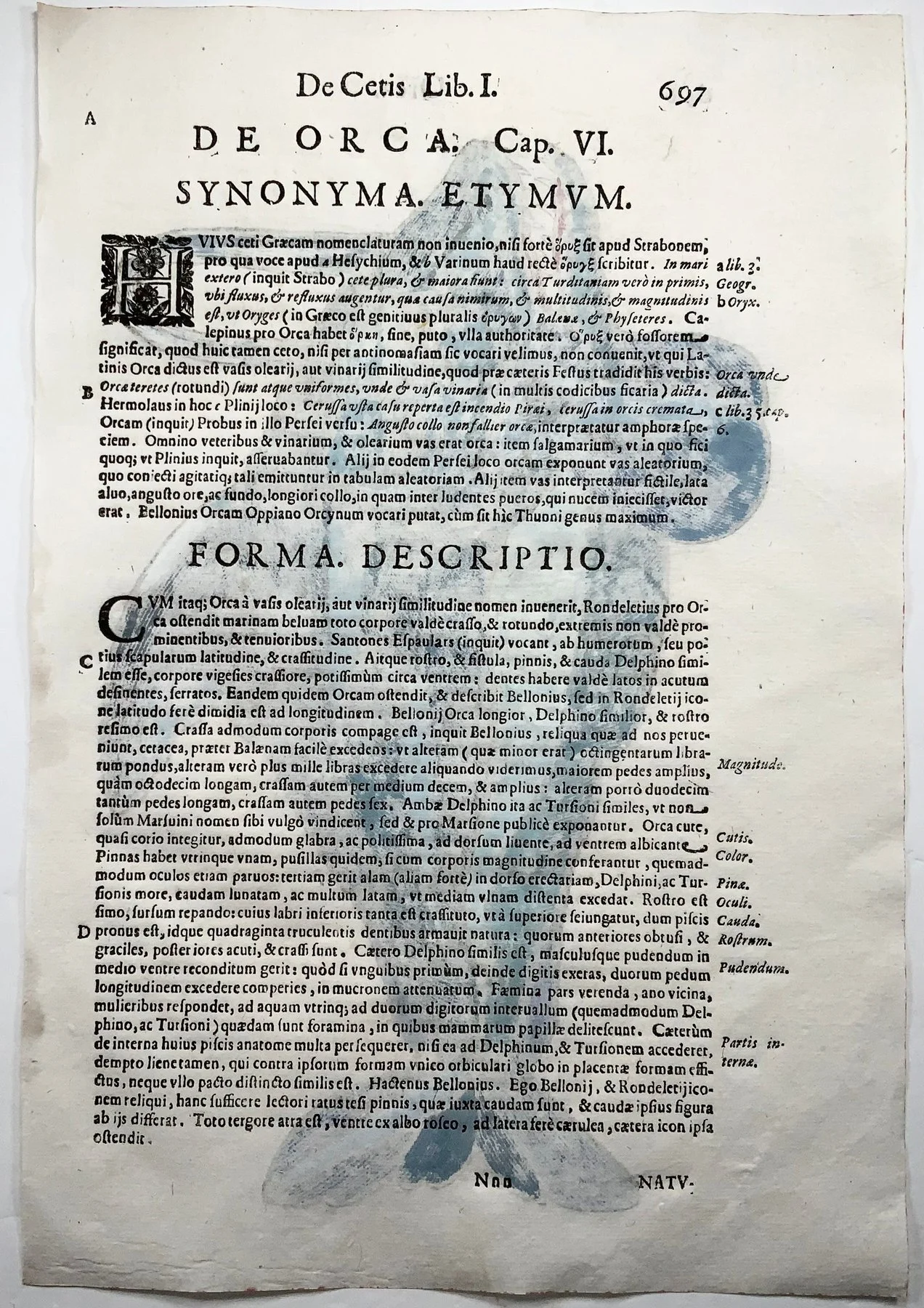 Image 2 of 4
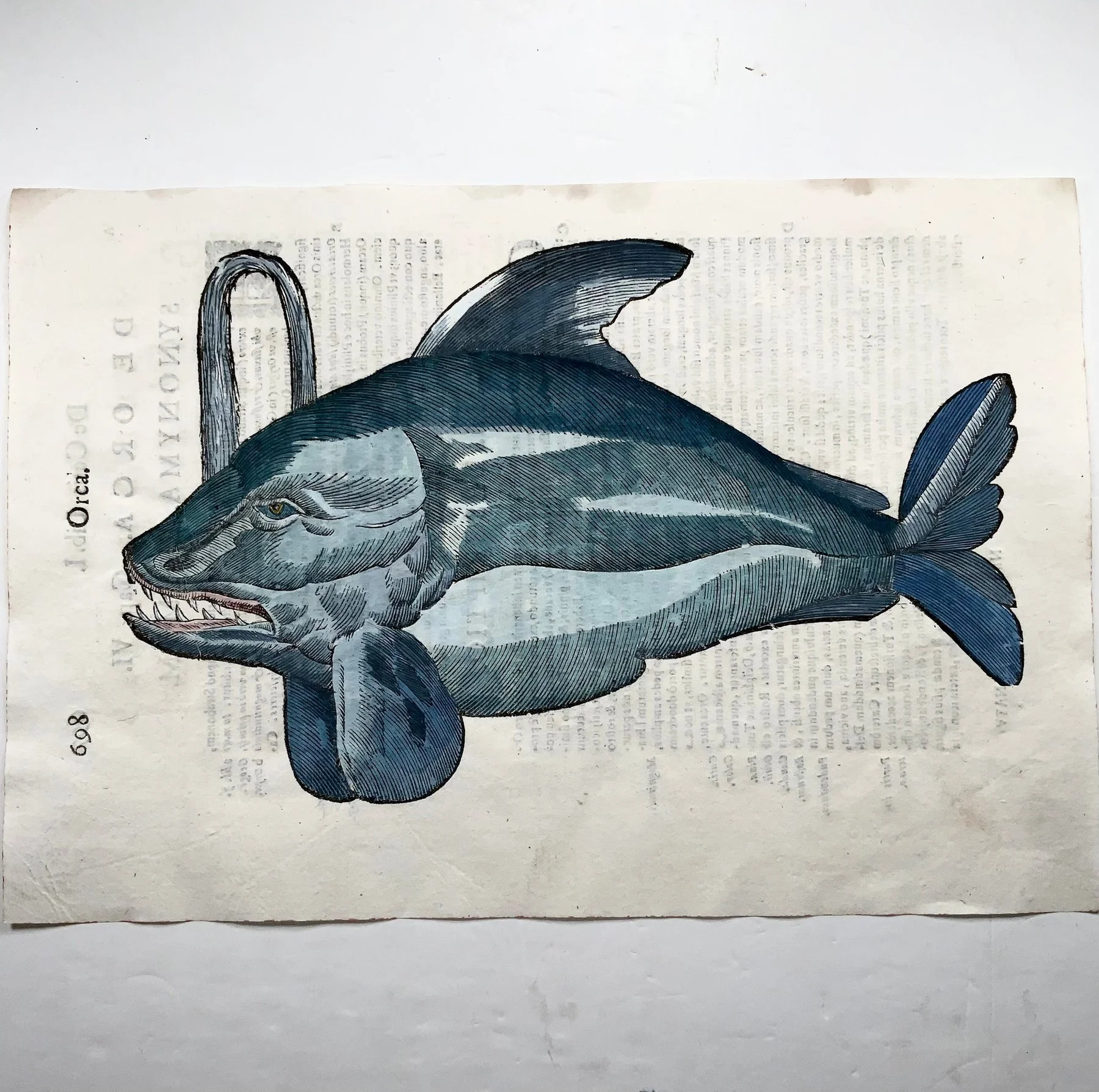 Image 3 of 4
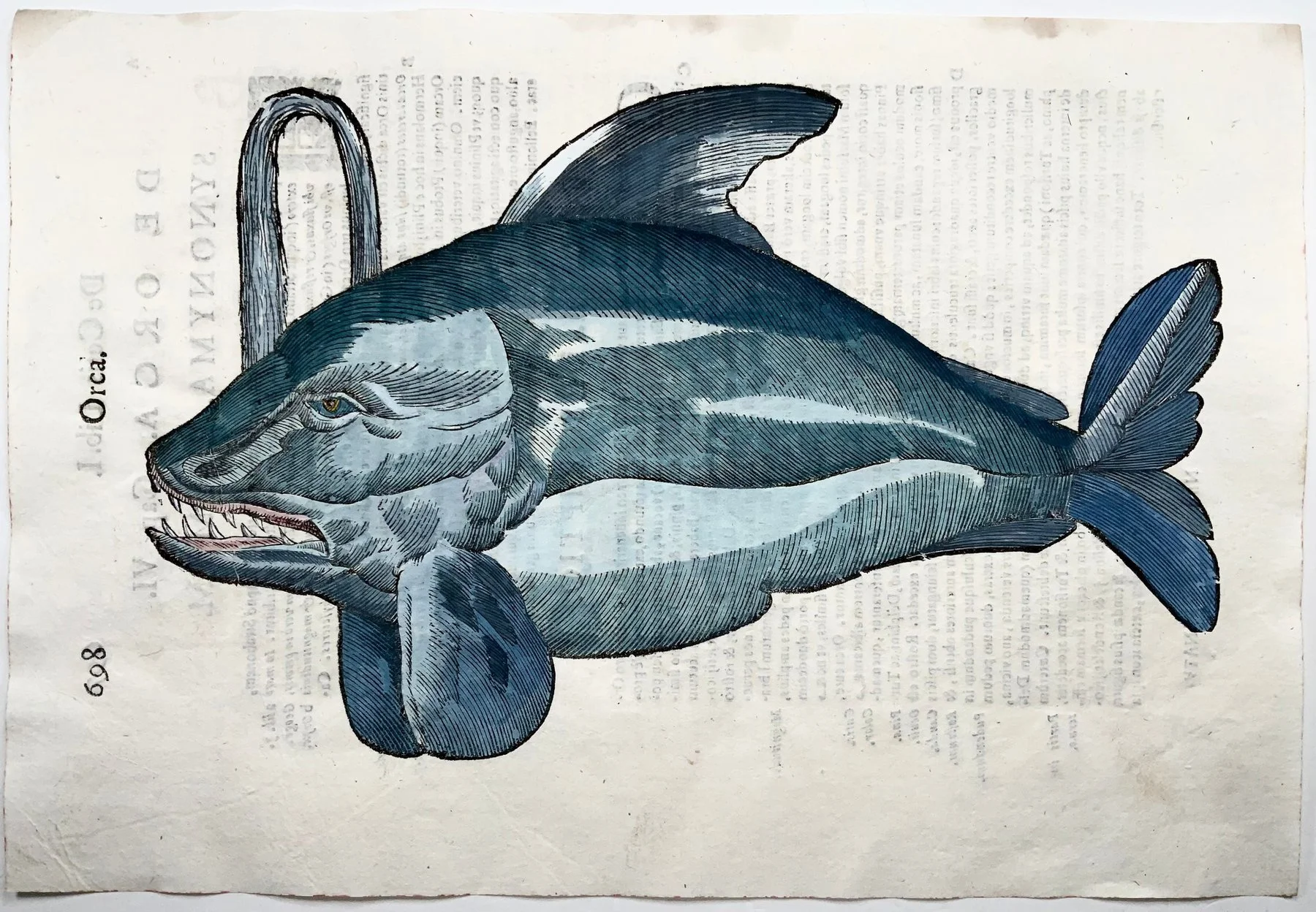 Image 4 of 4
From De Piscibus
Ulisse Aldrovandi, engraved by Cristoforo Coriolano
Bologna: Nicolaus Tebaldini, 1638
Hand-colored woodcut on folio leaf
Woodcut printed to recto
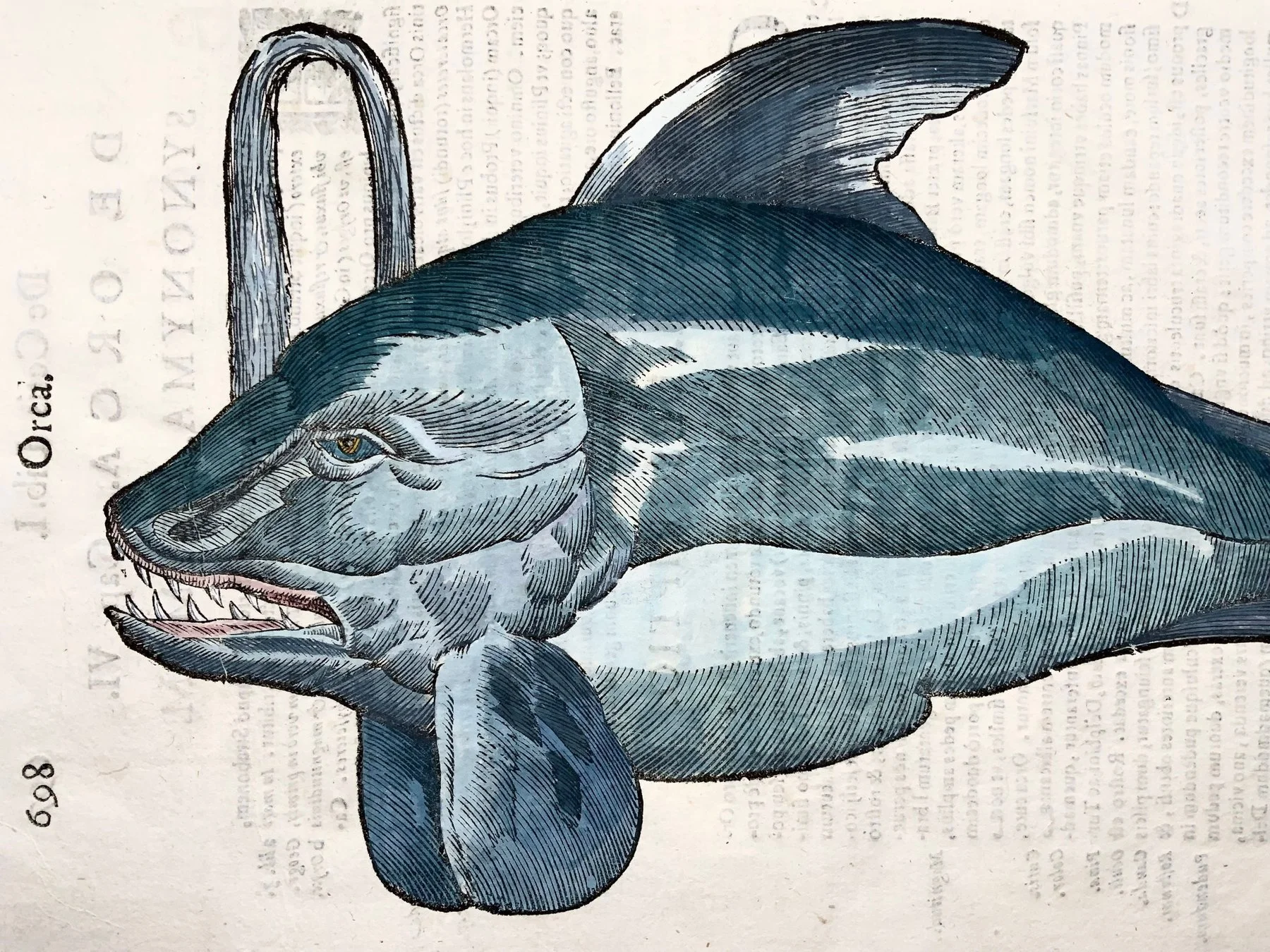
This dramatic folio woodcut depicting a sea monster, whale, and orca originates from De Piscibus, Ulisse Aldrovandi’s monumental study of marine life, published posthumously in Bologna in 1638 by Nicolaus Tebaldini. Among the most compelling images in Aldrovandi’s corpus, the print captures a moment when observation, myth, and classification had not yet fully separated.
Although the central creature represents what we now recognize as an orca, the animal is rendered in a form entirely unlike its modern understanding. In the early seventeenth century, orcas were poorly documented and frequently conflated with whales, sea serpents, and monstrous creatures described in classical and medieval sources. Aldrovandi’s image reflects this uncertainty, presenting the animal as a powerful and unfamiliar force rather than a clearly defined species.
Aldrovandi was described by contemporaries, sometimes with admiring irony, as the supreme authority on natural history for his relentless and exhaustive approach to classification. While his textual expansiveness was occasionally critiqued, the artistic quality of the illustrations in his works has been universally praised. Particular acclaim was given to his woodcut engraver Cristoforo Coriolano, whose cuts were noted for their exceptional refinement, said to resemble copper engravings in their elegance.
The present impression demonstrates this quality vividly. Coriolano’s line work is crisp and controlled, lending authority and presence even to creatures that were only partially understood. The sheet has been hand colored, likely shortly after publication, intensifying the drama of the scene and reinforcing its status as both a scientific illustration and a luxury object. Each hand-colored example is unique, shaped by the individual colorist’s interpretation.
Images such as this are central to the study of early modern science, revealing how knowledge evolved through print. The print stands as a visual record of the moment when real animals still occupied the realm of the monstrous, and when the ocean remained one of Europe’s least understood frontiers.
Good overall condition. Some color show-through to the verso. Minor marginal marks consistent with age and use. Please view images carefully.
Nissen, Zoologische Buchillustration (ZBI) 70
Nissen, Fischbücher 7
Westwood & Satchell 3
Huber 56
Medium: Hand-colored woodcut
Format: Folio leaf
Date: 1638
Dimensions: 13.78 × 9.37 inches (35 × 23.8 cm)
Status: Available
From De Piscibus
Ulisse Aldrovandi, engraved by Cristoforo Coriolano
Bologna: Nicolaus Tebaldini, 1638
Hand-colored woodcut on folio leaf
Woodcut printed to recto
This dramatic folio woodcut depicting a sea monster, whale, and orca originates from De Piscibus, Ulisse Aldrovandi’s monumental study of marine life, published posthumously in Bologna in 1638 by Nicolaus Tebaldini. Among the most compelling images in Aldrovandi’s corpus, the print captures a moment when observation, myth, and classification had not yet fully separated.
Although the central creature represents what we now recognize as an orca, the animal is rendered in a form entirely unlike its modern understanding. In the early seventeenth century, orcas were poorly documented and frequently conflated with whales, sea serpents, and monstrous creatures described in classical and medieval sources. Aldrovandi’s image reflects this uncertainty, presenting the animal as a powerful and unfamiliar force rather than a clearly defined species.
Aldrovandi was described by contemporaries, sometimes with admiring irony, as the supreme authority on natural history for his relentless and exhaustive approach to classification. While his textual expansiveness was occasionally critiqued, the artistic quality of the illustrations in his works has been universally praised. Particular acclaim was given to his woodcut engraver Cristoforo Coriolano, whose cuts were noted for their exceptional refinement, said to resemble copper engravings in their elegance.
The present impression demonstrates this quality vividly. Coriolano’s line work is crisp and controlled, lending authority and presence even to creatures that were only partially understood. The sheet has been hand colored, likely shortly after publication, intensifying the drama of the scene and reinforcing its status as both a scientific illustration and a luxury object. Each hand-colored example is unique, shaped by the individual colorist’s interpretation.
Images such as this are central to the study of early modern science, revealing how knowledge evolved through print. The print stands as a visual record of the moment when real animals still occupied the realm of the monstrous, and when the ocean remained one of Europe’s least understood frontiers.
Good overall condition. Some color show-through to the verso. Minor marginal marks consistent with age and use. Please view images carefully.
Nissen, Zoologische Buchillustration (ZBI) 70
Nissen, Fischbücher 7
Westwood & Satchell 3
Huber 56
Medium: Hand-colored woodcut
Format: Folio leaf
Date: 1638
Dimensions: 13.78 × 9.37 inches (35 × 23.8 cm)
Status: Available