Matthäus Merian Natural History Prints 17th Century Hand Colored Engravings Explained
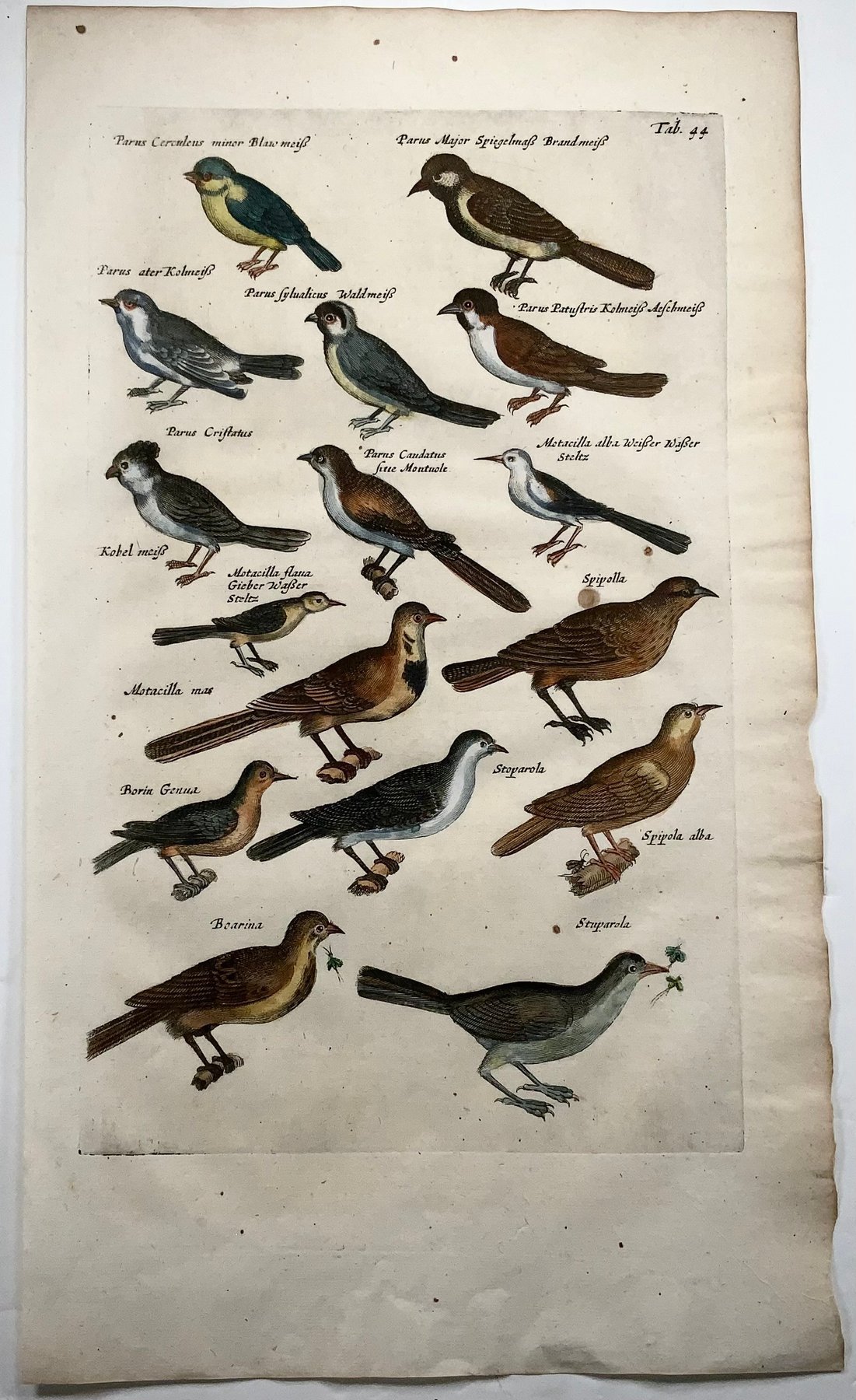
Tits, Wagtails & Flycatchers (Ornithology)
From Historia Naturalis
Matthäus Merian the Elder
Amsterdam, 1657
Issued in Historia Naturalis by Jon Jonston
Hand-colored copperplate engraving on folio leaf
Description
This refined folio engraving depicting tits, wagtails, and flycatchers was executed by Matthäus Merian the Elder and published in Amsterdam in 1657 as part of Jon Jonston’s Historia Naturalis. The plate focuses on smaller passerine birds, subjects that demanded close observation and careful differentiation at a time when ornithology was still emerging as a systematic science.
Merian’s composition presents multiple species together, encouraging comparison of size, posture, beak form, and plumage. Unlike birds of prey or waterfowl, these modest songbirds required a more delicate visual language. Merian responds with precision and restraint, rendering each figure clearly without exaggeration or symbolic flourish.
Printed from a finely engraved copperplate, the image exemplifies Merian’s control of line and balance. The sheet was subsequently hand colored, likely in a contemporary workshop, adding warmth and contrast while preserving the clarity of the engraving. Each hand-colored example is unique, shaped by the individual colorist’s technique.
Although Merian is best known for his Topographia series of city views, his natural history engravings are equally important. Plates such as this demonstrate how early modern science extended beyond dramatic or exotic subjects to include careful study of familiar European fauna. This folio stands as a quiet but essential document in the visual history of ornithology.
Condition
Good overall condition for the age. A few age spots, including one larger area, consistent with historical use. Please view images closely for details.
Details
Medium: Hand-colored copperplate engraving
Format: Folio leaf
Date: 1657
Dimensions: 15 × 8.70 inches (38.1 × 22.1 cm)
Subjects: Tits, Wagtails, Flycatchers, Ornithology
Status: Available
Matthäus Merian Natural History Prints and the Birth of Scientific Illustration
In the seventeenth century, before photography and before standardized taxonomy, the natural world was understood through engraving.
One of the most important figures in this visual transformation was Matthäus Merian the Elder, a Swiss born engraver and publisher active in Frankfurt in the early 1600s. His workshop produced some of the most refined natural history engravings of the Baroque period. Birds, reptiles, insects, marine life, shells, and exotic species were recorded in copper and ink with a level of clarity that helped shape early modern scientific thought.
Today, original hand colored impressions from Merian’s press remain among the most desirable natural history prints in the market.
Who Was Matthäus Merian
Matthäus Merian the Elder was born in 1593 in Basel. Trained as a copperplate engraver, he later established a major publishing house in Frankfurt, one of the intellectual centers of the Holy Roman Empire.
His workshop produced illustrated books on geography, theology, history, and natural science. He was not simply an engraver. He was a publisher, editor, and organizer of skilled craftsmen who worked in coordinated production. Copperplate engravers incised the plates. Press operators printed them. Colorists applied pigments by hand after printing.
Merian’s work circulated widely across Europe. His prints entered private collections, princely libraries, cabinets of curiosity, and academic institutions. They became reference images for scholars and collectors alike.
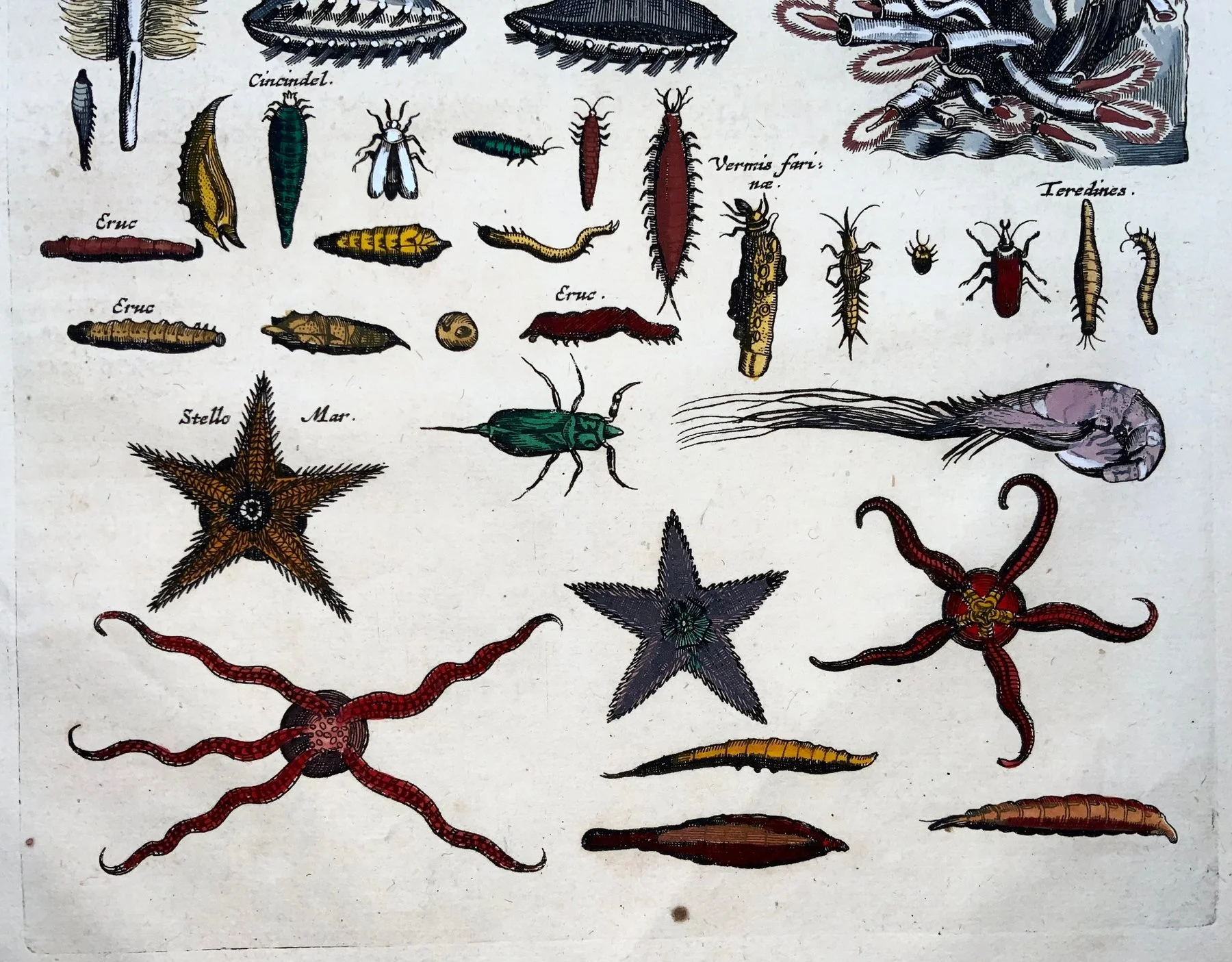
Insects & Echinoderms: Tarantula, Sea Stars, Marine Creatures
From Historia Naturalis
Matthäus Merian the Elder
Amsterdam, 1657
Issued in Historia Naturalis by Jon Jonston
Copperplate engraving on folio leaf
Later hand coloring
Description
This striking folio engraving depicts a wide array of insects and echinoderms, including a tarantula, butterflies, flies, spiders, marine worms, shipworms, and sea stars. Issued in 1657 as part of Jon Jonston’s Historia Naturalis, the plate exemplifies the early modern effort to impose order on a natural world that was still only partially understood.
The composition brings together terrestrial and marine life on a single sheet, reflecting seventeenth century scientific thinking before the development of modern taxonomy. Creatures we now separate into distinct biological categories were then grouped according to appearance, habitat, or perceived affinity. The inclusion of both tarantula and starfish underscores this transitional moment in the history of science, when observation coexisted with inherited classification systems.
The engraving was executed by Matthäus Merian the Elder, one of the most accomplished copperplate engravers of the seventeenth century. Trained across Basel, Zurich, Strasbourg, Nancy, and Paris, Merian brought exceptional precision and compositional balance to scientific illustration. His engravings for Historia Naturalis are admired for their clarity, legibility, and visual authority.
The plate has been hand colored, enhancing contrast between species and giving each figure a distinct presence. As with all hand-colored examples, the application of pigment is unique, shaped by the individual colorist. The survival of color after more than three and a half centuries speaks to the quality of both pigments and paper.
Prints such as this are central to understanding how early modern Europe conceptualized nature. They document a period when spiders, insects, and marine organisms shared a visual language, revealing the intellectual pathways that led toward modern zoology.
Condition
Very good overall condition for age. Please view images closely for details.
Details
Medium: Copperplate engraving with hand coloring
Format: Folio leaf
Date: 1657
Dimensions: 15 × 8.66 inches (38.1 × 22 cm)
Subjects: Tarantula, Starfish, Insects, Marine Creatures
Status: Available
How Seventeenth Century Copperplate Engravings Were Made
Understanding the printing process is essential to understanding why original Merian impressions are valuable.
Copperplate engraving begins with a polished copper sheet. The engraver uses a burin to cut fine incised lines directly into the surface. These lines hold ink. The plate is inked and wiped so that ink remains only in the engraved recesses. Dampened laid paper is placed on top, and both are run through a rolling press under significant pressure.
The result is a sharply detailed impression, often with a visible plate mark around the image.
After printing, the sheets were hand colored. Skilled artisans applied watercolor pigments using small brushes. The coloring was done impression by impression. This is why no two examples are identical. Differences in tone, layering, and pigment density are part of the character of an original print.
When you examine a Merian engraving closely, you will see:
Fine cross hatching in feathers and scales
Carefully modulated line weight to create depth
Hand applied pigments that sit slightly within the engraved lines
Laid paper with visible chain lines when held to light
These are material qualities that reproductions cannot replicate.
Why These Prints Matter in the History of Science
Merian worked during a period when Europe was actively cataloging the natural world. Exploration had expanded dramatically. New species were being described. Cabinets of curiosity were assembling specimens from across continents.
Natural history illustration served as visual documentation. Without photography, engraved images became a form of scientific evidence.
Before Linnaeus standardized binomial nomenclature in the eighteenth century, early modern naturalists relied heavily on detailed imagery. Engravings allowed species to be compared, classified, and discussed across borders.
Merian’s prints represent this pre Linnaean moment. They capture a time when art and empirical observation were deeply intertwined.
Owning an original Merian impression is owning a document from the formative era of European scientific thought.
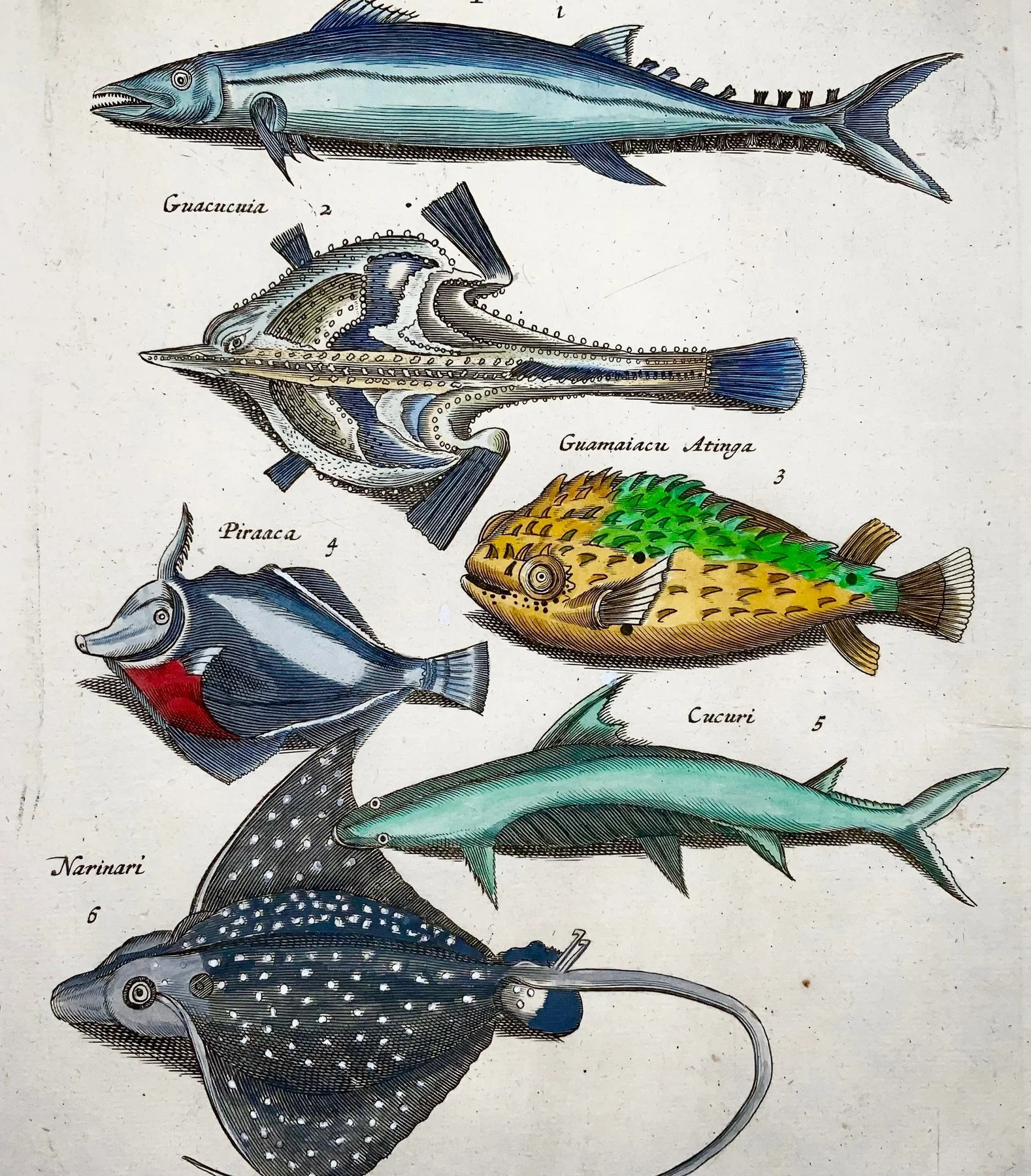
Bat Fish, Rays, Cucuri & Wahoo (Ichthyology)
From Historia Naturalis
Matthäus Merian the Elder
Amsterdam, 1657
Issued in Historia Naturalis by Jon Jonston
Hand-colored copperplate engraving on folio leaf
Description
This richly detailed folio engraving depicts a diverse group of marine fish, including bat fish, rays, cucuri, wahoo, and related species, and was executed by Matthäus Merian the Elder for Jon Jonston’s Historia Naturalis, published in Amsterdam in 1657. The plate reflects the expanding European encounter with global marine life during the seventeenth century, incorporating species described through exploration, trade, and colonial contact.
The composition presents multiple fish species arranged for visual comparison, a hallmark of early modern ichthyology. Several of the species shown, including the longnose batfish and various rays, were unfamiliar to European audiences and often described using indigenous or transliterated names such as Guarapucu, Guacucuia, Cucuri, and Narinari. These names preserve traces of early encounters with New World and tropical marine environments and underscore the global scope of Jonston’s project.
Printed from a finely engraved copperplate, the image demonstrates Merian’s exceptional control of line, proportion, and spatial organization. The engraving was subsequently hand colored, likely in a contemporary workshop, enhancing differentiation between species while preserving the clarity of the underlying engraving. Each hand-colored example is unique, shaped by the individual colorist’s interpretation.
Matthäus Merian the Elder is best known for his monumental Topographia series of European city views, yet his natural history engravings are equally significant. Plates such as this one reveal Merian’s ability to translate unfamiliar and exotic subjects into clear, authoritative images, contributing to the early visual language of scientific observation.
This engraving stands as a compelling document of early modern marine science, combining exploration, taxonomy, and artistry at a moment when Europe was still learning to describe the world’s oceans.
Condition
Good overall condition for the age. Please view images closely for details.
Details
Medium: Hand-colored copperplate engraving
Format: Folio leaf
Date: 1657
Dimensions: 13.86 × 8.43 inches (35.2 × 21.4 cm)
Subjects: Bat Fish, Rays, Cucuri, Wahoo, Ichthyology
Status: Available
What to Look for in an Original Matthäus Merian Print
Collectors should understand a few key markers of authenticity.
First, examine the paper. Seventeenth century sheets were printed on laid paper. When held to light, you should see vertical chain lines and horizontal laid lines. The paper will have a soft texture and natural toning consistent with age.
Second, look for a plate mark. Copperplate engravings leave a faint rectangular indentation around the image area.
Third, inspect the line work under magnification. True engraved lines have slight burr characteristics and subtle depth. Modern reproductions often appear flat or mechanically screened.
Fourth, assess the coloring. Period hand coloring shows variation and slight overlap beyond engraved boundaries. Uniform digital coloring lacks this organic inconsistency.
Condition also matters. Minor age toning is expected. Excessive trimming, heavy staining, or later over coloring reduces desirability.
Why Collectors Seek Merian Prints Today
Supply is finite. Seventeenth century impressions are no longer being produced. Surviving examples were subject to centuries of handling, binding removal, environmental exposure, and institutional absorption.
Many impressions now reside permanently in libraries and museums. Private market availability fluctuates and high quality examples are increasingly scarce.
Collectors are drawn to Merian for several reasons.
Historical importance
Strong decorative presence
Clear engraving quality
Recognizable authorship
Long term collectibility
These prints work in both academic and residential settings. They appeal to natural history collectors, rare book buyers, and those who value early scientific imagery.
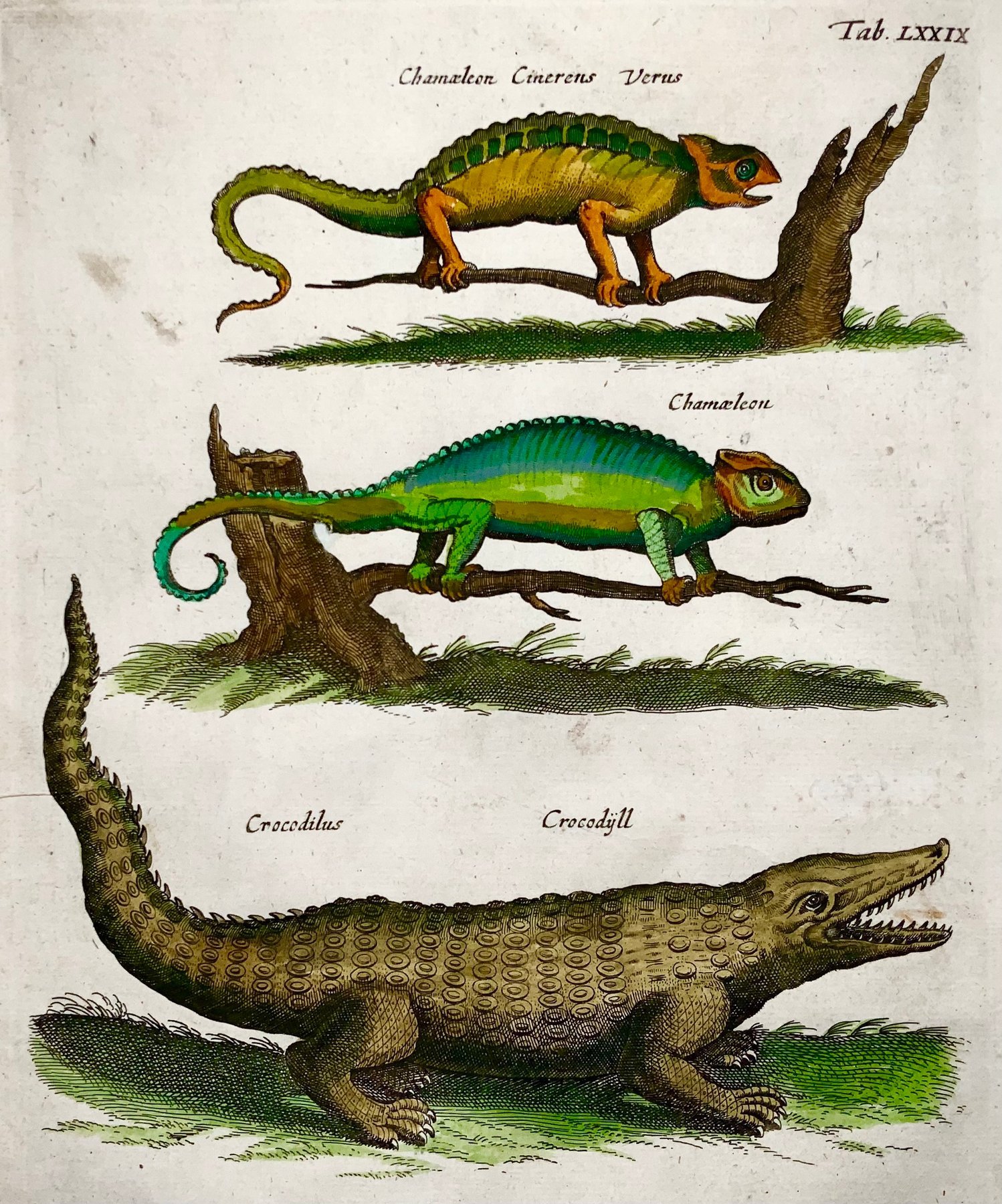
Reptiles: Chameleons & Crocodiles
From Historia Naturalis
Matthäus Merian the Elder
Amsterdam, 1657
Issued in Historia Naturalis by Jon Jonston
Hand-colored copperplate engraving on folio leaf
This folio engraving depicting chameleons and crocodiles was executed by Matthäus Merian the Elder and published in Amsterdam in 1657 as part of Jon Jonston’s Historia Naturalis, one of the most influential natural history compilations of the 17th century. The work reflects the moment when Renaissance curiosity evolved into early modern scientific taxonomy, combining empirical observation with inherited classical knowledge.
Merian, a Swiss-born engraver trained in Basel, Zurich, Strasbourg, and Paris, spent most of his career in Frankfurt am Main, where he established himself as one of the leading engravers and publishers of his generation. Best known today for his Topographia series of town views and maps, Merian brought the same precision, compositional clarity, and technical refinement to scientific illustration. His engravings are characterized by crisp line work, balanced spatial organization, and a restrained yet expressive visual language.
The present engraving was printed from a copperplate and subsequently hand-colored, likely in a contemporary workshop, enhancing the visual differentiation of species and increasing the print’s appeal as both a scientific image and a luxury object. Hand-colored examples from Jonston’s Historia Naturalis are especially desirable, as each impression is unique and reflects early modern practices of bespoke coloring.
Merian’s contribution to natural history illustration lies in his ability to render complex subjects with clarity and authority, making works such as this essential documents in the visual history of zoology and the transmission of scientific knowledge in early modern Europe.
Condition:
Good overall condition for the age. A few light surface marks. Slight dusting and fingering to the margins, consistent with handling. Please view images closely for details.
Status: Available
Inquiries: Acquisition and exhibition inquiries welcome
The Enduring Appeal of Hand Colored Natural History Engravings
In an era dominated by digital images, hand colored copperplate engravings carry a material presence that cannot be replicated.
You can see the pressure of the press in the plate mark. You can see the slight pooling of pigment in engraved recesses. You can see the careful brush strokes in the layering of greens, blues, and ochres.
The craftsmanship is visible.
Merian’s engravings represent a moment when knowledge was transmitted through disciplined line work and patient coloring. They reflect an intellectual culture that believed careful observation and skilled craftsmanship were inseparable.
For serious collectors, these qualities matter.
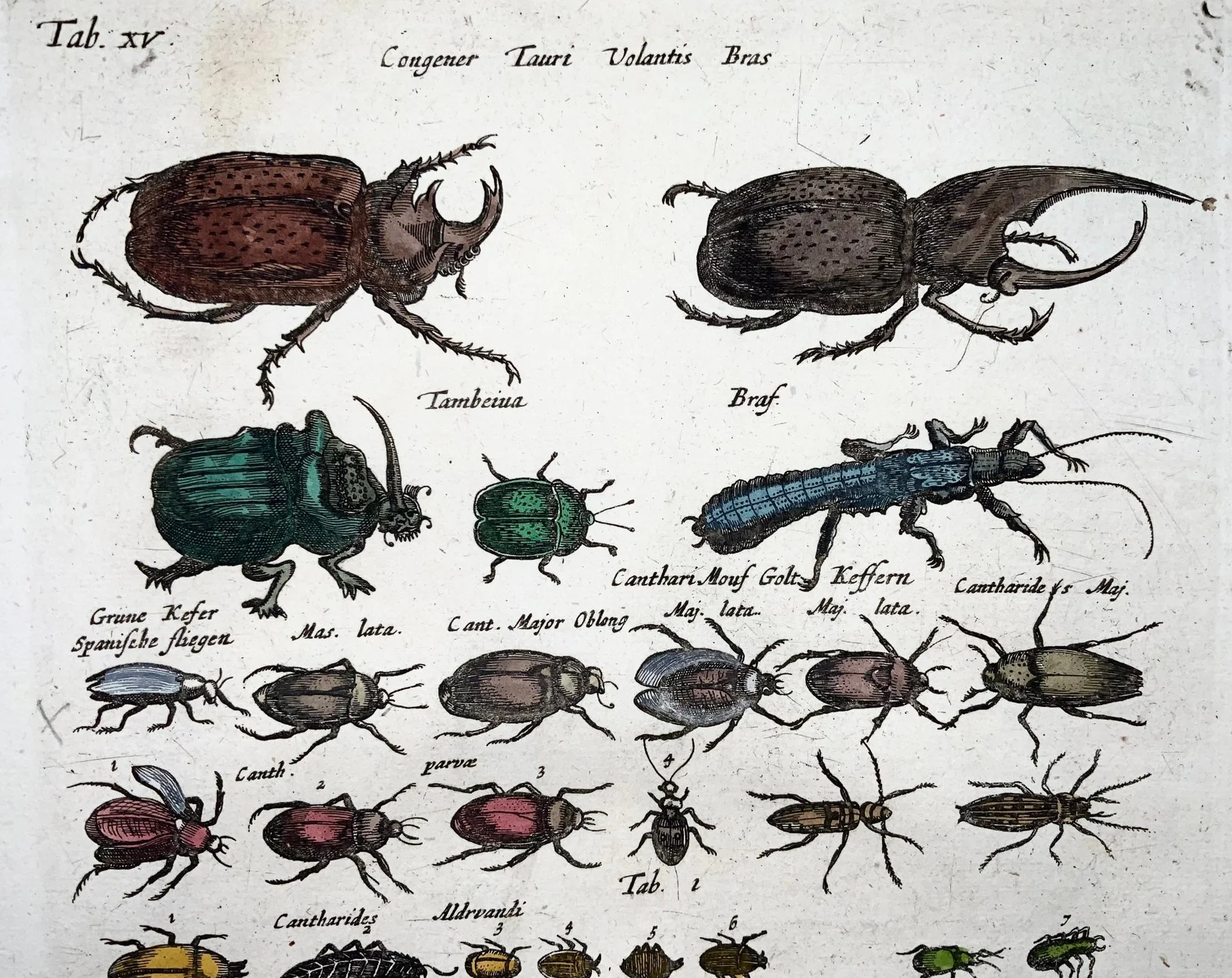
Scarab Beetles, Bugs & Insects (Entomology)
From Historia Naturalis
Matthäus Merian the Elder
Amsterdam, 1657
Issued in Historia Naturalis by Jon Jonston
Hand-colored copperplate engraving on folio leaf
Description
This finely detailed folio engraving depicting scarab beetles, bugs, and assorted insects was executed by Matthäus Merian the Elder and published in Amsterdam in 1657 as part of Jon Jonston’s Historia Naturalis. The plate stands as an early and compelling document in the visual history of entomology, produced at a moment when insects were only beginning to be studied systematically.
The composition assembles multiple insect species on a single sheet, encouraging comparison of body structure, segmentation, and wing form. Scarab beetles in particular fascinated early modern naturalists due to their durability, metamorphosis, and symbolic associations inherited from antiquity. Merian’s engraving treats these creatures not as allegory, but as physical organisms to be observed and recorded.
Printed from a precisely cut copperplate, the engraving demonstrates Merian’s exceptional control of line and proportion. The sheet was subsequently hand colored, likely in a contemporary workshop, enhancing contrast and legibility while preserving the crispness of the engraving. As with all hand-colored examples, each impression is unique, shaped by the individual colorist’s choices.
Matthäus Merian the Elder was among the most accomplished engravers of the seventeenth century, best known for his Topographia series of European city views. His natural history plates, however, are equally significant, translating unfamiliar and often overlooked subjects into authoritative images that helped shape early scientific understanding.
This engraving offers a rare glimpse into how insects were first organized visually within Renaissance science, making it an important artifact for collectors and institutions interested in the origins of zoology and scientific illustration.
Condition
Good overall condition for the age. Some fingering to the margins consistent with historical handling. Please view images closely for details.
Details
Medium: Hand-colored copperplate engraving
Format: Folio leaf
Date: 1657
Dimensions: 13.86 × 8.43 inches (35.2 × 21.4 cm)
Subjects: Scarab Beetles, Bugs, Insects, Entomology
Status: Available
Explore Available Matthäus Merian Prints
Original seventeenth century impressions by Matthäus Merian are currently available.
You can view available examples in the shop at:
If you have questions about condition, authenticity, paper type, or coloring, feel free to reach out. Collecting early natural history prints requires careful attention to detail, and informed buyers make better long term decisions.
Matthäus Merian’s engravings remain among the most accessible entry points into seventeenth century scientific illustration. They are historically significant, visually compelling, and materially substantial.
Collectors who recognize their importance rarely regret acquiring strong impressions.
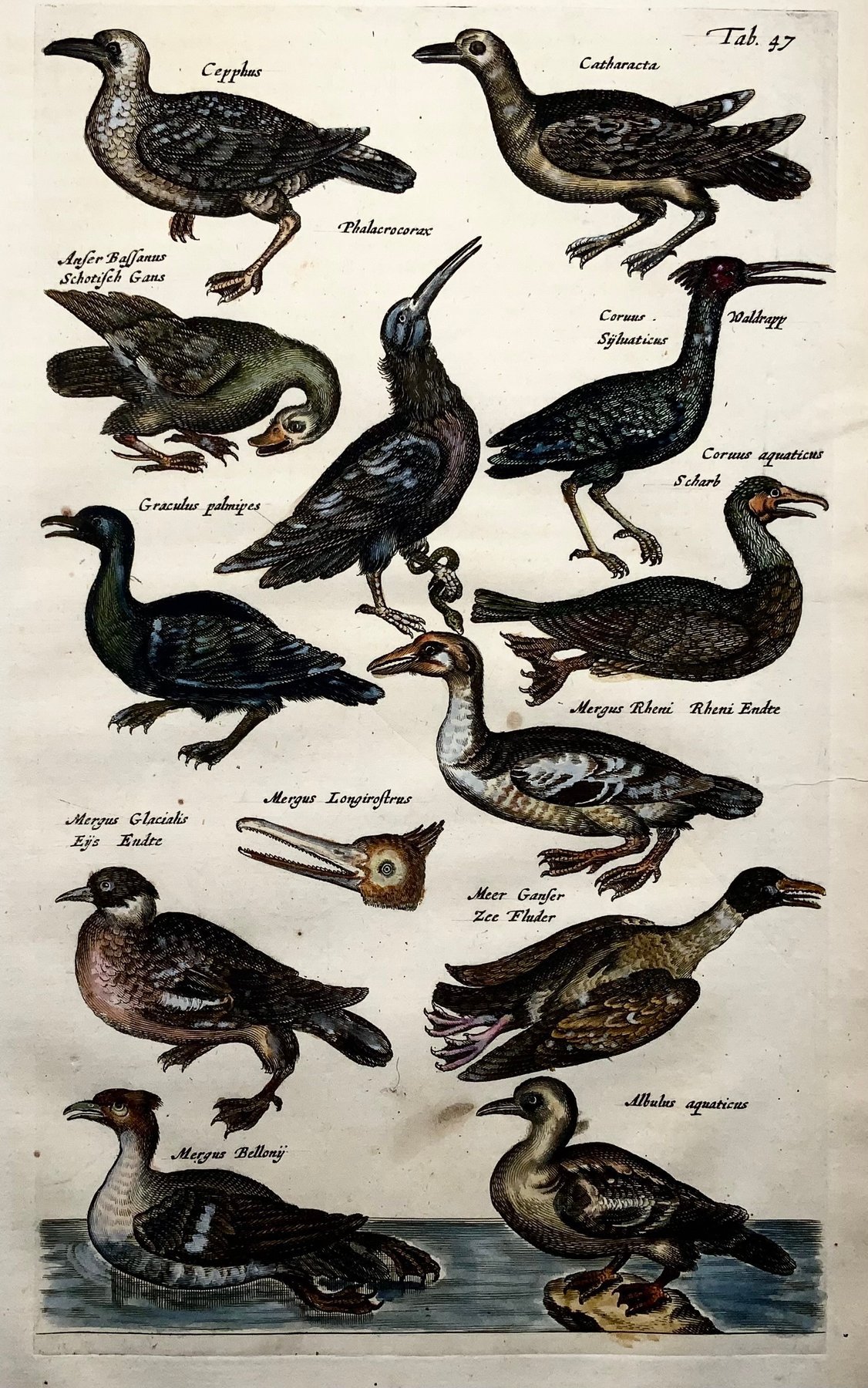
Waterbirds, Ducks & Geese (Ornithology)
From Historia Naturalis
Matthäus Merian the Elder
Amsterdam, 1657
Issued in Historia Naturalis by Jon Jonston
Hand-colored copperplate engraving on folio leaf
Description
This folio engraving depicting waterbirds, ducks, and geese was executed by Matthäus Merian the Elder and published in Amsterdam in 1657 as part of Jon Jonston’s Historia Naturalis. The plate represents early modern ornithology at a moment when systematic observation was beginning to replace symbolic or allegorical treatment of animals.
Merian’s engraving brings together multiple species in a carefully organized composition, allowing the viewer to compare posture, plumage, and form. Waterfowl were of particular interest to early naturalists due to their migratory behavior and adaptability across land and water. Merian’s treatment emphasizes physical structure and recognizability rather than decorative flourish, reflecting the growing scientific ambitions of seventeenth-century natural history.
Printed from a finely cut copperplate, the engraving was subsequently hand colored, likely in a contemporary workshop. The application of color enhances differentiation between species while preserving the crispness of Merian’s line work. As with all hand-colored examples, each impression is unique, shaped by the colorist’s choices and technique.
Matthäus Merian the Elder was among the most accomplished engravers of his generation, trained across Basel, Zurich, Strasbourg, Nancy, and Paris before establishing himself in Frankfurt. While widely celebrated for his Topographia series of city views and maps, Merian’s natural history engravings are equally important, combining clarity, balance, and authority in service of early scientific illustration.
This plate stands as a refined and historically significant document of early ornithology, valued by collectors and institutions for its scale, visual coherence, and place within the development of zoological knowledge.
Condition
Good overall condition for the age. A few scattered spots consistent with historical use. Please view images closely for details.
Details
Medium: Hand-colored copperplate engraving
Format: Folio leaf
Date: 1657
Dimensions: 15 × 8.66 inches (38.1 × 22 cm)
Subjects: Waterbirds, Ducks, Geese, Ornithology
Status: Available
