 Image 1 of 4
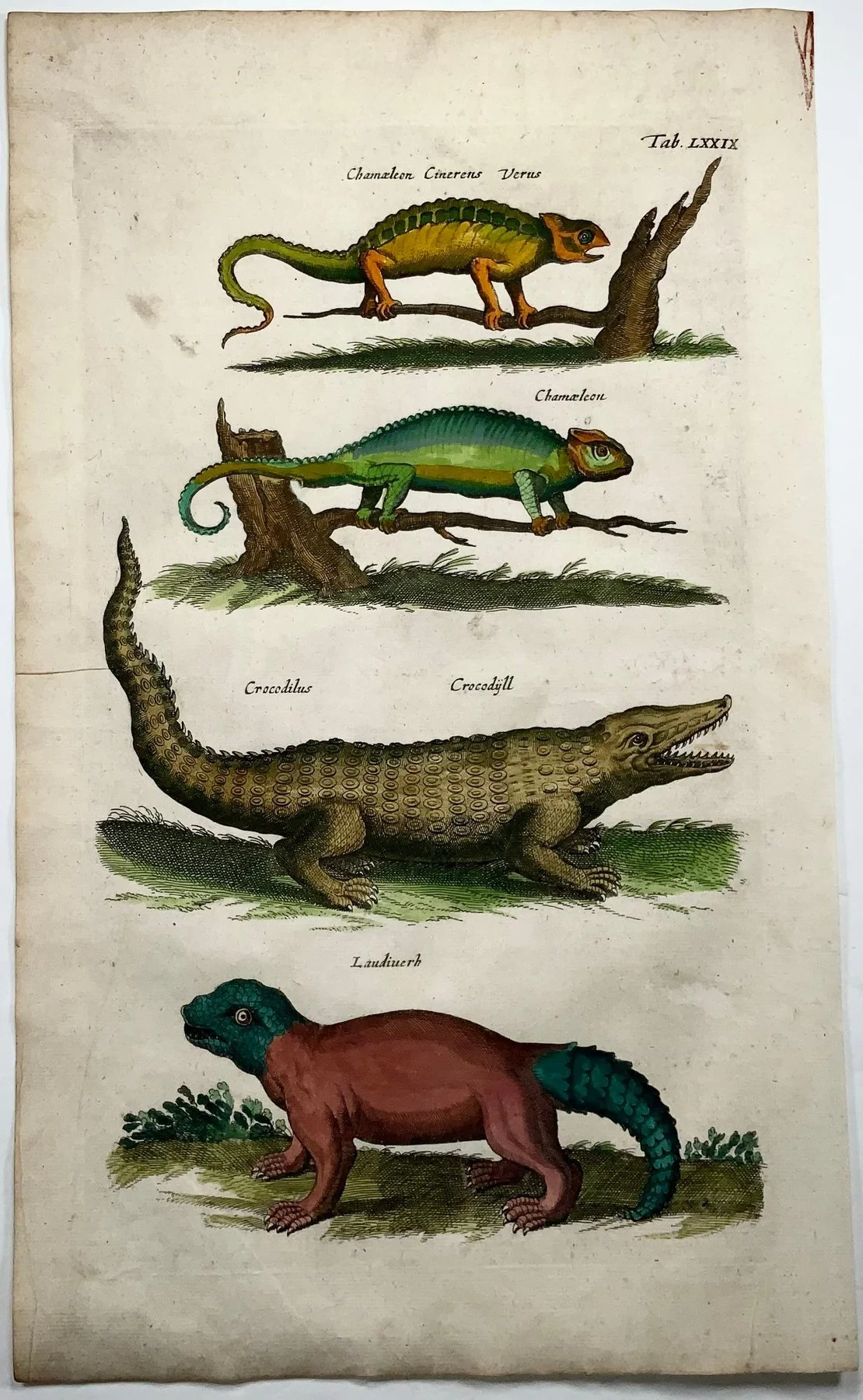 Image 2 of 4
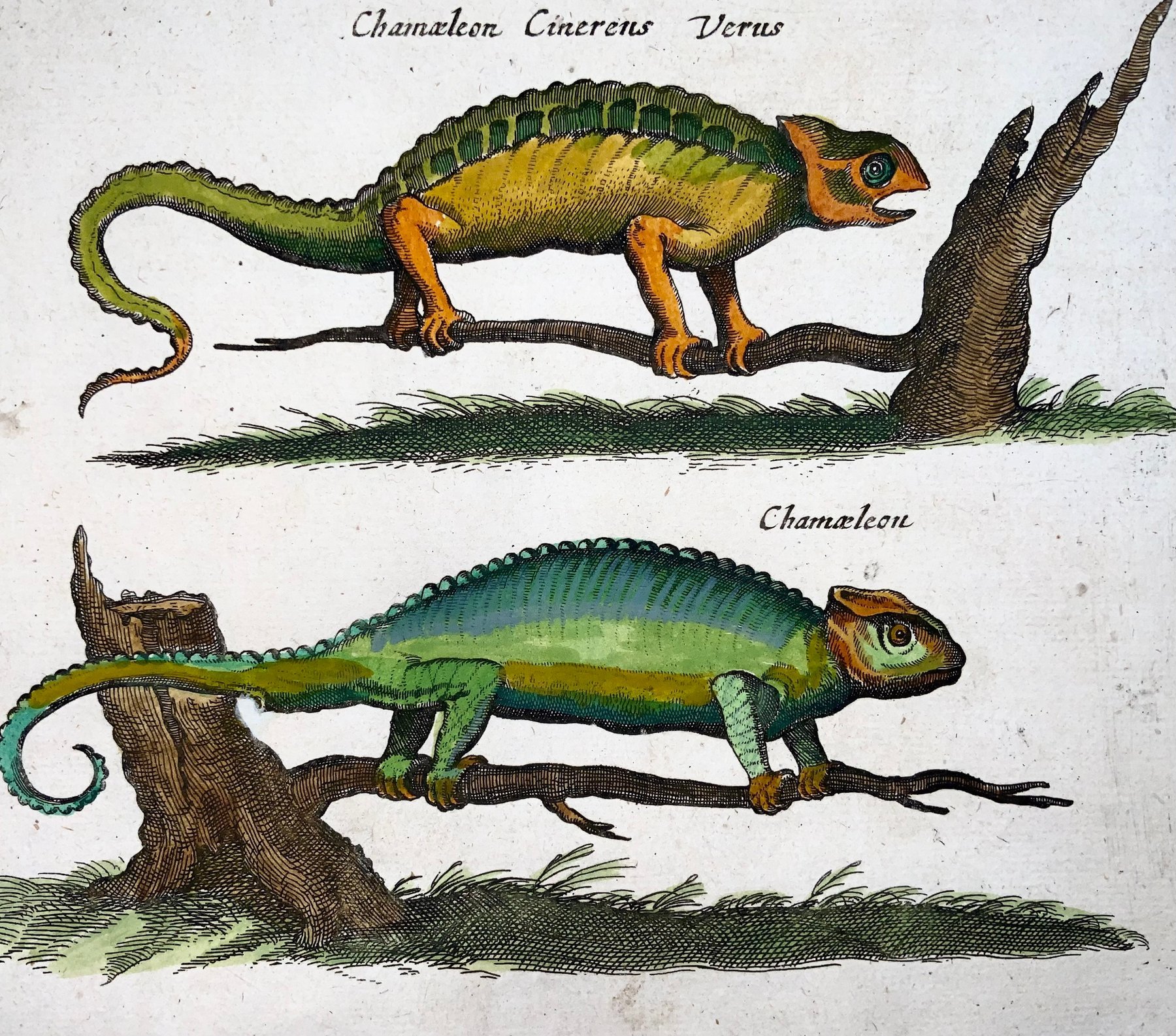 Image 3 of 4
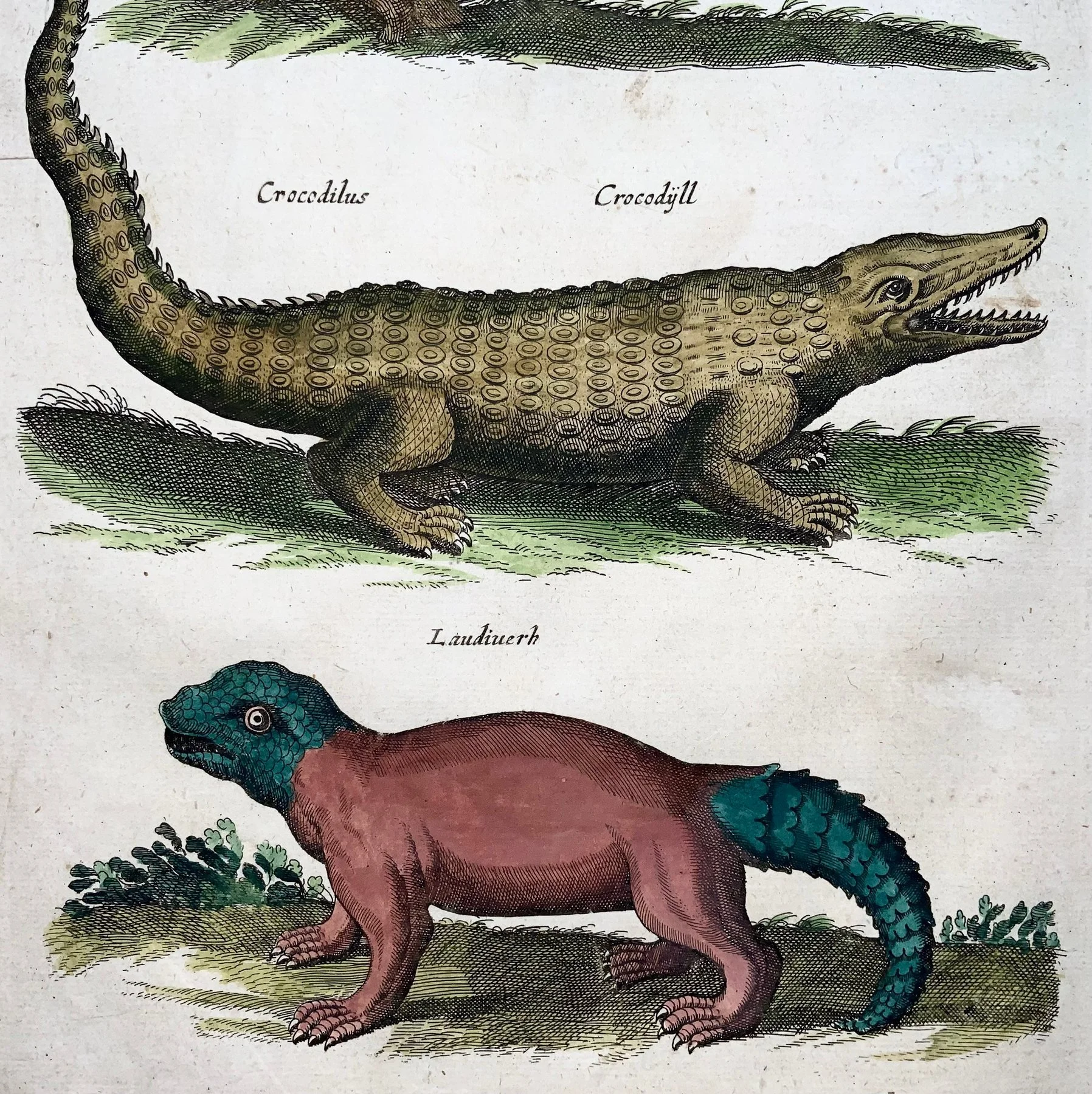 Image 4 of 4
From Historia Naturalis
Matthäus Merian the Elder
Amsterdam, 1657
Issued in Historia Naturalis by Jon Jonston
Hand-colored copperplate engraving on folio leaf
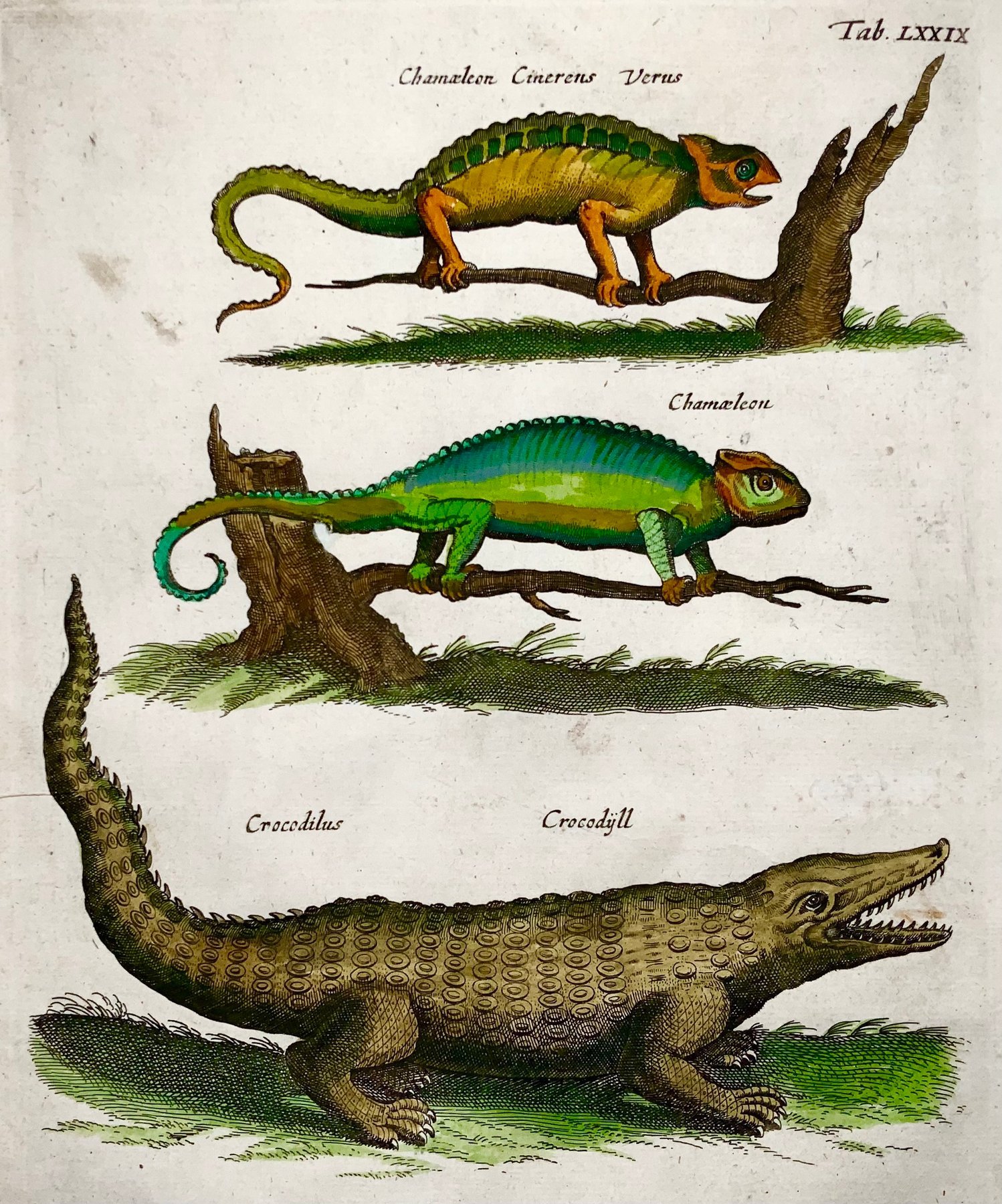
This folio engraving depicting chameleons and crocodiles was executed by Matthäus Merian the Elder and published in Amsterdam in 1657 as part of Jon Jonston’s Historia Naturalis, one of the most influential natural history compilations of the 17th century. The work reflects the moment when Renaissance curiosity evolved into early modern scientific taxonomy, combining empirical observation with inherited classical knowledge.
Merian, a Swiss-born engraver trained in Basel, Zurich, Strasbourg, and Paris, spent most of his career in Frankfurt am Main, where he established himself as one of the leading engravers and publishers of his generation. Best known today for his Topographia series of town views and maps, Merian brought the same precision, compositional clarity, and technical refinement to scientific illustration. His engravings are characterized by crisp line work, balanced spatial organization, and a restrained yet expressive visual language.
The present engraving was printed from a copperplate and subsequently hand-colored, likely in a contemporary workshop, enhancing the visual differentiation of species and increasing the print’s appeal as both a scientific image and a luxury object. Hand-colored examples from Jonston’s Historia Naturalis are especially desirable, as each impression is unique and reflects early modern practices of bespoke coloring.
Merian’s contribution to natural history illustration lies in his ability to render complex subjects with clarity and authority, making works such as this essential documents in the visual history of zoology and the transmission of scientific knowledge in early modern Europe.
Condition:
Good overall condition for the age. A few light surface marks. Slight dusting and fingering to the margins, consistent with handling. Please view images closely for details.
Status: Available
Inquiries: Acquisition and exhibition inquiries welcome
From Historia Naturalis
Matthäus Merian the Elder
Amsterdam, 1657
Issued in Historia Naturalis by Jon Jonston
Hand-colored copperplate engraving on folio leaf
This folio engraving depicting chameleons and crocodiles was executed by Matthäus Merian the Elder and published in Amsterdam in 1657 as part of Jon Jonston’s Historia Naturalis, one of the most influential natural history compilations of the 17th century. The work reflects the moment when Renaissance curiosity evolved into early modern scientific taxonomy, combining empirical observation with inherited classical knowledge.
Merian, a Swiss-born engraver trained in Basel, Zurich, Strasbourg, and Paris, spent most of his career in Frankfurt am Main, where he established himself as one of the leading engravers and publishers of his generation. Best known today for his Topographia series of town views and maps, Merian brought the same precision, compositional clarity, and technical refinement to scientific illustration. His engravings are characterized by crisp line work, balanced spatial organization, and a restrained yet expressive visual language.
The present engraving was printed from a copperplate and subsequently hand-colored, likely in a contemporary workshop, enhancing the visual differentiation of species and increasing the print’s appeal as both a scientific image and a luxury object. Hand-colored examples from Jonston’s Historia Naturalis are especially desirable, as each impression is unique and reflects early modern practices of bespoke coloring.
Merian’s contribution to natural history illustration lies in his ability to render complex subjects with clarity and authority, making works such as this essential documents in the visual history of zoology and the transmission of scientific knowledge in early modern Europe.
Condition:
Good overall condition for the age. A few light surface marks. Slight dusting and fingering to the margins, consistent with handling. Please view images closely for details.
Status: Available
Inquiries: Acquisition and exhibition inquiries welcome