How to Tell If an Antique Print Is Authentic and Not a Reproduction
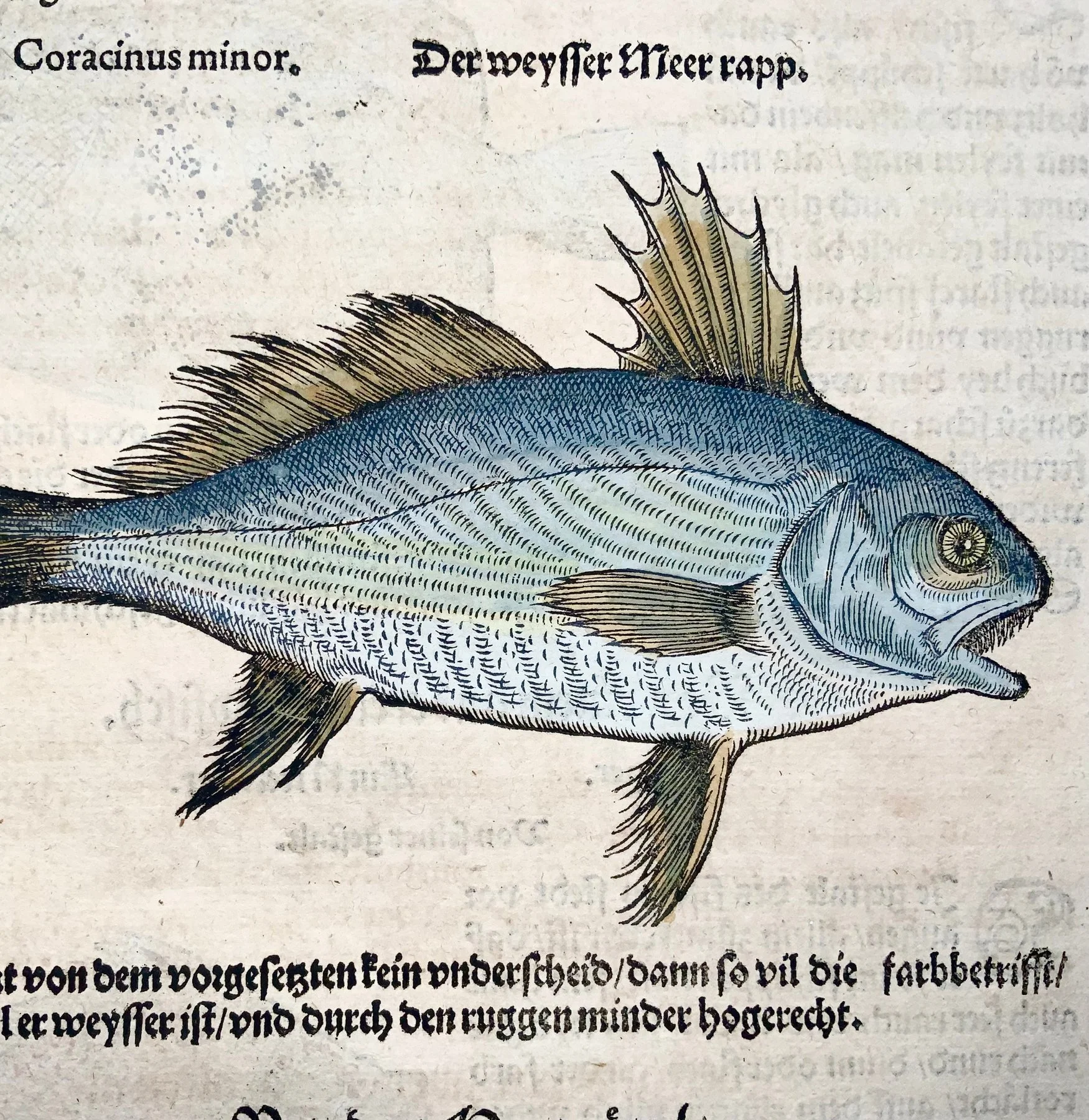
Bream & Triggerfish (Ichthyology)
From Fischbuch
Conrad Gesner
Zurich, German edition, 1563
Five woodcuts on a single folio leaf
Later hand coloring
Description
This folio leaf featuring five woodcut illustrations of fish, including bream and triggerfish, originates from the 1563 German edition of Conrad Gesner’s Fischbuch. Issued during Gesner’s lifetime, the Fischbuch represents one of the earliest focused attempts to document and classify aquatic species as a distinct branch of natural history.
Gesner was among the great polymaths of the Renaissance, active as a physician, philosopher, bibliographer, and natural historian. His approach to ichthyology was groundbreaking in its insistence on careful observation and comparative description. Rather than treating fish as symbolic or mythical creatures, Gesner presented them as physical organisms to be studied, named, and differentiated.
The woodcuts for the Fischbuch were executed by Hans Asper, Johann Thomas, and Lukas Schrön, artists whose work contributed significantly to the clarity and authority of Gesner’s publications. Their cuts are direct and descriptive, emphasizing form, proportion, and distinguishing features over ornament.
The present impression has been hand colored at a later date, adding visual warmth and individuality while preserving the integrity of the original woodcuts. Such later coloring was commonly undertaken for collectors and readers who valued enhanced legibility and visual appeal. Each example is therefore unique.
Early Gesner fish prints are highly sought after for their age, scholarly importance, and role in the development of ichthyology. This leaf, with multiple species presented together, offers a rare opportunity to see how Renaissance naturalists approached marine classification in its formative stage.
Condition
Good overall condition. Light, even age toning with minor edge wear consistent with the period. Please view images carefully.
References
Nissen, Fischbücher 59
Details
Medium: Woodcuts with later hand coloring
Format: Folio leaf
Date: 1563
Dimensions: 13.58 × 8.54 inches (34.5 × 21.7 cm)
Subjects: Bream, Triggerfish, Ichthyology
Status: Available
Collecting antique prints is one of the most rewarding ways to live with history. A genuine print is not simply an image from the past but a physical object that was handled, printed, colored, sold, and preserved across generations. For new collectors, however, one concern almost always comes first: how do you know an antique print is real and not a modern reproduction?
This is a fair question. Reproductions are everywhere. Some are clearly decorative, others are intentionally deceptive, and many sit in a gray area where sellers themselves may not fully understand what they are offering. Learning how to distinguish an authentic antique print from a later copy is not difficult, but it does require knowing what to look for and what questions to ask. This guide explains the core elements that matter, using plain language and practical observation rather than jargon.
Why reproductions exist and why they cause confusion
Reproductions exist for many reasons. Some were created in the nineteenth and early twentieth centuries to meet demand for famous images that had become scarce. Others were produced in the late twentieth century as decorative items meant to evoke an antique look without the cost. More recently, high resolution digital scanning and modern printing techniques have made it easy to produce convincing looking copies at scale.
The problem is not reproduction itself but misrepresentation. A decorative reproduction sold as such is harmless. A modern print presented as an eighteenth century engraving is not. Because online marketplaces mix sellers of varying expertise and honesty, collectors need to rely on their own understanding rather than descriptions alone.
![Conrad Gesner [Konrad Gessner] 1516-1565: Fishbuch: Halibut, Flatfish - Folio with woodcuts - 1620](https://images.squarespace-cdn.com/content/v1/696fb74856703d5db9f3c89f/2d652b83-ccd1-49b1-9cb5-3d53a3895116/halibut+1.jpg)
Halibut & Flatfish (Ichthyology)
From Fischbuch (Latin Edition)
Conrad Gesner
Latin edition, 1620
Woodcuts on a single folio leaf
Later hand coloring
Description
This large folio leaf depicting halibut and flatfish originates from the 1620 Latin edition of Conrad Gesner’s Fischbuch, one of the most influential works in the early history of ichthyology. Although first issued in the mid-sixteenth century, Gesner’s fish studies continued to be reprinted well into the seventeenth century due to their scholarly authority and enduring relevance.
Gesner was among the great polymaths of the Renaissance, active as a physician, philosopher, bibliographer, philologist, and natural historian. His approach to marine life represented a decisive shift away from symbolic and mythic traditions toward systematic observation and comparison. Flatfish were of particular interest to early naturalists because of their unusual morphology, asymmetry, and benthic habitat, which challenged inherited classification systems.
The woodcuts for the Fischbuch were executed by Hans Asper, Johann Thomas, and Lukas Schrön, whose restrained and descriptive style emphasized structure, proportion, and distinguishing characteristics. The present example has been hand colored at a later date, enhancing contrast and visual presence while preserving the integrity of the original woodcuts. Each hand-colored impression is unique.
Latin editions of Gesner’s Fischbuch were intended for an international scholarly audience and played a critical role in disseminating Renaissance natural history beyond German-speaking regions. This folio stands as a foundational document in the visual history of marine science and remains highly sought after for its scale, clarity, and intellectual importance.
Condition
Good overall condition. Some staining to the upper left margin consistent with age and use. Please view images carefully.
References
Nissen, Fischbücher 59
Details
Medium: Woodcuts with later hand coloring
Format: Folio leaf
Date: 1620
Dimensions: 15.24 × 9.13 inches (38.7 × 23.2 cm)
Subjects: Halibut, Flatfish, Ichthyology
Status: Available
The importance of paper
Paper is one of the most reliable indicators of authenticity. Antique prints were printed on papers made very differently from modern stock. Before the early nineteenth century, paper was typically handmade from linen and cotton rags. This produces a surface that is strong, flexible, and irregular in subtle ways.
When examining an antique print, look closely at the paper texture. Genuine early paper often shows slight variations in thickness and tone. It does not look perfectly uniform. If you hold it up to light, you may see chain lines or laid lines, faint parallel lines created by the paper mold during manufacture. These are not defects but signs of hand production.
Modern paper, by contrast, is machine made. It tends to be uniformly smooth, evenly white or artificially toned, and consistent edge to edge. Even when aged intentionally, it often lacks the structural character of older paper. Artificial aging usually affects the surface color but not the internal structure.
Plate marks and impressions
Most antique prints were produced using intaglio processes such as engraving or etching. In these methods, ink is pushed into incised lines on a metal plate, and damp paper is pressed into the plate under high pressure. This process leaves a physical impression.
A genuine antique print will usually show a plate mark, a rectangular or oval indentation around the image where the plate pressed into the paper. This mark is not printed but embossed. You can often feel it by gently running a finger across the surface or see it clearly when the print is viewed at an angle.
Modern reproductions frequently lack true plate marks. Some may imitate the look by printing a faint border or artificially embossing the paper, but these imitations tend to look shallow and uniform. Real plate marks vary slightly in depth and clarity, especially on older prints where the plate was reinked and reused over time.
![Conrad Gesner [1516-1565] - Whitethroat, Goldcrest, ornithology, folio with 2 woodcuts - 1669](https://images.squarespace-cdn.com/content/v1/696fb74856703d5db9f3c89f/3186b049-d2f5-4b7a-a917-88fde80ac6c0/whitethroat+1.jpg)
Whitethroat & Goldcrest (Ornithology)
From Historiae Animalium / Allgemeines Thier-Buch
Conrad Gesner
Zurich, later German edition published 1669
Two woodcuts on a single folio leaf
Later hand coloring
Description
This folio leaf featuring two ornithological woodcuts, depicting a whitethroat and a goldcrest, was issued in 1669 as part of the German Allgemeines Thier-Buch, a vernacular continuation of Conrad Gesner’s groundbreaking Historiae Animalium. Gesner’s original Latin editions, first published in Zurich during the mid-sixteenth century, represent the first modern attempt to systematically describe all known animals and remain foundational texts in the history of science.
Gesner, a physician and professor at the Carolinum in Zurich, approached natural history with an unprecedented scholarly rigor. His work synthesized classical sources, medieval tradition, traveler accounts, and direct observation, while introducing comparative method and bibliographic citation. In ornithology, Gesner was particularly influential, treating birds as distinct species defined by morphology and behavior rather than symbolic meaning.
The present leaf presents two species together, allowing for visual comparison and reinforcing Gesner’s systematic approach. The woodcuts are clear and restrained, focusing on form and proportion rather than ornament. The sheet has been hand colored at a later date, enhancing visual contrast while preserving the integrity of the original cuts. Each colored example is unique, shaped by the hand of the colorist.
Gesner’s bird illustrations mark a decisive shift in European natural history. They document the moment when observation replaced allegory, laying the groundwork for modern ornithology and scientific illustration. Prints such as this are prized for their intellectual importance, age, and quiet visual authority.
Condition
Good overall condition. Light, even age toning consistent with the period. Please view images carefully.
Details
Medium: Woodcuts with later hand coloring
Format: Folio leaf
Date: 1669
Dimensions: 13.23 × 7.87 inches (33.6 × 20 cm)
Subjects: Whitethroat, Goldcrest, Ornithology
Status: Available
Ink and printing quality
The ink used in antique prints behaves differently from modern inks. Engraved lines in authentic prints often appear slightly raised or textured under magnification. The ink sits within the grooves pressed into the paper rather than resting flat on the surface.
Under close inspection, you may see tiny variations in line thickness or ink density. This is normal and expected. Early printing was done by hand, and each impression carries subtle differences.
Modern reproductions, especially digital prints, often show perfectly uniform lines. Under magnification, they may reveal dot patterns or smooth tonal gradients that were not possible in early printmaking. These are strong indicators of later production.
Hand coloring versus modern color printing
Many antique prints were originally printed in black ink and then colored by hand. Hand coloring was done with watercolor or gouache and applied individually. This means no two examples are exactly alike.
Look closely at colored areas. Hand coloring often shows slight variation in saturation, uneven edges, or brush overlap. Colors may sit lightly on the paper rather than forming a uniform layer. Under magnification, you should not see dot patterns.
Modern color printing uses mechanical or digital processes that produce consistent color distribution. If colors appear perfectly uniform across the entire image or show a halftone pattern, the print is almost certainly a reproduction.
It is also worth noting that some antique prints were issued uncolored and colored later, sometimes decades after printing. This does not make them reproductions, but it does affect value and should be disclosed by the seller.
Signs of age that are difficult to fake
Age leaves evidence that is hard to reproduce convincingly. Genuine antique prints often show oxidation or toning that develops slowly over time. This may appear as gentle darkening of the paper or light foxing, small brownish spots caused by impurities in the paper reacting with humidity.
Edges may show wear, small tears, or softening from handling. These signs are not flaws but part of an object’s history. Excessively uniform staining or dramatic discoloration applied evenly across a sheet can indicate artificial aging.
Smell can also be a clue. Old paper has a distinct scent that is difficult to replicate. While this is not a definitive test, experienced collectors often recognize it immediately.
![Conrad Gesner [1516-1565] - Cuckoo, ornithology, folio with woodcut - 1669](https://images.squarespace-cdn.com/content/v1/696fb74856703d5db9f3c89f/4592ac14-c46d-4939-82b2-0e86c8b185f8/cuckoo+1.jpg)
Cuckoo (Ornithology)
From Historiae Animalium / Allgemeines Thier-Buch
Conrad Gesner
Zurich, later German edition published 1669
Woodcut on folio leaf
Later hand coloring
Description
This folio woodcut depicting a cuckoo originates from the German edition of Conrad Gesner’s monumental zoological project, issued in 1669 as part of the Allgemeines Thier-Buch, a continuation and vernacular expansion of Gesner’s Historiae Animalium. Gesner’s original Latin editions, first published in Zurich in the mid-sixteenth century, are widely regarded as the first modern works of zoology.
Gesner, a physician and professor at the Carolinum in Zurich, sought to compile a complete inventory of all animals known to Renaissance Europe. His work was unprecedented in scope and method, combining classical sources, medieval knowledge, traveler accounts, and direct observation. Equally important, Historiae Animalium represents the first true bibliography of natural history, establishing standards for scientific citation and comparison.
The cuckoo was of particular interest to early naturalists due to its unusual behavior, migratory patterns, and reproductive habits, which challenged prevailing assumptions about birds. Gesner’s treatment reflects this curiosity, presenting the bird as a distinct and recognizable species rather than a symbolic or allegorical creature.
The present impression has been hand colored at a later date, adding visual warmth and individuality to the image while preserving the clarity of the original woodcut. Such later coloring was often undertaken to enhance legibility and appeal for collectors, and each example remains unique.
Gesner’s ornithological woodcuts are prized for their quiet authority and observational focus. They mark a decisive shift away from myth toward empirical study and remain foundational documents in the history of zoology and scientific illustration.
Condition
Good overall condition. Even age toning consistent with the period. Please view images carefully.
Details
Medium: Woodcut with later hand coloring
Format: Folio leaf
Date: 1669
Dimensions: 13.39 × 7.48 inches (34 × 19 cm)
Subject: Ornithology, Cuckoo
Status: Available
Size and trimming
Many antique prints were originally issued with margins. Over time, some were trimmed for framing or binding. This does not necessarily mean a print is inauthentic, but extreme trimming can remove plate marks or other identifying features.
If a print seems unusually small or cropped tight to the image, it is worth asking whether margins were cut and when. A modern reproduction is often printed to the exact image size with no historical margin context.
Provenance and seller disclosure
No physical test replaces transparent documentation. Reputable dealers describe prints accurately, including approximate date, printing method, condition issues, and whether coloring is contemporary or later. They do not rely on vague phrases or exaggerated claims.
Be cautious of listings that use terms like vintage style, old master after, or museum quality without clear explanation. These phrases are often used to avoid making verifiable statements.
Ask questions. A legitimate seller should be able to explain why a print is dated as it is and how they determined its authenticity. Evasive or defensive responses are a warning sign.
![Conrad Gesner [1516-1565] - Partridge, Plover, ornithology, folio with 2 woodcuts - 1669](https://images.squarespace-cdn.com/content/v1/696fb74856703d5db9f3c89f/2c083dcc-63a5-4316-8843-0ee1f3dd26b7/Partridge+1.jpg)
Partridge & Plover (Ornithology)
From Historiae Animalium / Allgemeines Thier-Buch
Conrad Gesner
Zurich, later German edition published 1669
Two woodcuts on a single folio leaf
Later hand coloring (partridge colored; plover uncolored)
Description
This folio leaf featuring two ornithological woodcuts, depicting a partridge and a plover, was issued in 1669 as part of the German Allgemeines Thier-Buch, a vernacular continuation of Conrad Gesner’s groundbreaking Historiae Animalium. Gesner’s original Latin editions, first published in Zurich in the mid-sixteenth century, represent the first modern attempt to describe all known animals and remain foundational works in the history of zoology.
Gesner, a physician and professor at the Carolinum in Zurich, approached the study of animals with unprecedented scholarly rigor. His work synthesized classical authorities, medieval traditions, traveler accounts, and direct observation, while introducing systematic comparison and bibliographic citation. In ornithology, Gesner was particularly influential, treating birds as distinct biological species rather than allegorical symbols.
The present leaf presents two species together, encouraging visual comparison and reflecting Gesner’s methodical approach to classification. The partridge has been hand colored at a later date, enhancing its presence and legibility, while the plover remains uncolored, offering a rare opportunity to compare the same woodcut plate both with and without pigment. Such mixed presentation underscores the varied ways these prints were finished for different readers and collectors.
Gesner’s bird illustrations are valued for their restraint, clarity, and intellectual authority. They document a decisive moment when empirical observation began to replace inherited symbolism, laying the groundwork for modern ornithology.
Condition
Good overall condition. Even age toning consistent with the period. Please view images carefully.
Details
Medium: Woodcuts with partial later hand coloring
Format: Folio leaf
Date: 1669
Dimensions: 13.15 × 7.40 inches (33.4 × 18.8 cm)
Subjects: Partridge, Plover, Ornithology
Status: Available
Online buying and realistic expectations
Buying antique prints online requires careful reading and visual scrutiny. High quality photographs are essential. You should be able to see paper texture, edges, and plate marks clearly. If images are overly filtered, heavily cropped, or deliberately vague, proceed with caution.
Price can also be a clue, though it should never be the sole criterion. If a supposed seventeenth century engraving is priced like a modern poster, something is likely wrong. At the same time, high prices alone do not guarantee authenticity.
Learning over time
The most reliable way to develop confidence is exposure. Handle real prints when possible. Compare examples from museums, libraries, and established dealers. Over time, your eye will become trained, and what once felt uncertain will become intuitive.
Collecting antique prints is not about catching sellers in mistakes but about understanding objects deeply. When you learn how paper feels, how ink behaves, and how age presents itself honestly, authenticity becomes less mysterious.
Final thoughts
An authentic antique print carries physical evidence of its origin. Paper, ink, impression, and age all tell a story that modern reproductions struggle to imitate convincingly. While no single feature guarantees authenticity, the combination of these elements creates a clear picture.
Approach collecting with patience and curiosity rather than fear. Ask questions, examine closely, and buy from sources that value accuracy over persuasion. With time, the difference between a true antique print and a reproduction becomes not only visible but obvious.
