 Image 1 of 5
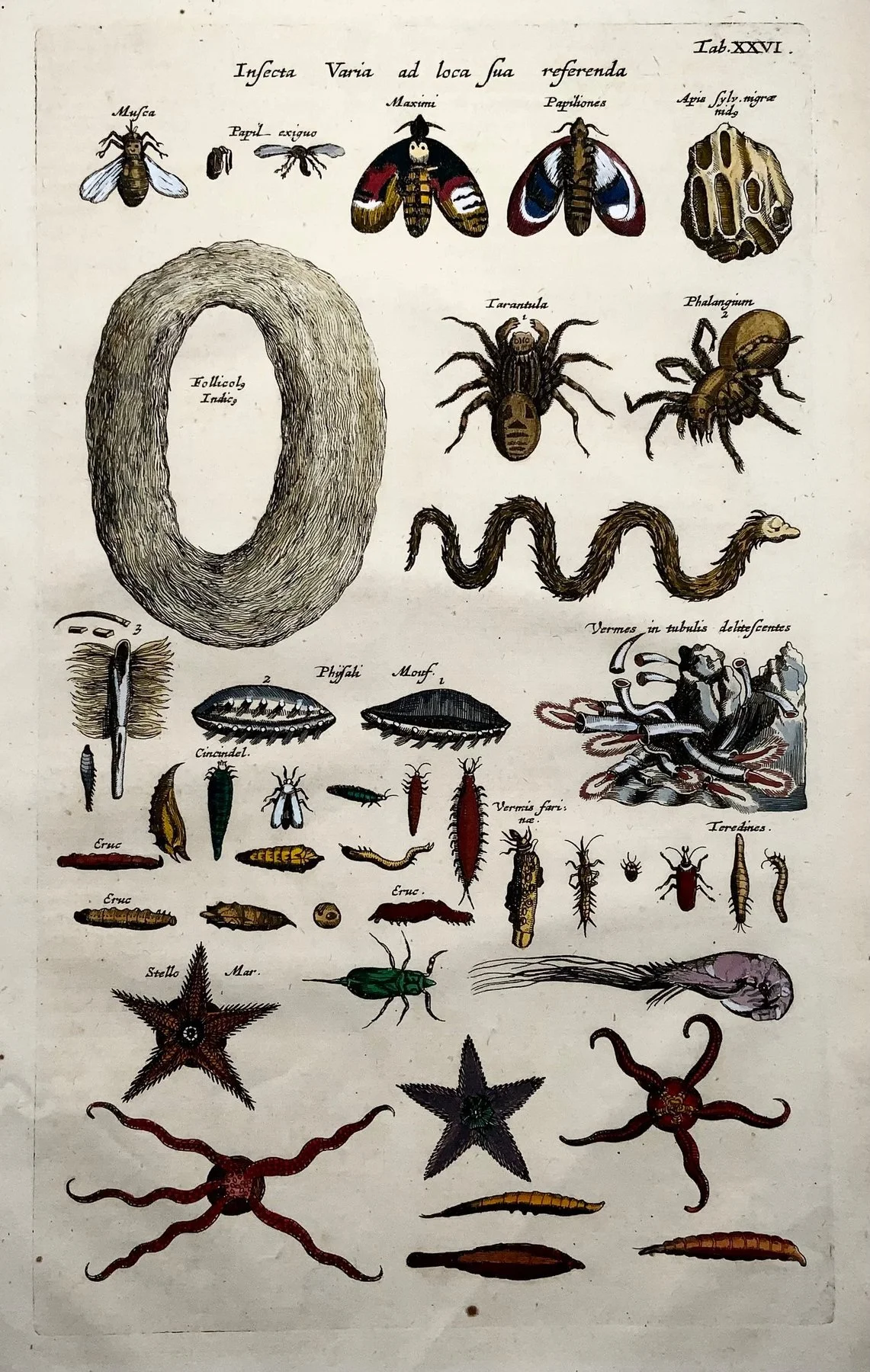 Image 2 of 5
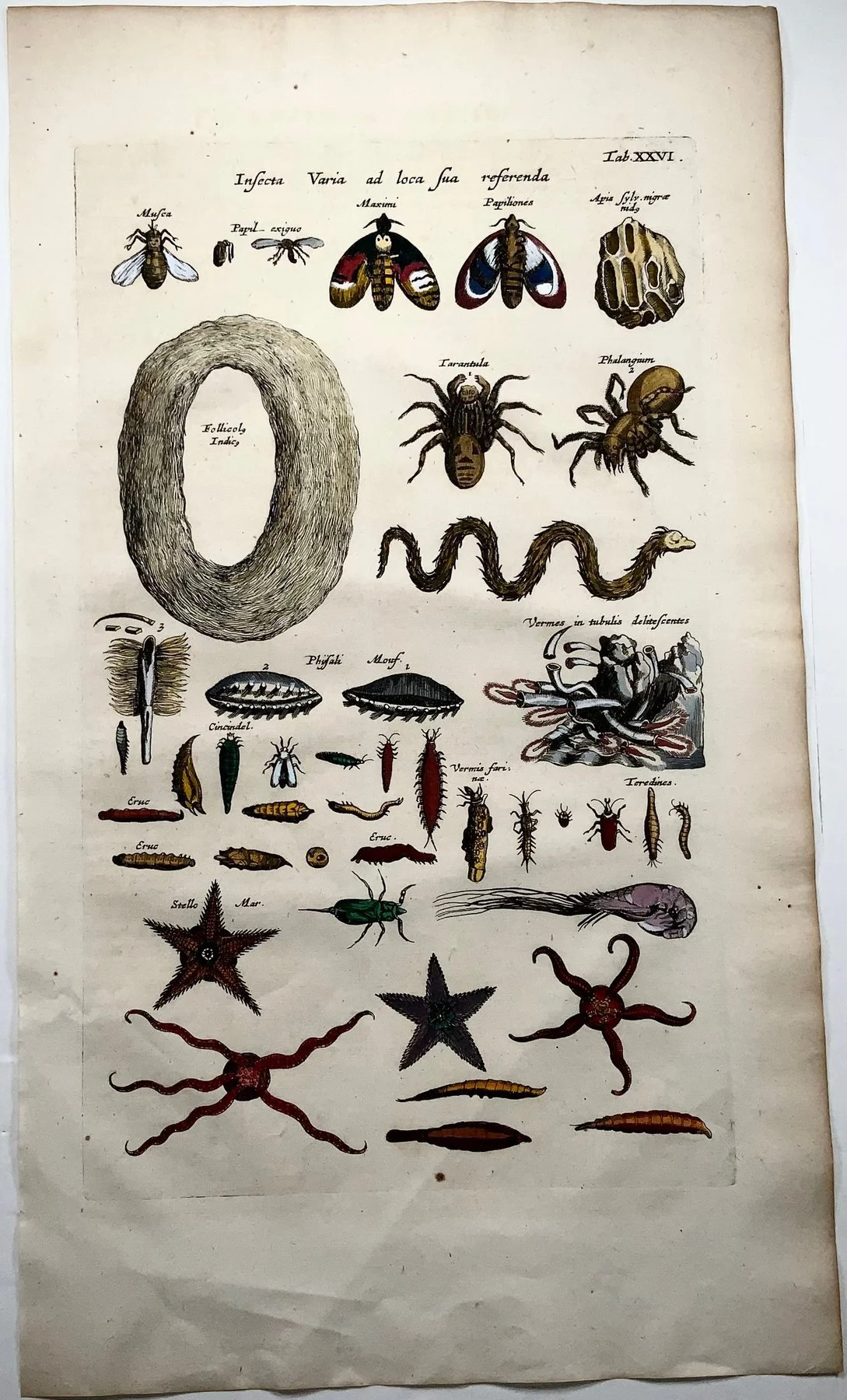 Image 3 of 5
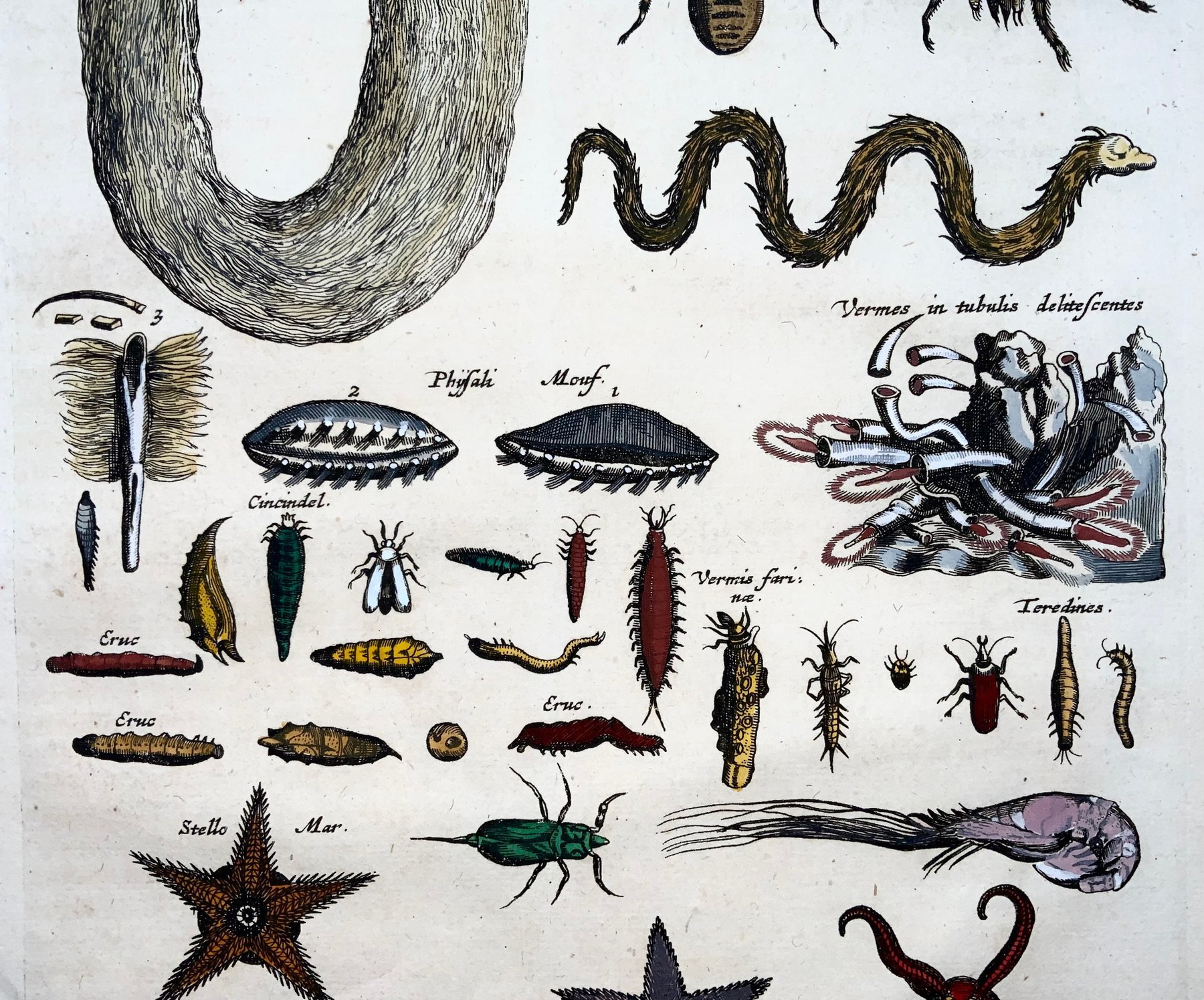 Image 4 of 5
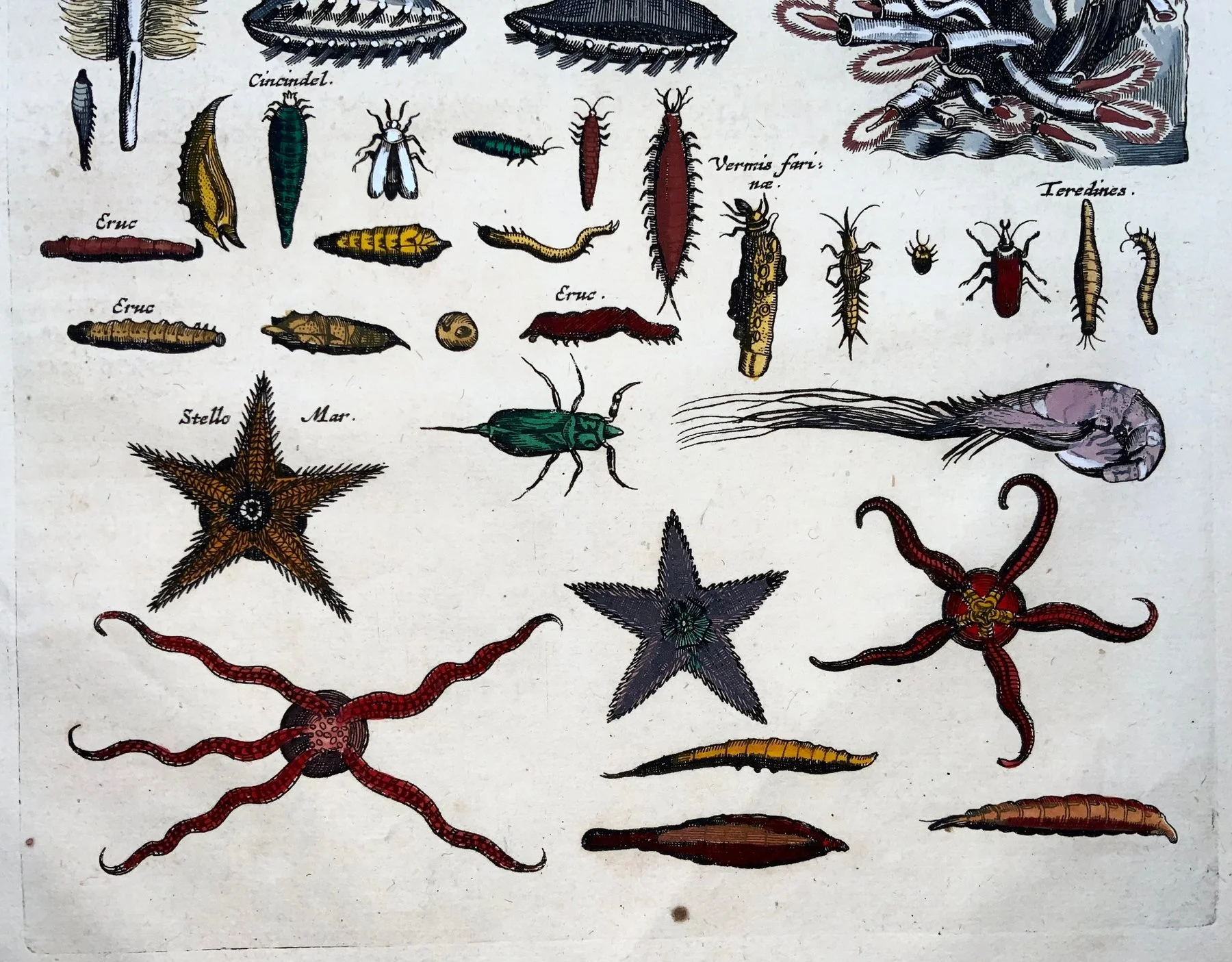 Image 5 of 5
From Historia Naturalis
Matthäus Merian the Elder
Amsterdam, 1657
Issued in Historia Naturalis by Jon Jonston
Copperplate engraving on folio leaf
Later hand coloring
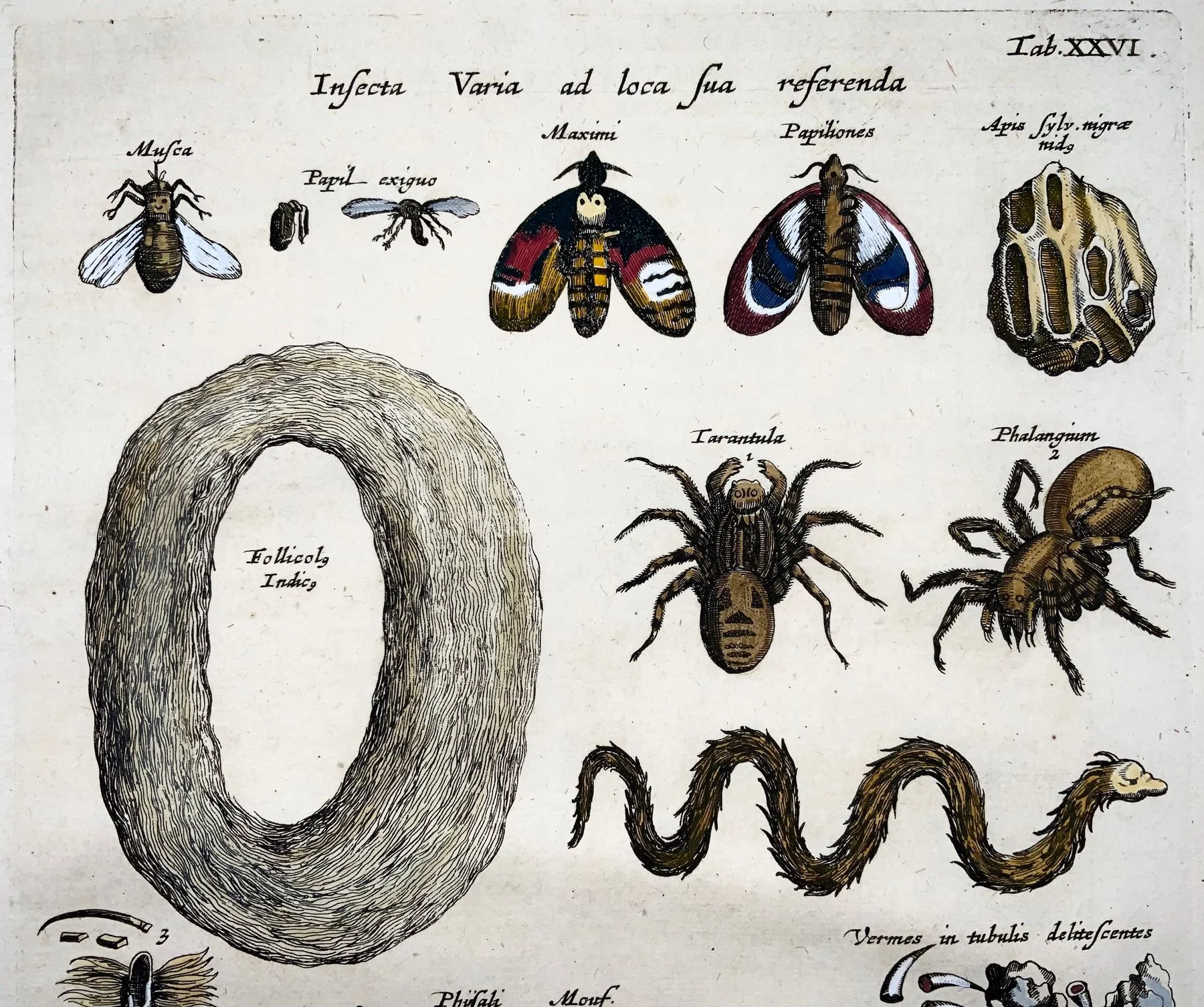
This striking folio engraving depicts a wide array of insects and echinoderms, including a tarantula, butterflies, flies, spiders, marine worms, shipworms, and sea stars. Issued in 1657 as part of Jon Jonston’s Historia Naturalis, the plate exemplifies the early modern effort to impose order on a natural world that was still only partially understood.
The composition brings together terrestrial and marine life on a single sheet, reflecting seventeenth century scientific thinking before the development of modern taxonomy. Creatures we now separate into distinct biological categories were then grouped according to appearance, habitat, or perceived affinity. The inclusion of both tarantula and starfish underscores this transitional moment in the history of science, when observation coexisted with inherited classification systems.
The engraving was executed by Matthäus Merian the Elder, one of the most accomplished copperplate engravers of the seventeenth century. Trained across Basel, Zurich, Strasbourg, Nancy, and Paris, Merian brought exceptional precision and compositional balance to scientific illustration. His engravings for Historia Naturalis are admired for their clarity, legibility, and visual authority.
The plate has been hand colored, enhancing contrast between species and giving each figure a distinct presence. As with all hand-colored examples, the application of pigment is unique, shaped by the individual colorist. The survival of color after more than three and a half centuries speaks to the quality of both pigments and paper.
Prints such as this are central to understanding how early modern Europe conceptualized nature. They document a period when spiders, insects, and marine organisms shared a visual language, revealing the intellectual pathways that led toward modern zoology.
Very good overall condition for age. Please view images closely for details.
Medium: Copperplate engraving with hand coloring
Format: Folio leaf
Date: 1657
Dimensions: 15 × 8.66 inches (38.1 × 22 cm)
Subjects: Tarantula, Starfish, Insects, Marine Creatures
Status: Available
From Historia Naturalis
Matthäus Merian the Elder
Amsterdam, 1657
Issued in Historia Naturalis by Jon Jonston
Copperplate engraving on folio leaf
Later hand coloring
This striking folio engraving depicts a wide array of insects and echinoderms, including a tarantula, butterflies, flies, spiders, marine worms, shipworms, and sea stars. Issued in 1657 as part of Jon Jonston’s Historia Naturalis, the plate exemplifies the early modern effort to impose order on a natural world that was still only partially understood.
The composition brings together terrestrial and marine life on a single sheet, reflecting seventeenth century scientific thinking before the development of modern taxonomy. Creatures we now separate into distinct biological categories were then grouped according to appearance, habitat, or perceived affinity. The inclusion of both tarantula and starfish underscores this transitional moment in the history of science, when observation coexisted with inherited classification systems.
The engraving was executed by Matthäus Merian the Elder, one of the most accomplished copperplate engravers of the seventeenth century. Trained across Basel, Zurich, Strasbourg, Nancy, and Paris, Merian brought exceptional precision and compositional balance to scientific illustration. His engravings for Historia Naturalis are admired for their clarity, legibility, and visual authority.
The plate has been hand colored, enhancing contrast between species and giving each figure a distinct presence. As with all hand-colored examples, the application of pigment is unique, shaped by the individual colorist. The survival of color after more than three and a half centuries speaks to the quality of both pigments and paper.
Prints such as this are central to understanding how early modern Europe conceptualized nature. They document a period when spiders, insects, and marine organisms shared a visual language, revealing the intellectual pathways that led toward modern zoology.
Very good overall condition for age. Please view images closely for details.
Medium: Copperplate engraving with hand coloring
Format: Folio leaf
Date: 1657
Dimensions: 15 × 8.66 inches (38.1 × 22 cm)
Subjects: Tarantula, Starfish, Insects, Marine Creatures
Status: Available