Sea Bream, Wrasse, Lumpfish & Kramet Fish (Tab. XIII)
From Historia Naturalis de Piscibus et Cetis
Jan Jonston, engraved by Matthäus Merian the Elder Amsterdam: Jan Jansson, 1657
Hand-coloured engraving on folio leaf Engraving printed to recto
Description
This folio engraving, Tab. XIII from Jan Jonston's Historia Naturalis de Piscibus et Cetis, presents fourteen Mediterranean and northern European fish arranged in seven rows across a single large plate — one of the most densely populated ichthyological compositions in the entire work. Published in Amsterdam in 1657, the Historia Naturalis was the last great natural history encyclopaedia in the Renaissance tradition, and its fish volumes drew on the accumulated authority of Rondelet, Gesner, Aldrovandi, and Belon to produce what amounted to a final summation of pre-Linnaean European ichthyology.
The fourteen fish depicted span a remarkable range of form and colour. At the top, the hump-backed lumpsucker (Piscis Gibbosus / Hogger) and the rotund Lunipus Anglorum — the lumpfish of English waters — face each other in contrasting profiles of yellow-ochre and deep blue. Below them, two species of Scarus — the parrotfish of classical antiquity, prized by Roman gastronomes above all other sea fish — are rendered in silver-grey and olive-gold with deep red gill highlights. The middle rows are given over to a systematic survey of Turdus, the wrasse family, presented in six distinct species and colour forms: spotted, striped, blue, brown, and the iridescent Turdus Meer Pfaw — the sea peacock — whose scaled body glitters with applied colour. The lower rows introduce the Pavo or Meer Pfaw (peacock wrasse), and two species of Attagenus, including the Roter Kramet fisch — the red wrasse — whose warm ochre and rust tones close the plate with a flourish.
The engravings in Jonston's Historia Naturalis were produced under the direction of Matthäus Merian the Elder, the celebrated Swiss-born engraver and Frankfurt publisher whose copperplate technique brought a new level of precision and visual authority to natural history illustration. Each fish is rendered in profile with careful attention to scale texture, fin structure, and the characteristic eye — almost always shown as a vivid red iris — that gives the creatures of this plate their alert, watchful quality.
The sheet has been hand coloured throughout, with each of the fourteen fish individually coloured in a distinct palette: blues, greens, ochres, browns, reds, and silvers applied with close attention to species differentiation. The result is both a scientific survey and a work of considerable decorative richness.
Condition
Even age toning. Minor offsetting to verso. Condition commensurate with age. Please view all images carefully.
Details
Sea Bream, Wrasse, Lumpfish & Kramet Fish (Tab. XIII)
From Historia Naturalis de Piscibus et Cetis
Jan Jonston, engraved by Matthäus Merian the Elder Amsterdam: Jan Jansson, 1657
Hand-coloured engraving on folio leaf Engraving printed to recto
Description
This folio engraving, Tab. XIII from Jan Jonston's Historia Naturalis de Piscibus et Cetis, presents fourteen Mediterranean and northern European fish arranged in seven rows across a single large plate — one of the most densely populated ichthyological compositions in the entire work. Published in Amsterdam in 1657, the Historia Naturalis was the last great natural history encyclopaedia in the Renaissance tradition, and its fish volumes drew on the accumulated authority of Rondelet, Gesner, Aldrovandi, and Belon to produce what amounted to a final summation of pre-Linnaean European ichthyology.
The fourteen fish depicted span a remarkable range of form and colour. At the top, the hump-backed lumpsucker (Piscis Gibbosus / Hogger) and the rotund Lunipus Anglorum — the lumpfish of English waters — face each other in contrasting profiles of yellow-ochre and deep blue. Below them, two species of Scarus — the parrotfish of classical antiquity, prized by Roman gastronomes above all other sea fish — are rendered in silver-grey and olive-gold with deep red gill highlights. The middle rows are given over to a systematic survey of Turdus, the wrasse family, presented in six distinct species and colour forms: spotted, striped, blue, brown, and the iridescent Turdus Meer Pfaw — the sea peacock — whose scaled body glitters with applied colour. The lower rows introduce the Pavo or Meer Pfaw (peacock wrasse), and two species of Attagenus, including the Roter Kramet fisch — the red wrasse — whose warm ochre and rust tones close the plate with a flourish.
The engravings in Jonston's Historia Naturalis were produced under the direction of Matthäus Merian the Elder, the celebrated Swiss-born engraver and Frankfurt publisher whose copperplate technique brought a new level of precision and visual authority to natural history illustration. Each fish is rendered in profile with careful attention to scale texture, fin structure, and the characteristic eye — almost always shown as a vivid red iris — that gives the creatures of this plate their alert, watchful quality.
The sheet has been hand coloured throughout, with each of the fourteen fish individually coloured in a distinct palette: blues, greens, ochres, browns, reds, and silvers applied with close attention to species differentiation. The result is both a scientific survey and a work of considerable decorative richness.
Condition
Even age toning. Minor offsetting to verso. Condition commensurate with age. Please view all images carefully.
Details
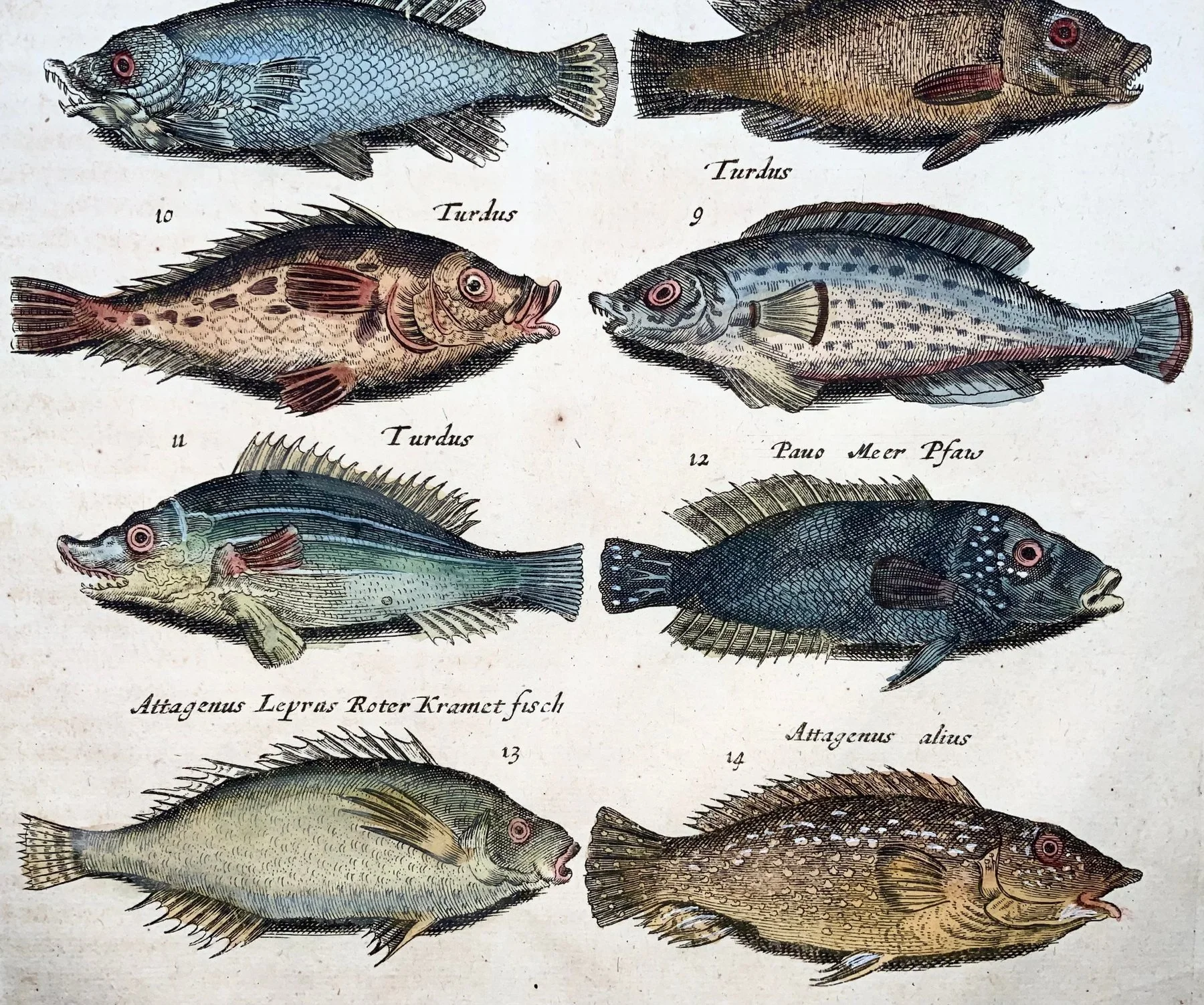 Image 1 of 6
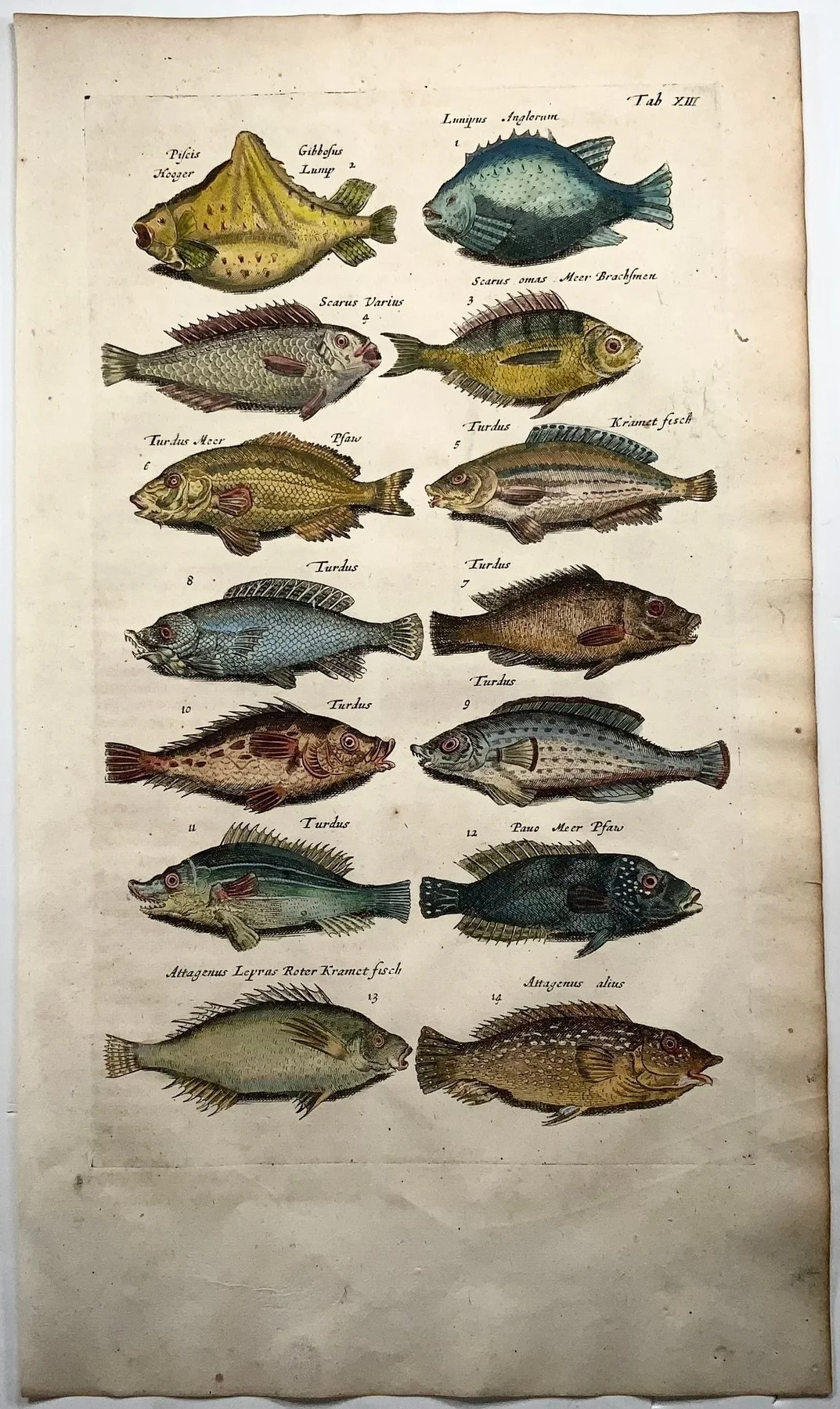 Image 2 of 6
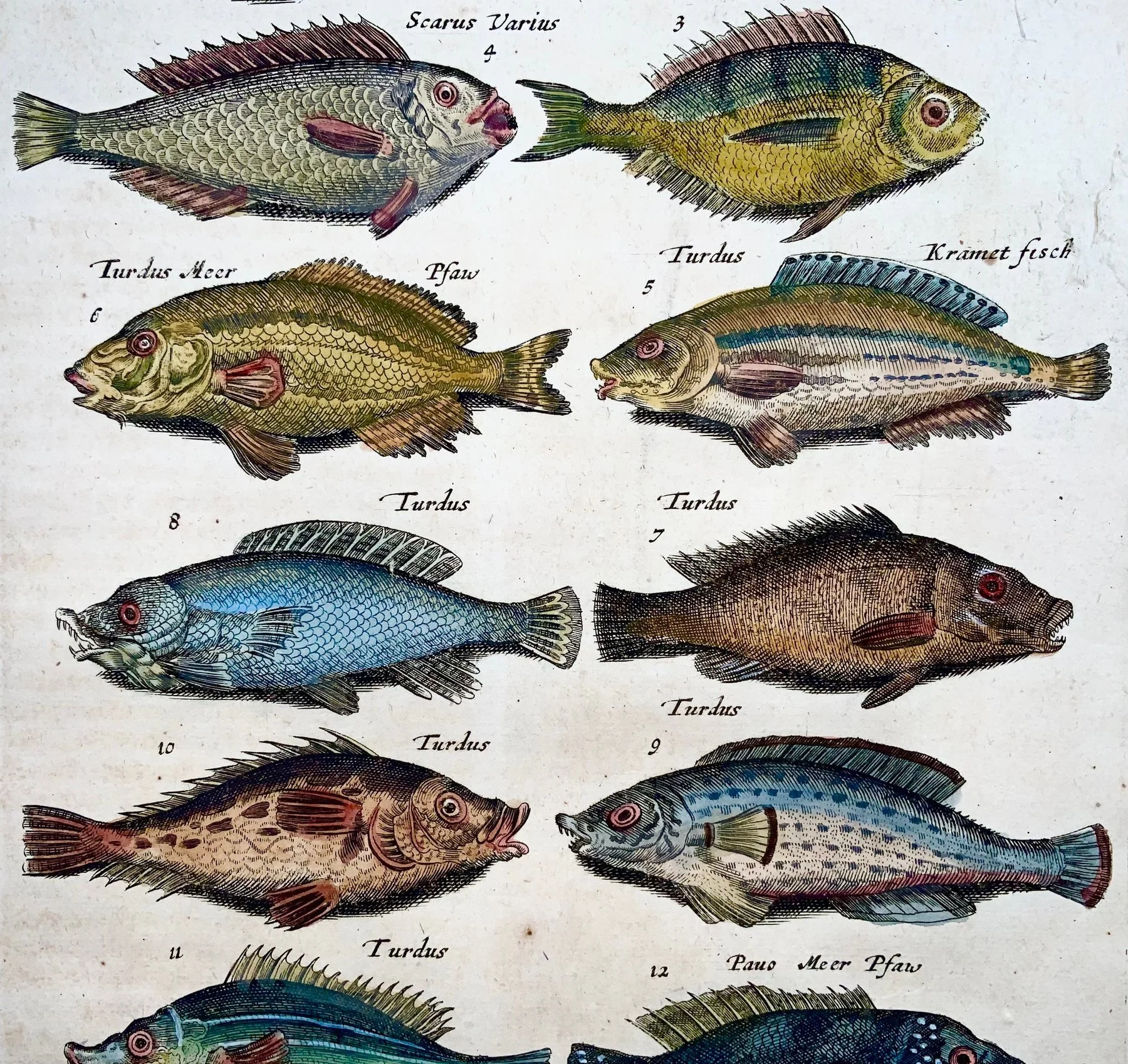 Image 3 of 6
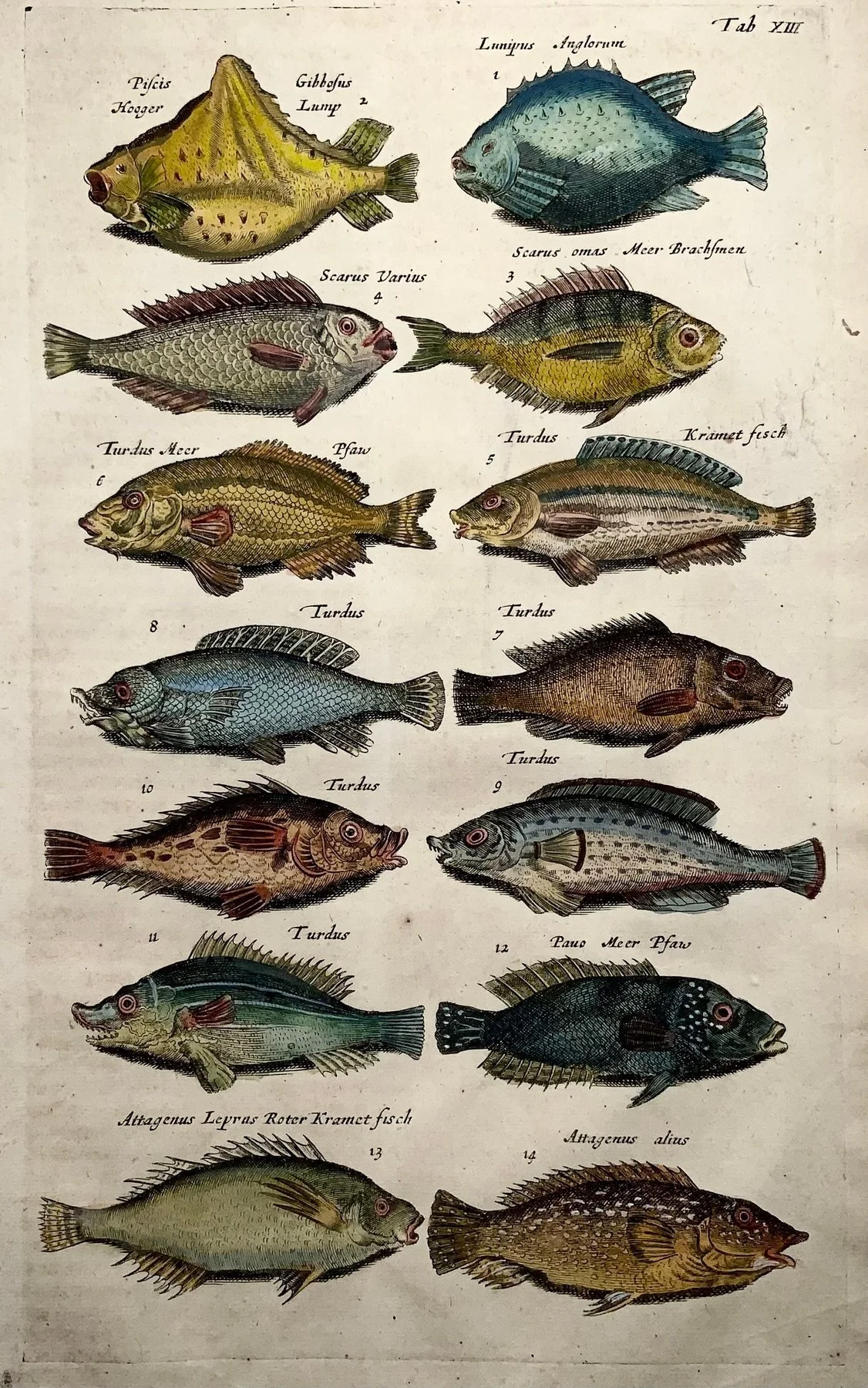 Image 4 of 6
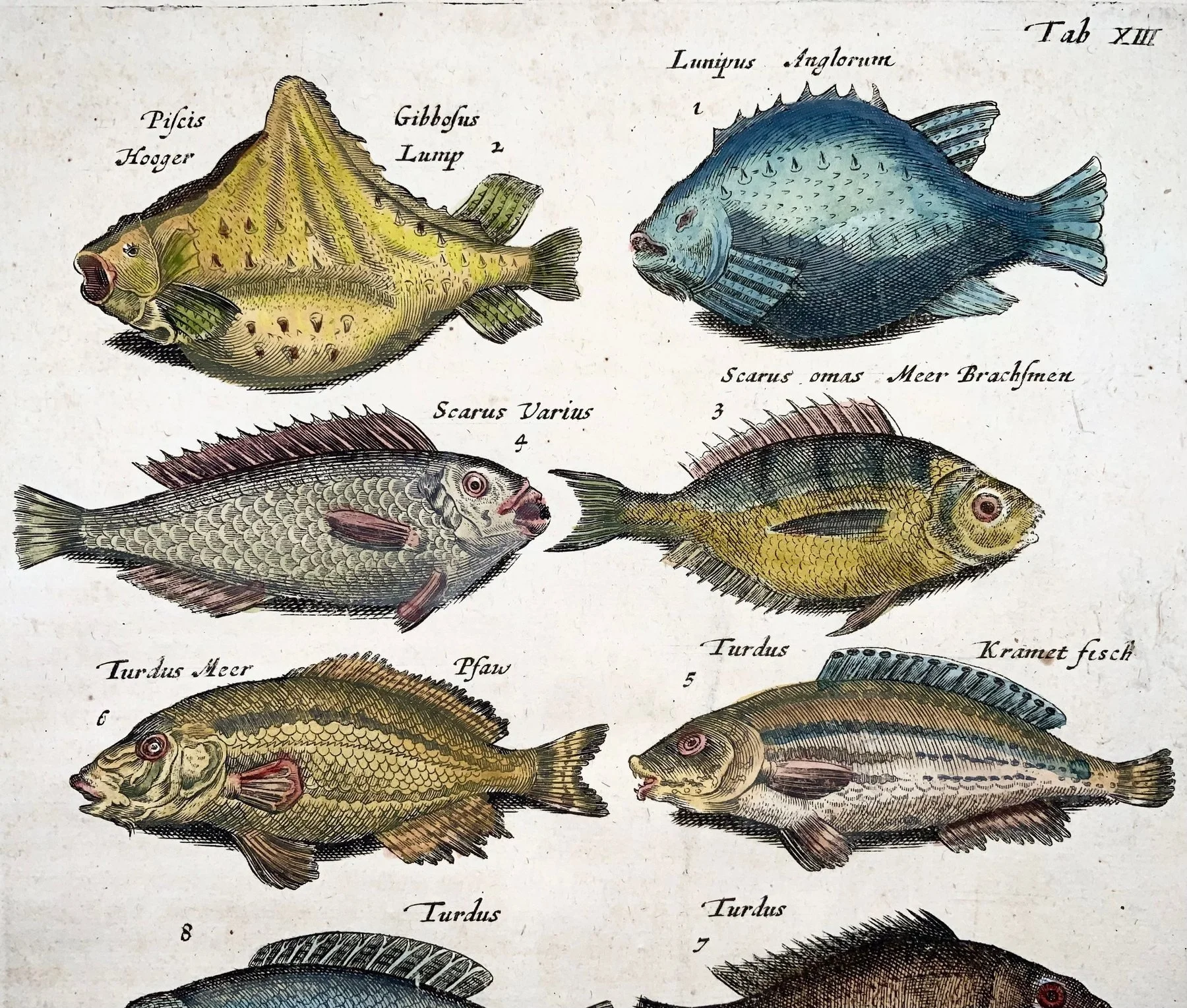 Image 5 of 6
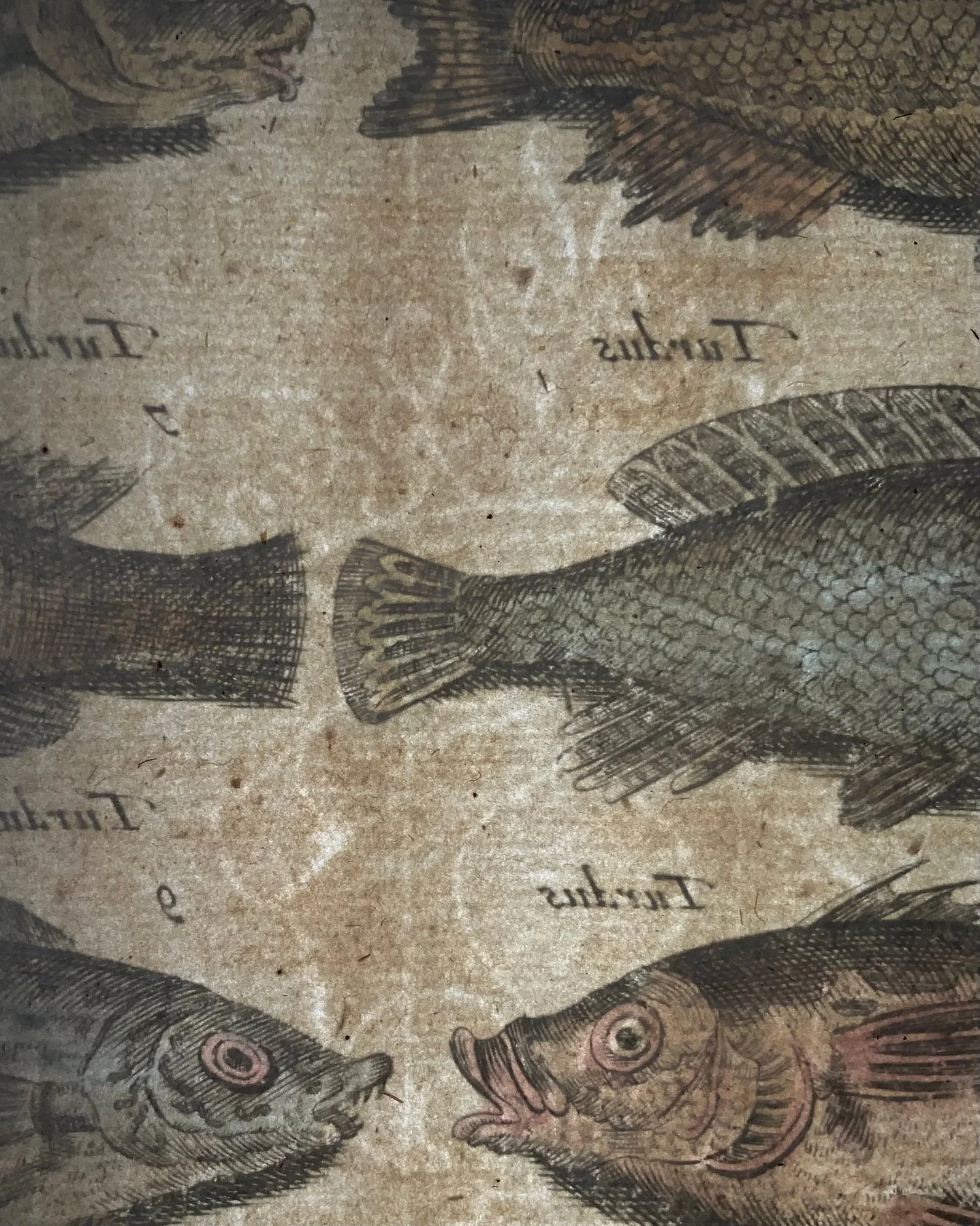 Image 6 of 6