Lizards, Skinks & Stellions (Tab. LXXVI)
From Historia Naturalis de Quadrupedibus
Jan Jonston, engraved by Matthäus Merian the Elder Amsterdam: Jan Jansson, 1657
Hand-coloured engraving on folio leaf Engraving printed to recto
Description
This folio engraving, Tab. LXXVI from Jan Jonston's Historia Naturalis, presents eleven lizards and skinks in a systematic survey that ranges from the common European lizard to the giant Cyprus skink — one of the most comprehensive herpetological plates in the entire work. Published in Amsterdam in 1657, the Historia Naturalis drew on the full breadth of Renaissance natural history scholarship to produce what amounted to a final inventory of the known animal world before the Linnaean revolution transformed the discipline.
The eleven creatures depicted span an extraordinary range of form and colour. At the top, a spectacular crested Lacerta rears in a three-quarter pose, its body rendered in deep blue-grey with white spotting — one of the most dynamically composed figures on the plate. Beside it, the Eydexen — the common lizard of Central Europe — is shown in warm brown, matter-of-fact and precisely observed. Below, the Lacerta Chalcidica flexnosa appears as a near-limbless copper skink, its serpentine body tapering to a fine point. The middle rows introduce the Bologna green lizard (Lacerta Viridis Liguro Bononiensibus), rendered in vivid olive green with a long whip tail, alongside the remarkable Lacertq Viridis Cauda bifurca — a teal-blue lizard with a dramatically forked tail — and the Lacertus Viridis exiccatus Cauda bifida, a dried specimen with split tail preserved for study. The lower section is given over to the stellions: the star-spotted Lacertae et Stelliones, its body a deep mauve scattered with silver star markings, and a second stellion with a chevron-patterned back. The plate closes with the Lacertus Cyprius Scincoides — the Cyprus skink — a large, robustly built creature in warm ochre and brown that anchors the composition with its scale and solidity.
The engravings were produced under the direction of Matthäus Merian the Elder, whose copperplate technique brought a new standard of precision to natural history illustration. Each creature is rendered in confident profile with careful attention to scale texture, limb articulation, and postural variety — no two lizards share the same pose, and the overall effect is of a living menagerie arranged for systematic study.
The sheet has been hand coloured throughout, with each of the eleven creatures individually coloured in a distinct palette: blues, greens, teals, mauves, ochres, and warm browns applied with close attention to species differentiation. The star markings of the stellions and the forked tail of the bifurca lizard are particularly well handled, and the coloring is well-preserved across the sheet.
Condition
Good overall condition for age. Please view all images carefully.
Details
Lizards, Skinks & Stellions (Tab. LXXVI)
From Historia Naturalis de Quadrupedibus
Jan Jonston, engraved by Matthäus Merian the Elder Amsterdam: Jan Jansson, 1657
Hand-coloured engraving on folio leaf Engraving printed to recto
Description
This folio engraving, Tab. LXXVI from Jan Jonston's Historia Naturalis, presents eleven lizards and skinks in a systematic survey that ranges from the common European lizard to the giant Cyprus skink — one of the most comprehensive herpetological plates in the entire work. Published in Amsterdam in 1657, the Historia Naturalis drew on the full breadth of Renaissance natural history scholarship to produce what amounted to a final inventory of the known animal world before the Linnaean revolution transformed the discipline.
The eleven creatures depicted span an extraordinary range of form and colour. At the top, a spectacular crested Lacerta rears in a three-quarter pose, its body rendered in deep blue-grey with white spotting — one of the most dynamically composed figures on the plate. Beside it, the Eydexen — the common lizard of Central Europe — is shown in warm brown, matter-of-fact and precisely observed. Below, the Lacerta Chalcidica flexnosa appears as a near-limbless copper skink, its serpentine body tapering to a fine point. The middle rows introduce the Bologna green lizard (Lacerta Viridis Liguro Bononiensibus), rendered in vivid olive green with a long whip tail, alongside the remarkable Lacertq Viridis Cauda bifurca — a teal-blue lizard with a dramatically forked tail — and the Lacertus Viridis exiccatus Cauda bifida, a dried specimen with split tail preserved for study. The lower section is given over to the stellions: the star-spotted Lacertae et Stelliones, its body a deep mauve scattered with silver star markings, and a second stellion with a chevron-patterned back. The plate closes with the Lacertus Cyprius Scincoides — the Cyprus skink — a large, robustly built creature in warm ochre and brown that anchors the composition with its scale and solidity.
The engravings were produced under the direction of Matthäus Merian the Elder, whose copperplate technique brought a new standard of precision to natural history illustration. Each creature is rendered in confident profile with careful attention to scale texture, limb articulation, and postural variety — no two lizards share the same pose, and the overall effect is of a living menagerie arranged for systematic study.
The sheet has been hand coloured throughout, with each of the eleven creatures individually coloured in a distinct palette: blues, greens, teals, mauves, ochres, and warm browns applied with close attention to species differentiation. The star markings of the stellions and the forked tail of the bifurca lizard are particularly well handled, and the coloring is well-preserved across the sheet.
Condition
Good overall condition for age. Please view all images carefully.
Details
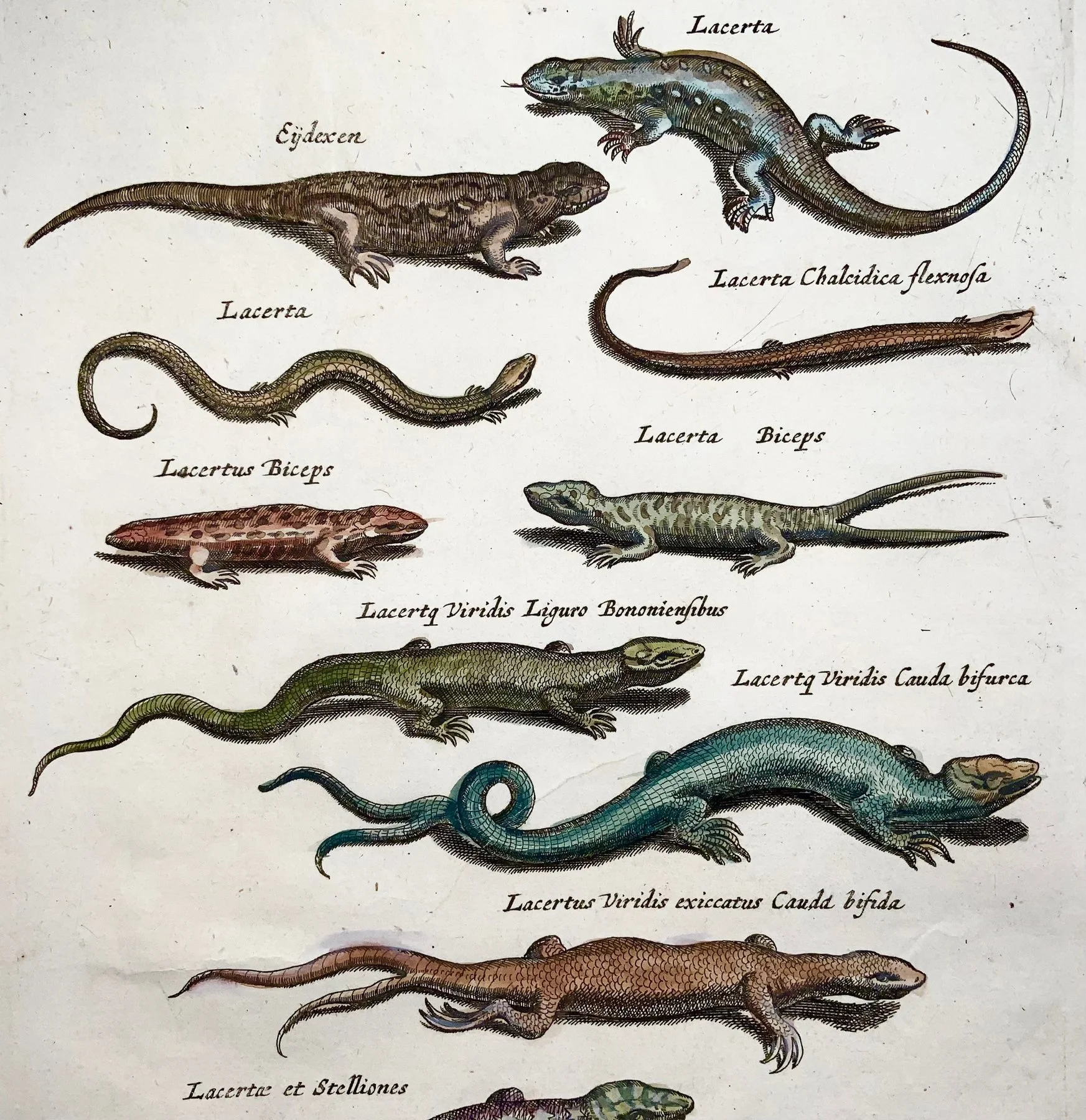 Image 1 of 6
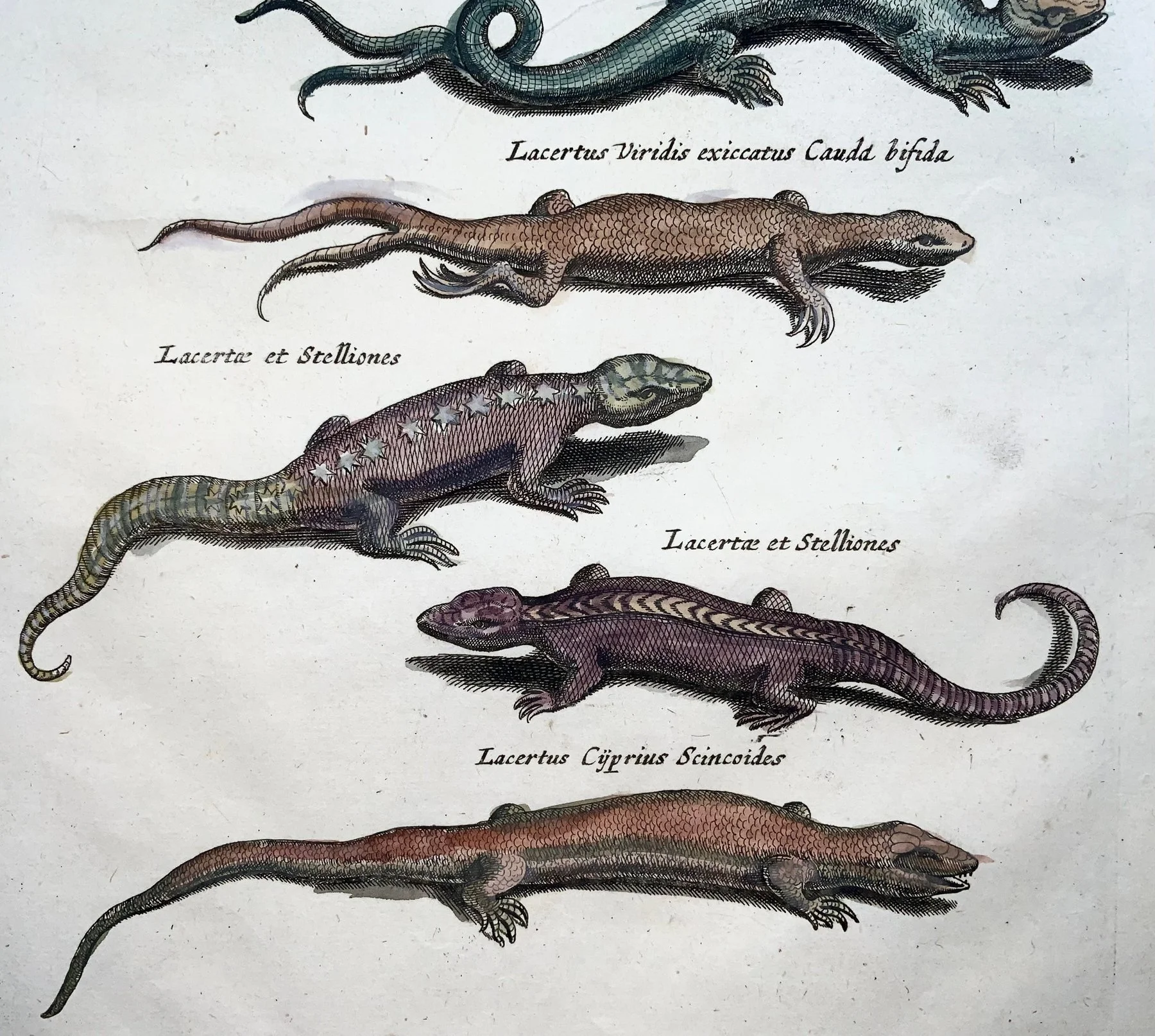 Image 2 of 6
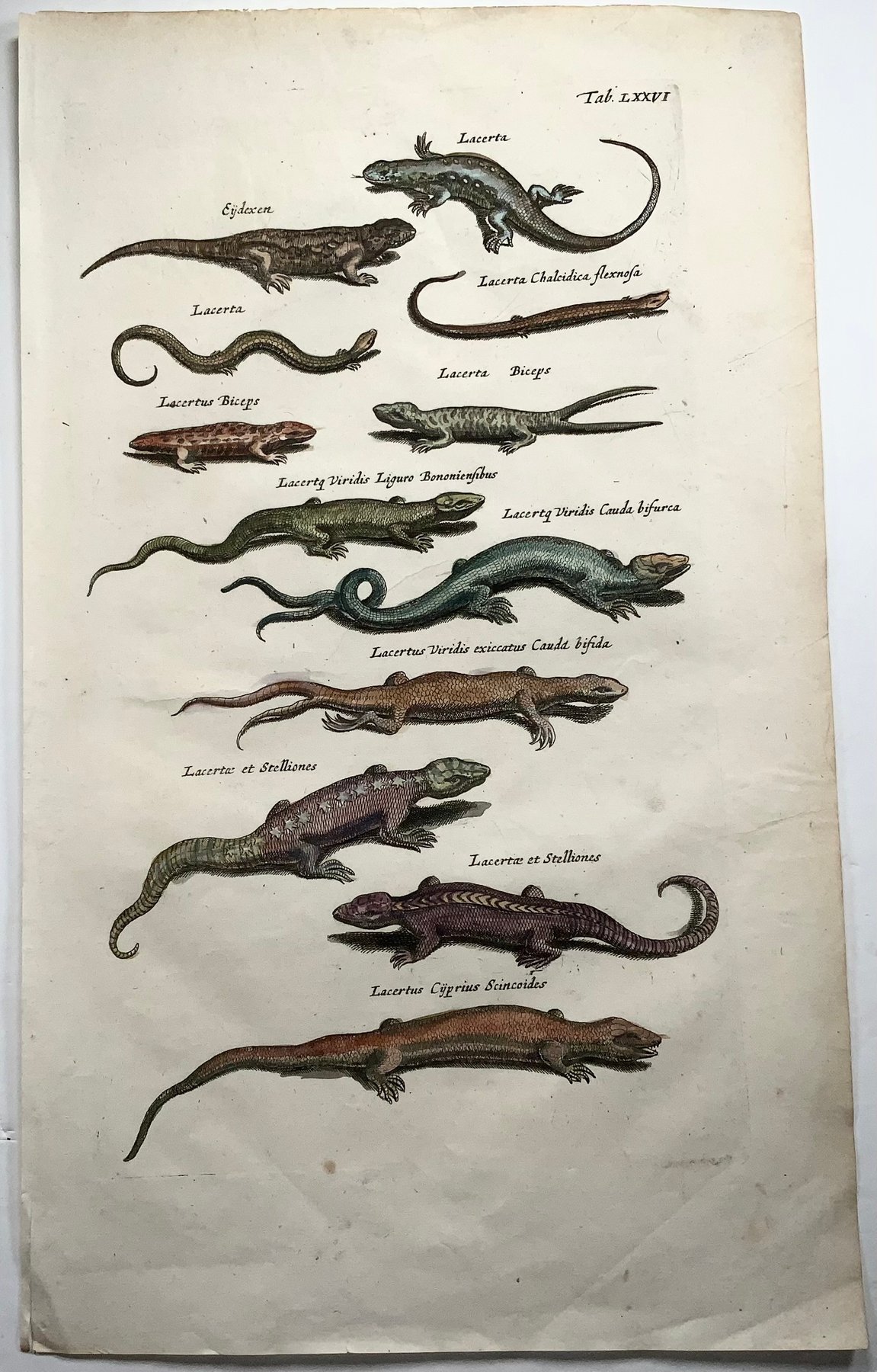 Image 3 of 6
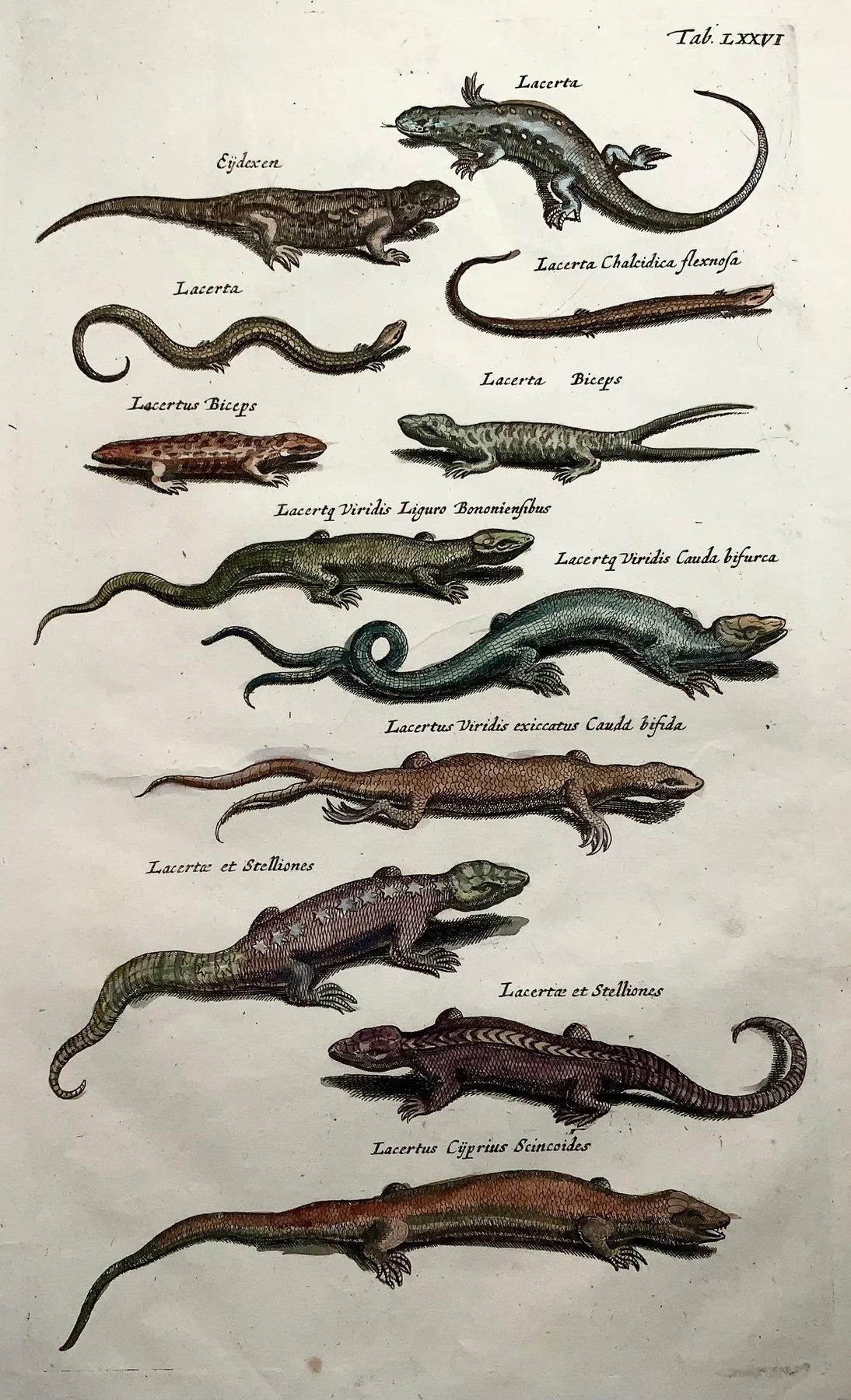 Image 4 of 6
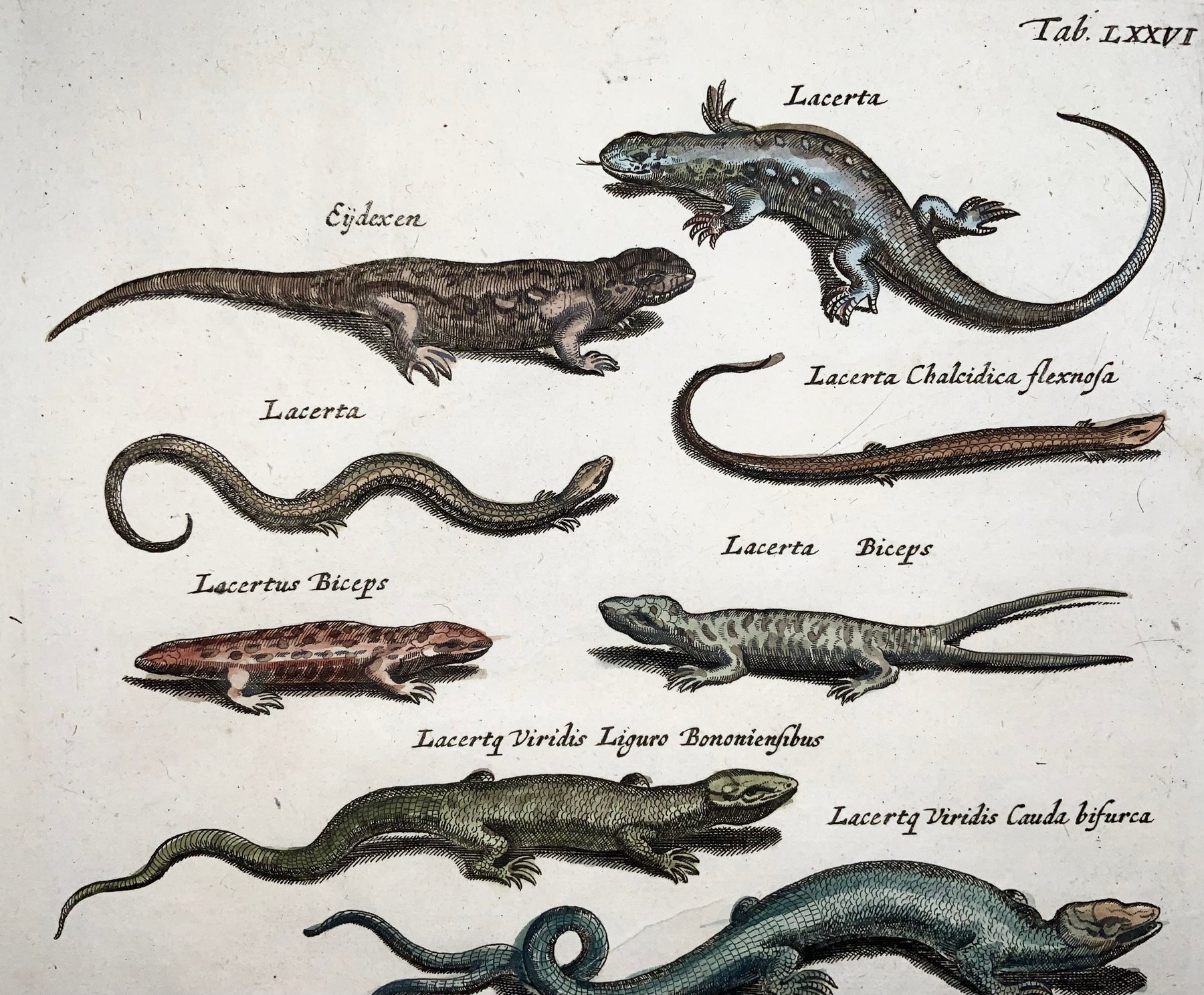 Image 5 of 6
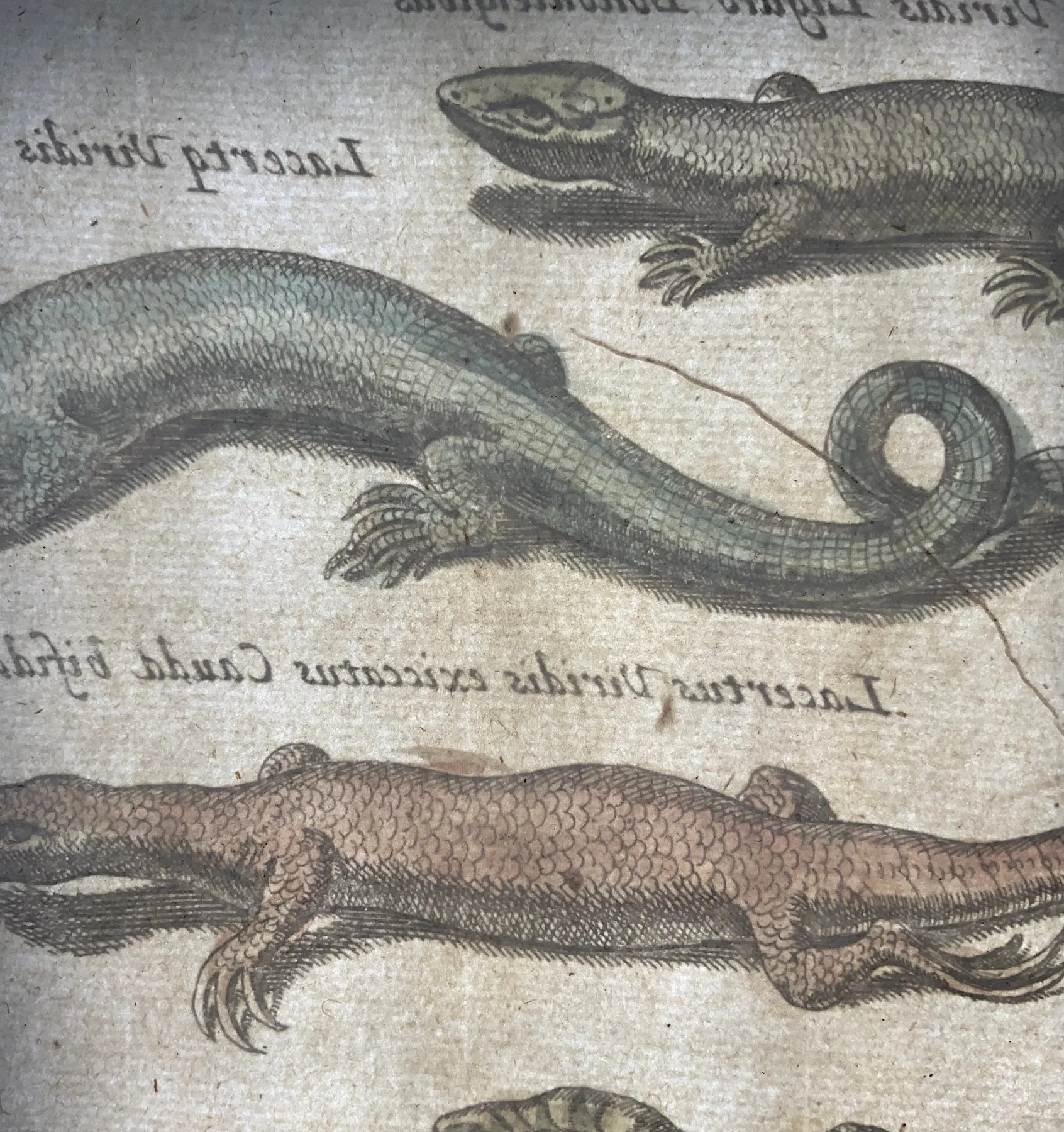 Image 6 of 6