Ravens and Crows
From Historia Naturalis de Avibus
Jan Jonston, engraved by Matthäus Merian the Elder Amsterdam: Jan Jansson, 1657
Hand-coloured engraving on folio leaf Engraving printed to recto
Description
This folio engraving depicting nine members of the corvid family — raven, hooded crow, jackdaw, chough, and related species — originates from Jan Jonston's Historia Naturalis de Avibus, one of the most lavishly illustrated natural history publications of the seventeenth century. Published in Amsterdam in 1657, the work brought together the accumulated ornithological knowledge of the Renaissance in a format designed for the libraries of serious collectors and scholars alike.
The plate is Tab. XVI and depicts the birds identified in the Latin and vernacular inscriptions as Corvus Rab (raven), Corvus Rap Rab, Cornix Krae (hooded crow), Graculus Tul Dole (jackdaw), Altray, Nebel Krae, Coriacias Arist, Pyrrhocorax Stein Rab (chough), Coraceus, and Pyrrhocorax alius. The Latin and German labels reflect the pre-Linnaean moment in which this work was produced — a period when classical nomenclature, vernacular names, and emerging empirical observation coexisted on the same page.
The engravings in Jonston's Historia Naturalis were produced under the direction of Matthäus Merian the Elder, the celebrated Swiss-born engraver and publisher who established his workshop in Frankfurt and became one of the most important figures in European illustrated publishing. Merian's copperplate technique — precise, controlled, and remarkably detailed in its rendering of feather texture and posture — elevated natural history illustration to a standard that would not be surpassed until Eleazar Albin and Mark Catesby introduced watercolour-based observation in the following century.
The sheet has been hand coloured, with the deep blacks of the corvid plumage offset by careful applications of grey, blue-black, and warm brown at the feet and bill. The coloring is restrained and period-appropriate, consistent with the hand-finishing practices of the Amsterdam trade in the mid-seventeenth century.
Corvids were among the most symbolically charged birds in early modern European culture — associated with prophecy, intelligence, and death, appearing in heraldry, folklore, and natural philosophy alike. A plate assembling nine members of the family in a single composition represents both a scientific survey and a cultural document.
Condition
Good overall condition for age. Please view all images carefully for full condition details.
Details
Ravens and Crows
From Historia Naturalis de Avibus
Jan Jonston, engraved by Matthäus Merian the Elder Amsterdam: Jan Jansson, 1657
Hand-coloured engraving on folio leaf Engraving printed to recto
Description
This folio engraving depicting nine members of the corvid family — raven, hooded crow, jackdaw, chough, and related species — originates from Jan Jonston's Historia Naturalis de Avibus, one of the most lavishly illustrated natural history publications of the seventeenth century. Published in Amsterdam in 1657, the work brought together the accumulated ornithological knowledge of the Renaissance in a format designed for the libraries of serious collectors and scholars alike.
The plate is Tab. XVI and depicts the birds identified in the Latin and vernacular inscriptions as Corvus Rab (raven), Corvus Rap Rab, Cornix Krae (hooded crow), Graculus Tul Dole (jackdaw), Altray, Nebel Krae, Coriacias Arist, Pyrrhocorax Stein Rab (chough), Coraceus, and Pyrrhocorax alius. The Latin and German labels reflect the pre-Linnaean moment in which this work was produced — a period when classical nomenclature, vernacular names, and emerging empirical observation coexisted on the same page.
The engravings in Jonston's Historia Naturalis were produced under the direction of Matthäus Merian the Elder, the celebrated Swiss-born engraver and publisher who established his workshop in Frankfurt and became one of the most important figures in European illustrated publishing. Merian's copperplate technique — precise, controlled, and remarkably detailed in its rendering of feather texture and posture — elevated natural history illustration to a standard that would not be surpassed until Eleazar Albin and Mark Catesby introduced watercolour-based observation in the following century.
The sheet has been hand coloured, with the deep blacks of the corvid plumage offset by careful applications of grey, blue-black, and warm brown at the feet and bill. The coloring is restrained and period-appropriate, consistent with the hand-finishing practices of the Amsterdam trade in the mid-seventeenth century.
Corvids were among the most symbolically charged birds in early modern European culture — associated with prophecy, intelligence, and death, appearing in heraldry, folklore, and natural philosophy alike. A plate assembling nine members of the family in a single composition represents both a scientific survey and a cultural document.
Condition
Good overall condition for age. Please view all images carefully for full condition details.
Details
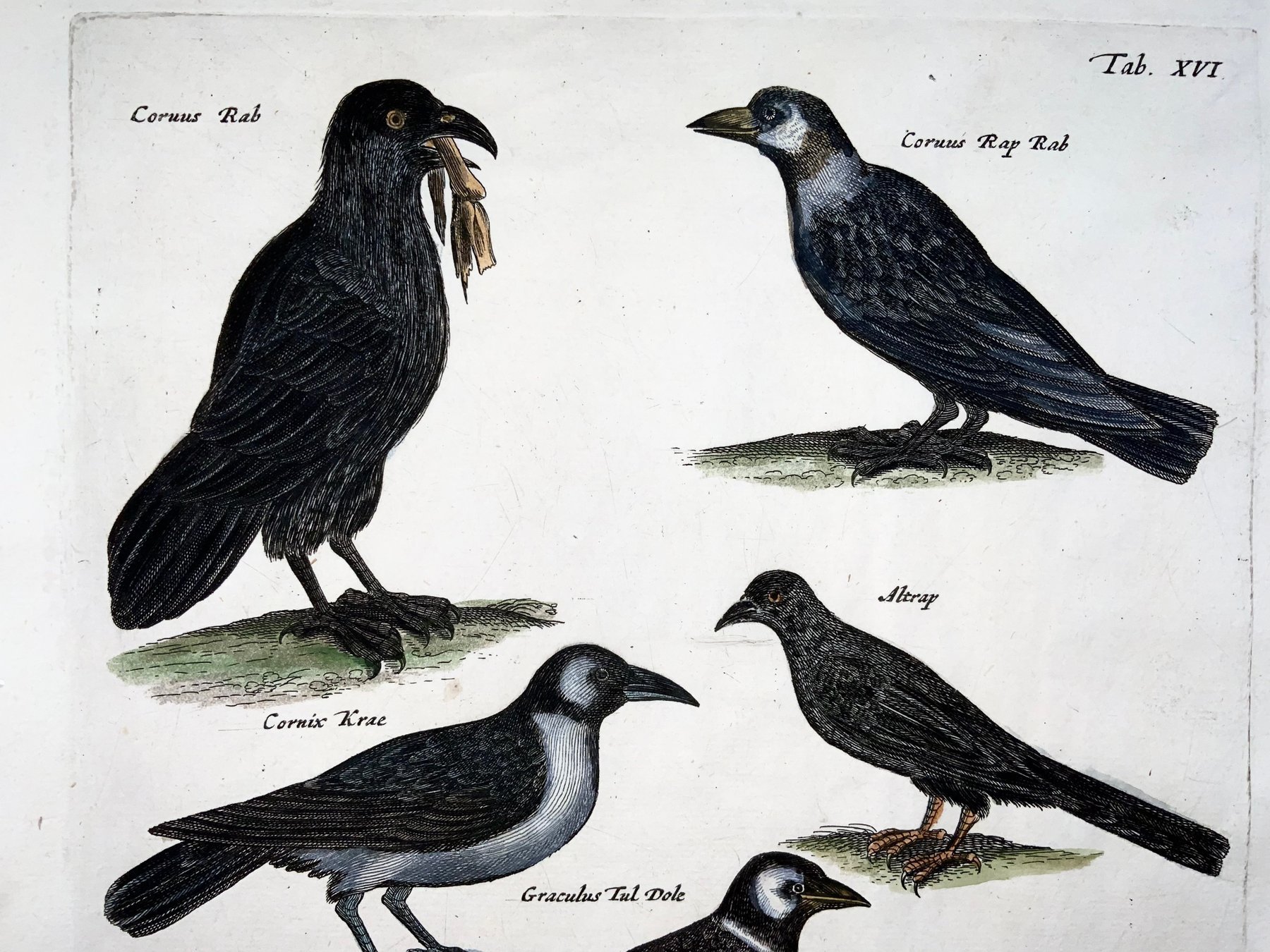 Image 1 of 7
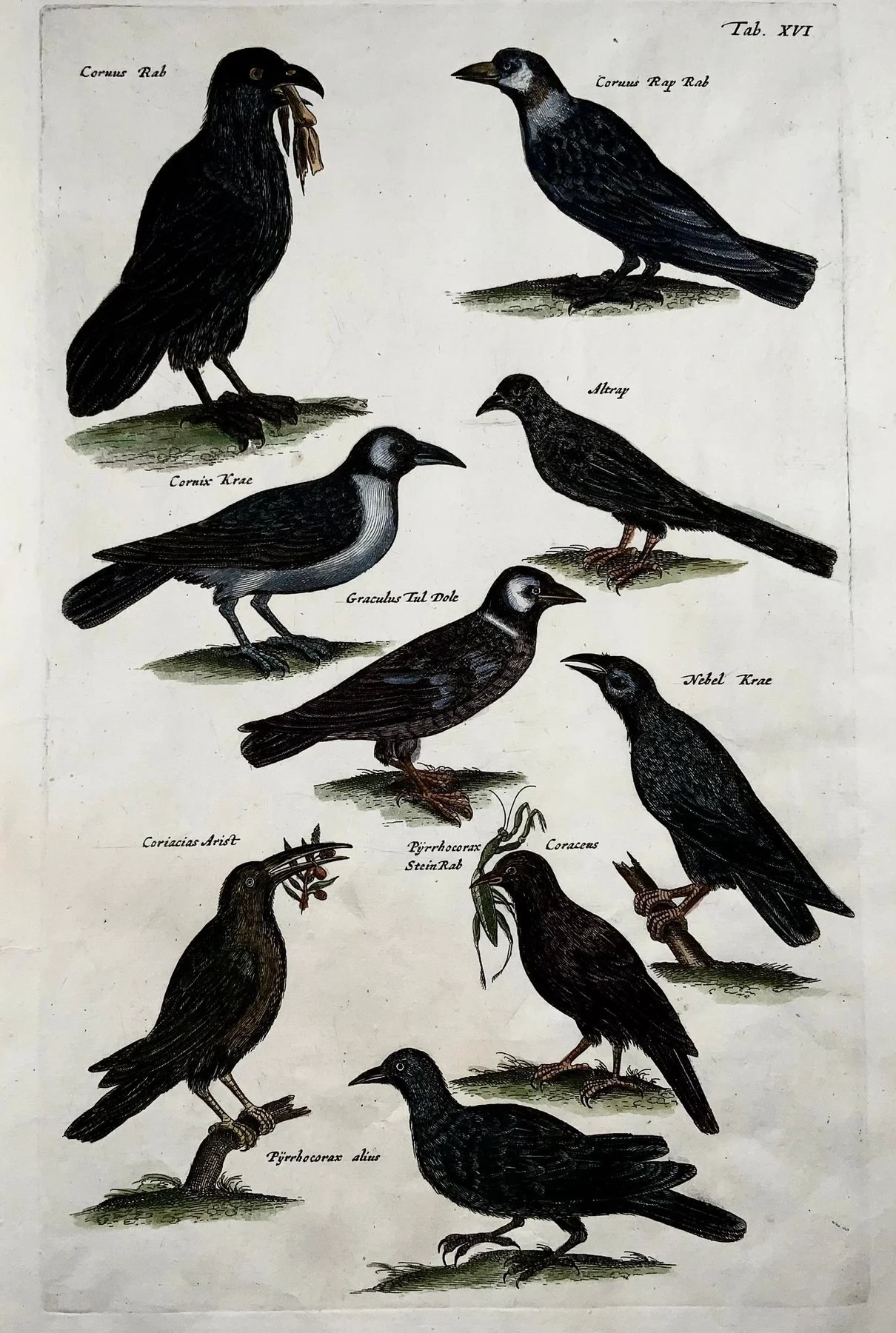 Image 2 of 7
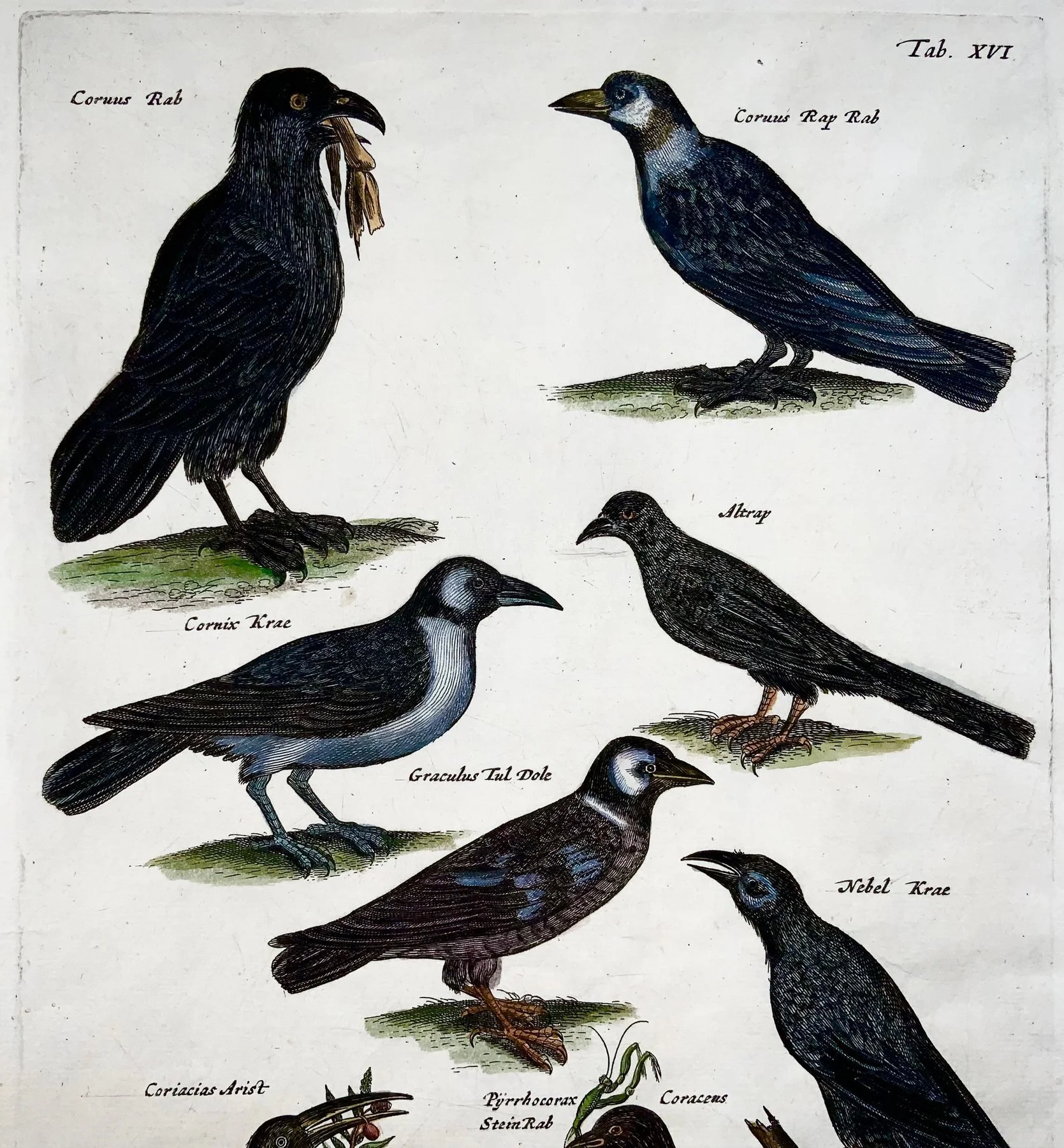 Image 3 of 7
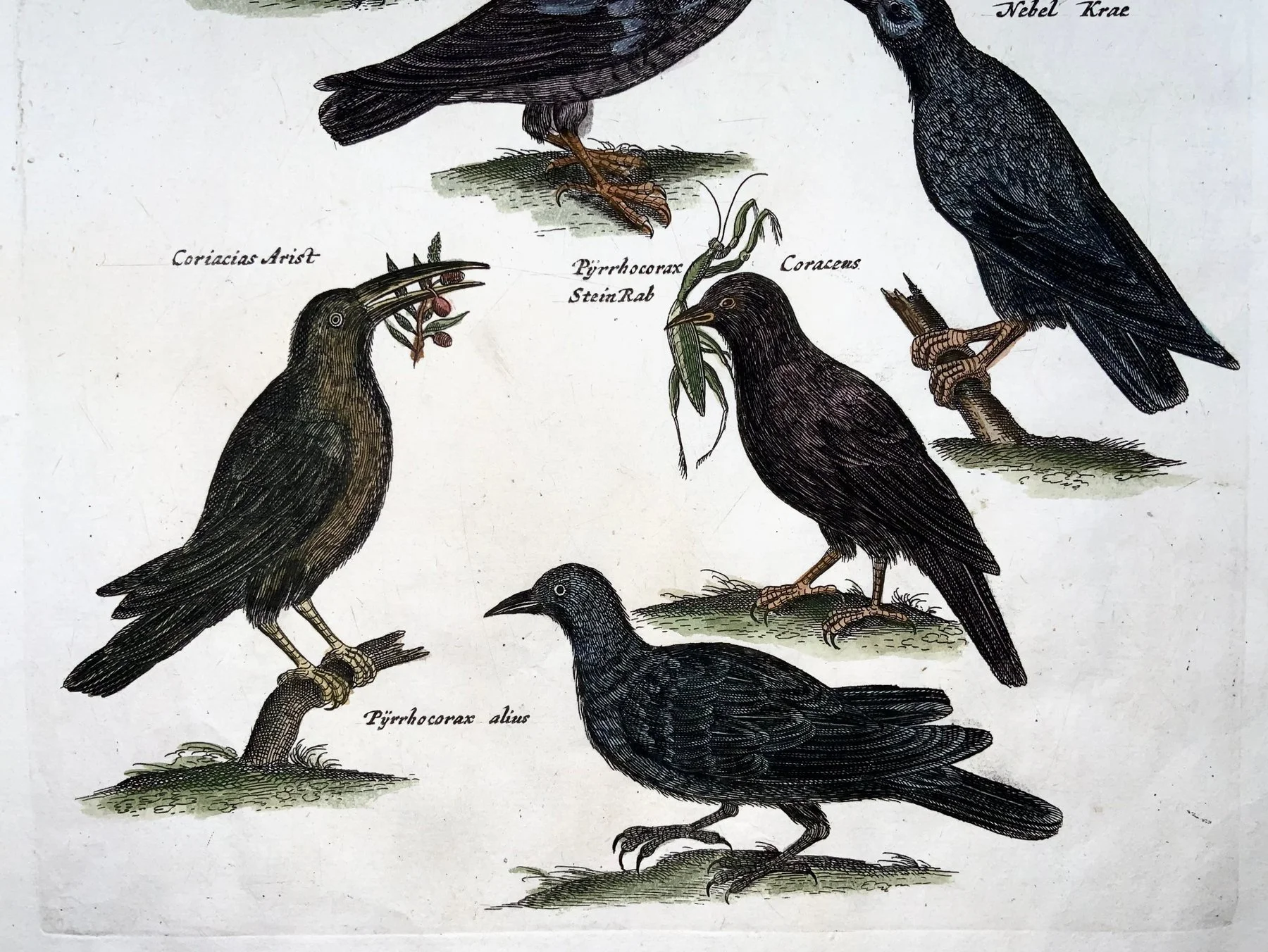 Image 4 of 7
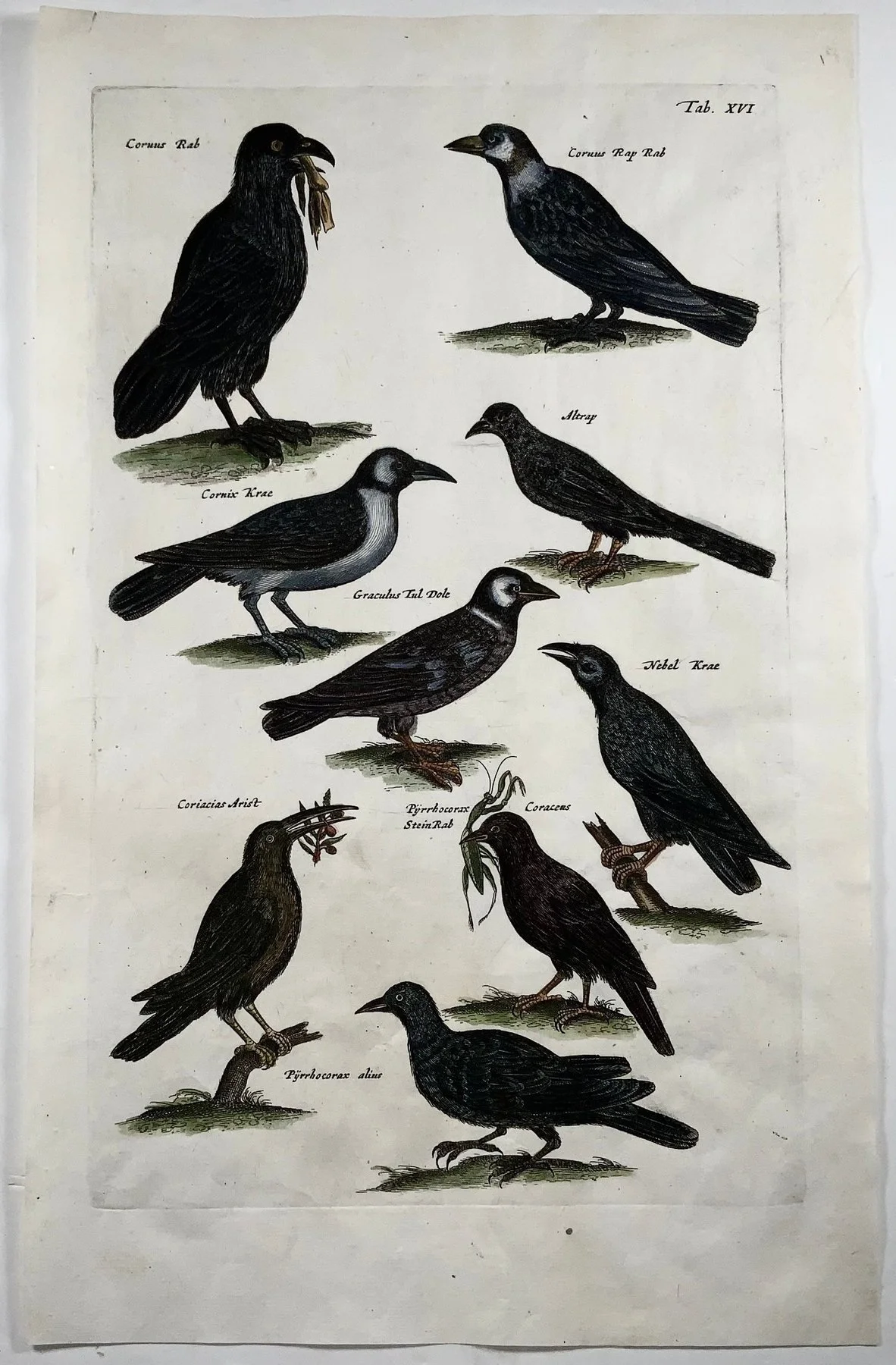 Image 5 of 7
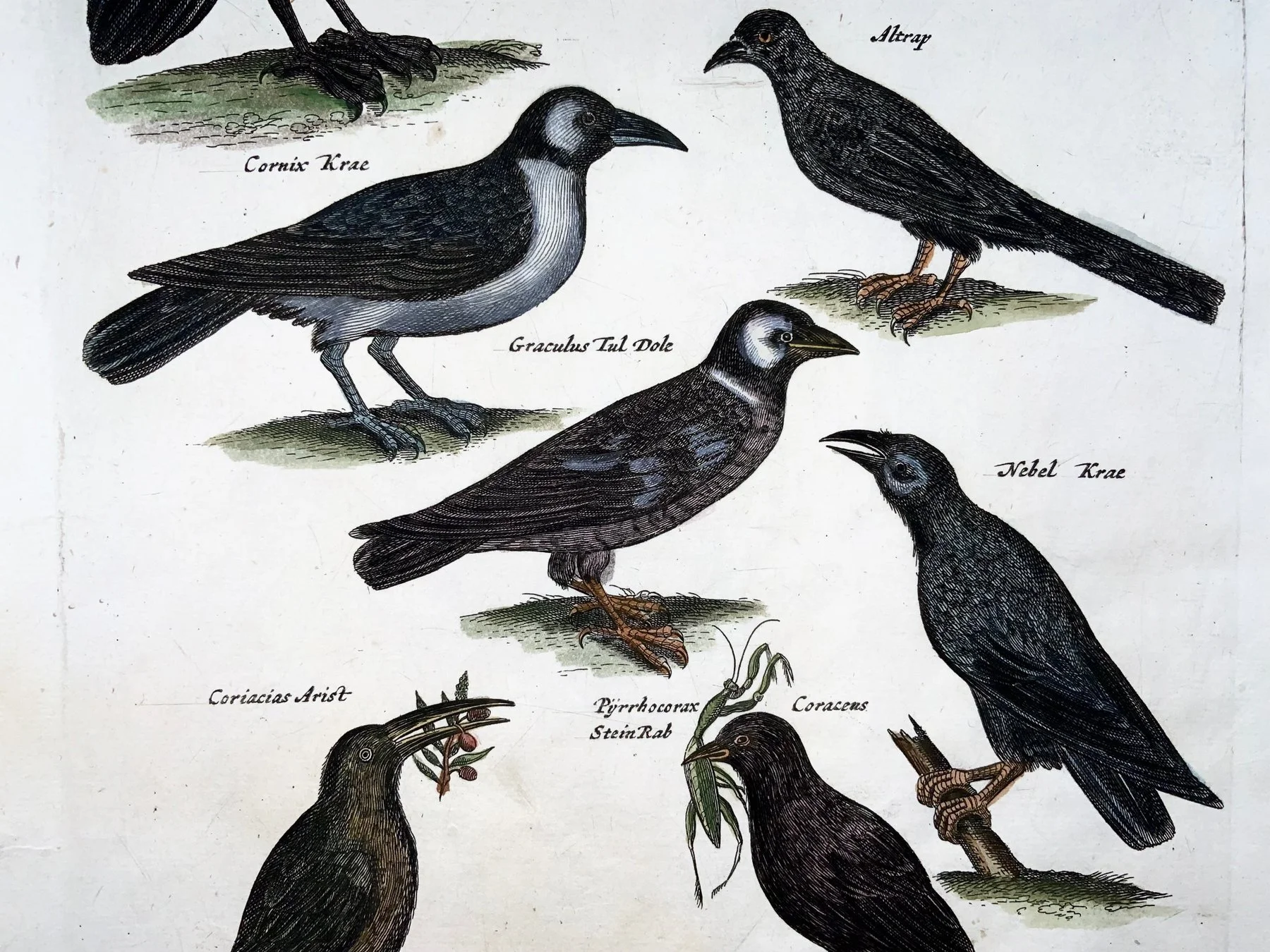 Image 6 of 7
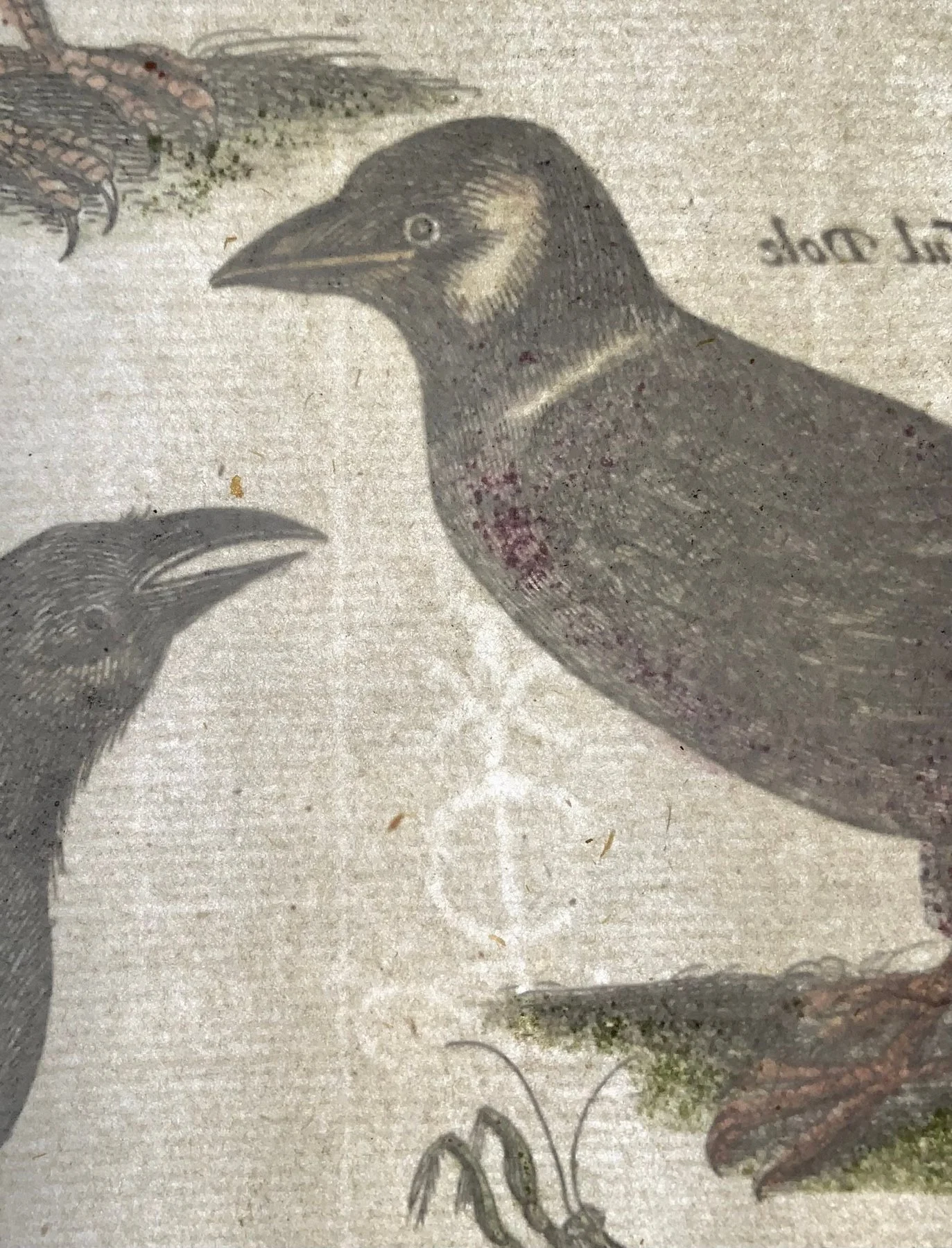 Image 7 of 7