Shrikes, Buzzard, Cuckoo & Hawks (Tab. XI)
From Historia Naturalis de Avibus
Jan Jonston, engraved by Matthäus Merian the Elder Amsterdam: Jan Jansson, 1657
Hand-coloured engraving on folio leaf Engraving printed to recto
Description
This folio engraving, Tab. XI from Jan Jonston's Historia Naturalis de Avibus, presents eight birds across five rows in a composition that ranges from the small but formidable shrikes at the top to the stooping kite and perched hawks at the bottom — a survey of European raptors and their allies that combines scientific rigour with genuine drama.
The plate opens with two shrikes, each standing over a freshly killed mouse — a naturalistic detail that immediately communicates something essential about these small but predatory birds. The Lanius Collorio (red-backed shrike) is shown in crisp profile with its distinctive crimson cap, grey flank, and black-and-white tail, its prey rendered with almost clinical precision beneath its feet. Beside it, the Lanius alius Warckengel (great grey shrike) repeats the composition in a darker, more barred plumage, both birds displaying the butcher-bird habit of prey display that made them objects of fascination for Renaissance naturalists.
The middle rows introduce larger birds. The Lanius Miluus — a large kite-like shrike with a deep red cap — perches on a branch in imperious profile, its forked tail and broad wing rendering unmistakable. Beside it, facing right, the Cuculus Guggauch / Kuk Kuck — the common cuckoo — is one of the most striking figures on the plate: a large, imposing bird with a rich crimson breast and barred underparts, shown in the characteristic lateral profile that makes the cuckoo instantly recognisable even at distance. Below, the Buteo Triorches / Bushart Busant — the honey buzzard — is perched open-beaked, its pale cream breast and barred tail rendered in warm browns and cream whites, the beak slightly agape in a posture of alertness. Flanking it, the great cuckoo again commands the right side of the composition with its full-bodied presence.
The lower rows present three smaller raptors: the spotted Accipiter maior (goshawk) on a log, the Miluus Weye (red kite) caught in a stooping pose with wings spread and talons extended — the most dynamically composed figure on the plate — and the compact Accipiter minor (sparrowhawk) perched upright, its pale spotted breast catching the light.
The sheet has been hand coloured throughout, with each bird individually coloured: the crimson caps of the shrikes and kite-shrike, the barred purple-grey of the great grey shrike, the rich crimson breast of the cuckoo, the warm brown and cream of the buzzard, and the blue-grey highlights of the hawks wings all applied with careful attention to species differentiation and preserved in excellent condition.
Condition
Good overall condition for age. Please view all images carefully.
Details
Shrikes, Buzzard, Cuckoo & Hawks (Tab. XI)
From Historia Naturalis de Avibus
Jan Jonston, engraved by Matthäus Merian the Elder Amsterdam: Jan Jansson, 1657
Hand-coloured engraving on folio leaf Engraving printed to recto
Description
This folio engraving, Tab. XI from Jan Jonston's Historia Naturalis de Avibus, presents eight birds across five rows in a composition that ranges from the small but formidable shrikes at the top to the stooping kite and perched hawks at the bottom — a survey of European raptors and their allies that combines scientific rigour with genuine drama.
The plate opens with two shrikes, each standing over a freshly killed mouse — a naturalistic detail that immediately communicates something essential about these small but predatory birds. The Lanius Collorio (red-backed shrike) is shown in crisp profile with its distinctive crimson cap, grey flank, and black-and-white tail, its prey rendered with almost clinical precision beneath its feet. Beside it, the Lanius alius Warckengel (great grey shrike) repeats the composition in a darker, more barred plumage, both birds displaying the butcher-bird habit of prey display that made them objects of fascination for Renaissance naturalists.
The middle rows introduce larger birds. The Lanius Miluus — a large kite-like shrike with a deep red cap — perches on a branch in imperious profile, its forked tail and broad wing rendering unmistakable. Beside it, facing right, the Cuculus Guggauch / Kuk Kuck — the common cuckoo — is one of the most striking figures on the plate: a large, imposing bird with a rich crimson breast and barred underparts, shown in the characteristic lateral profile that makes the cuckoo instantly recognisable even at distance. Below, the Buteo Triorches / Bushart Busant — the honey buzzard — is perched open-beaked, its pale cream breast and barred tail rendered in warm browns and cream whites, the beak slightly agape in a posture of alertness. Flanking it, the great cuckoo again commands the right side of the composition with its full-bodied presence.
The lower rows present three smaller raptors: the spotted Accipiter maior (goshawk) on a log, the Miluus Weye (red kite) caught in a stooping pose with wings spread and talons extended — the most dynamically composed figure on the plate — and the compact Accipiter minor (sparrowhawk) perched upright, its pale spotted breast catching the light.
The sheet has been hand coloured throughout, with each bird individually coloured: the crimson caps of the shrikes and kite-shrike, the barred purple-grey of the great grey shrike, the rich crimson breast of the cuckoo, the warm brown and cream of the buzzard, and the blue-grey highlights of the hawks wings all applied with careful attention to species differentiation and preserved in excellent condition.
Condition
Good overall condition for age. Please view all images carefully.
Details
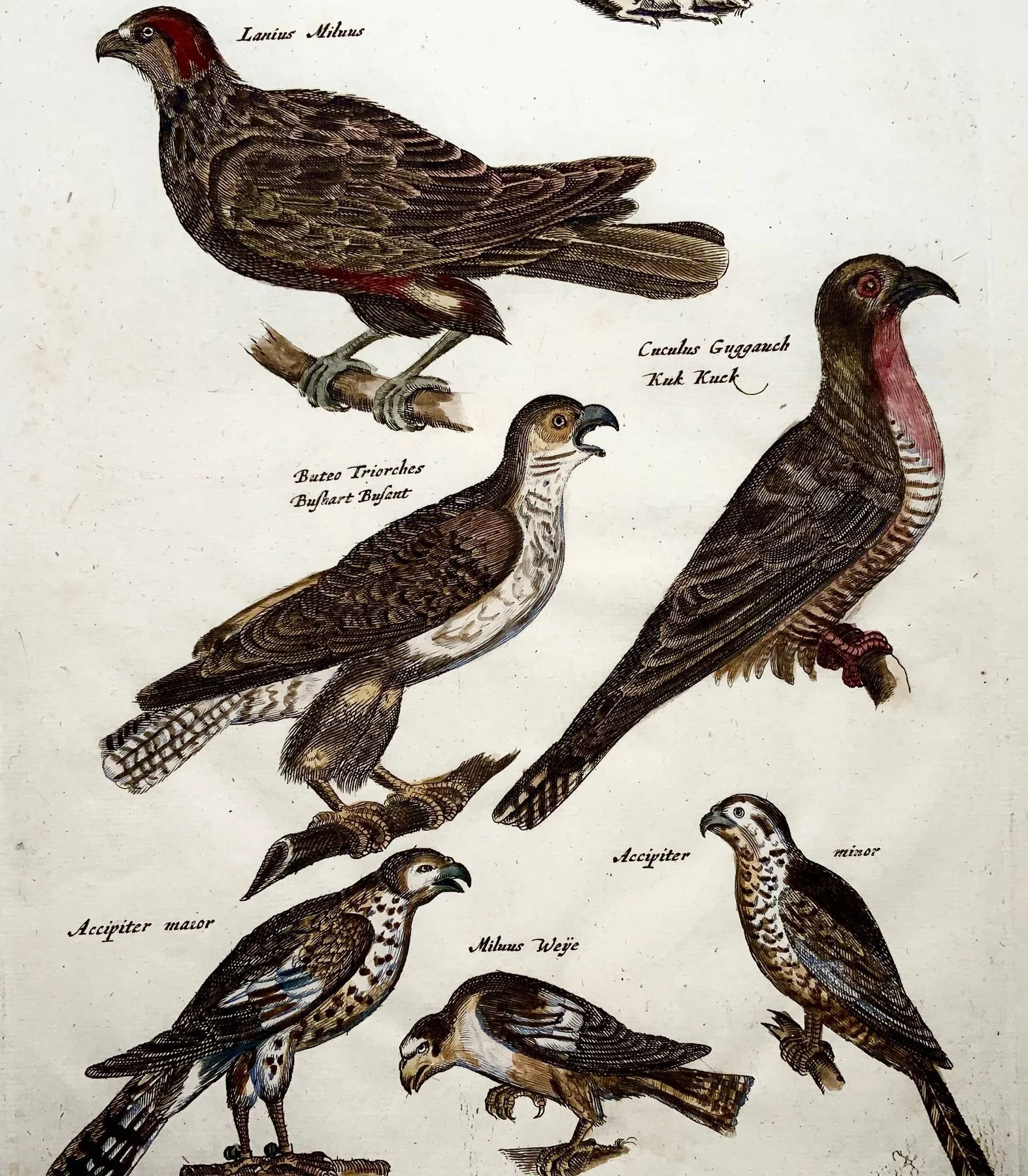 Image 1 of 6
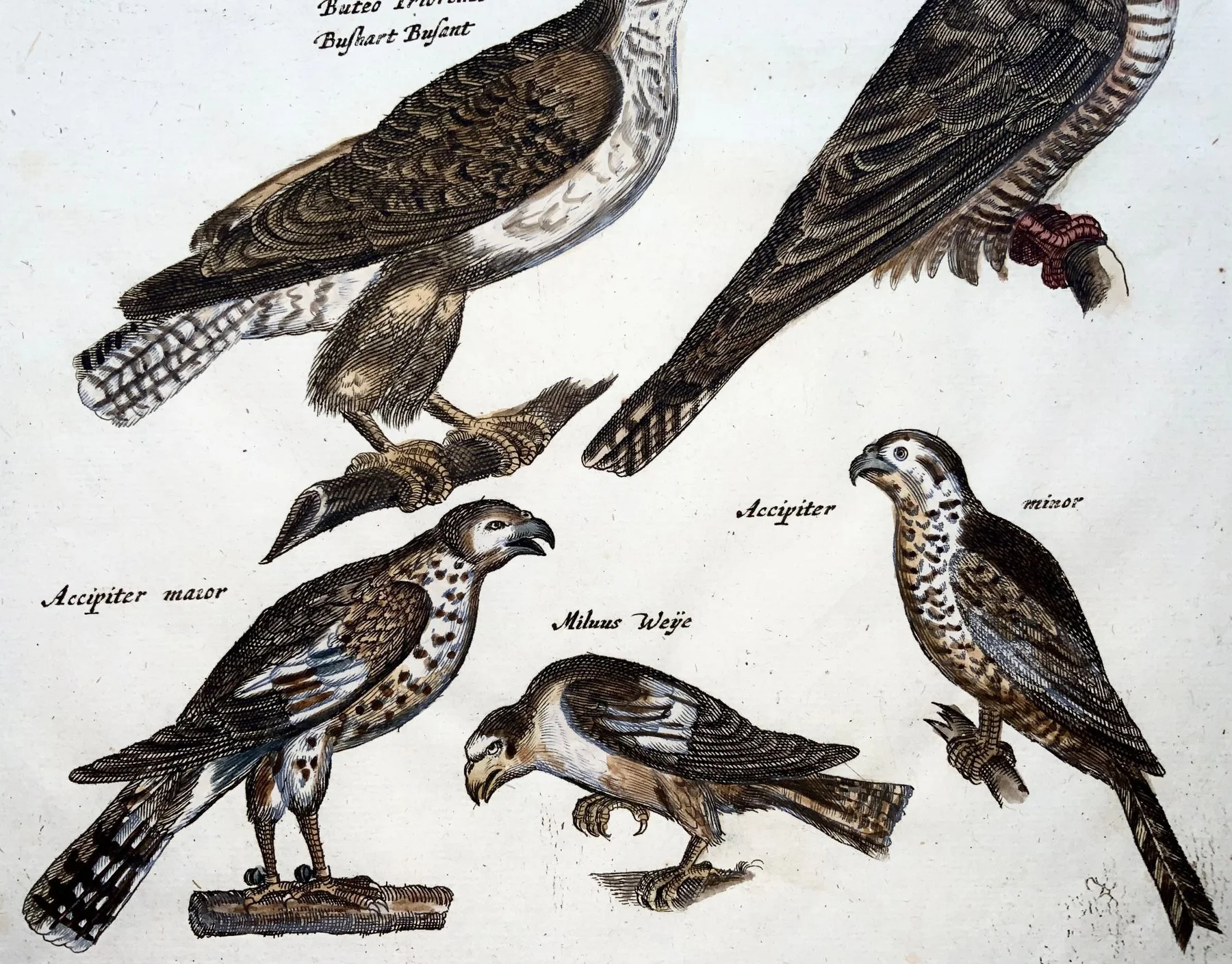 Image 2 of 6
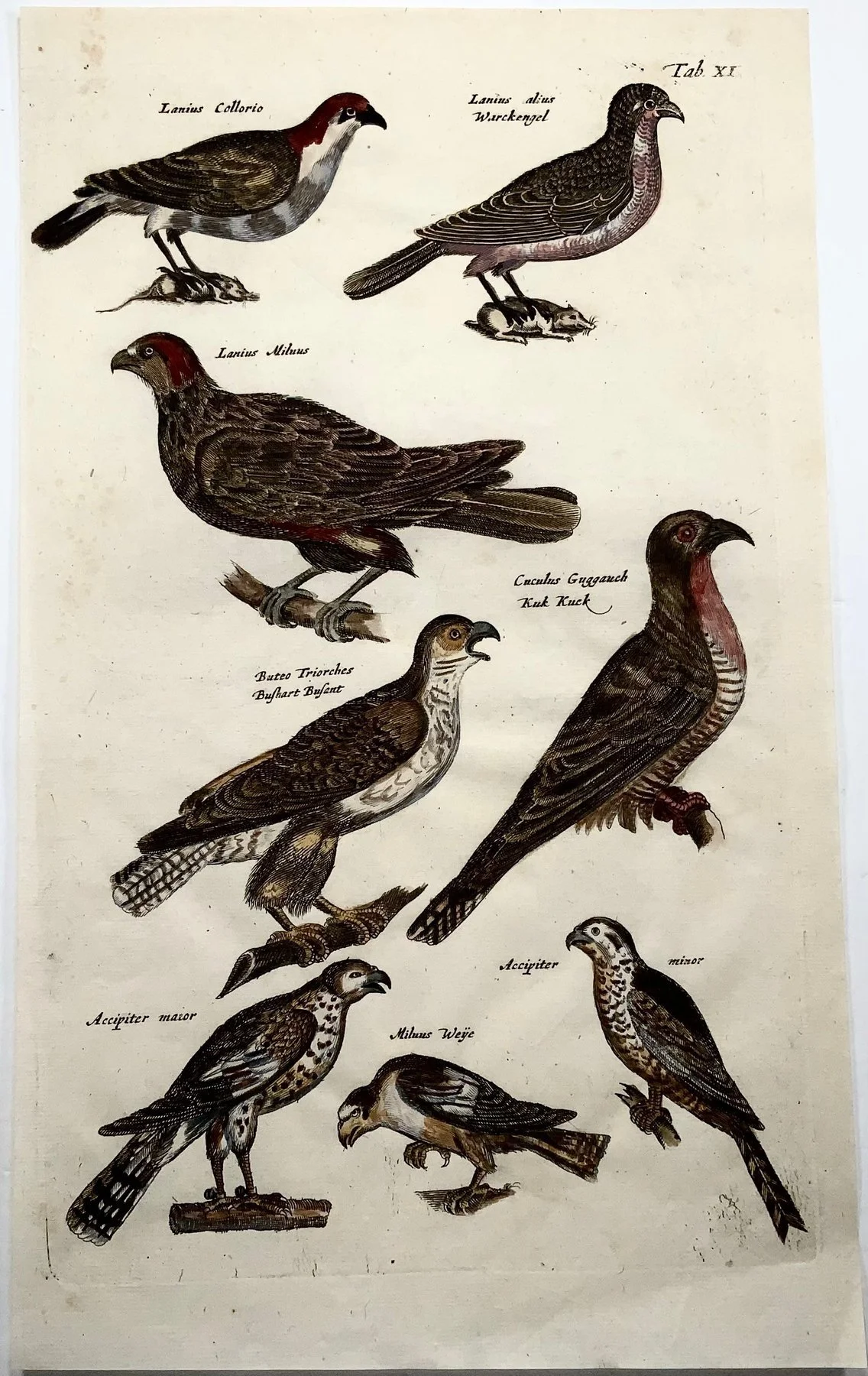 Image 3 of 6
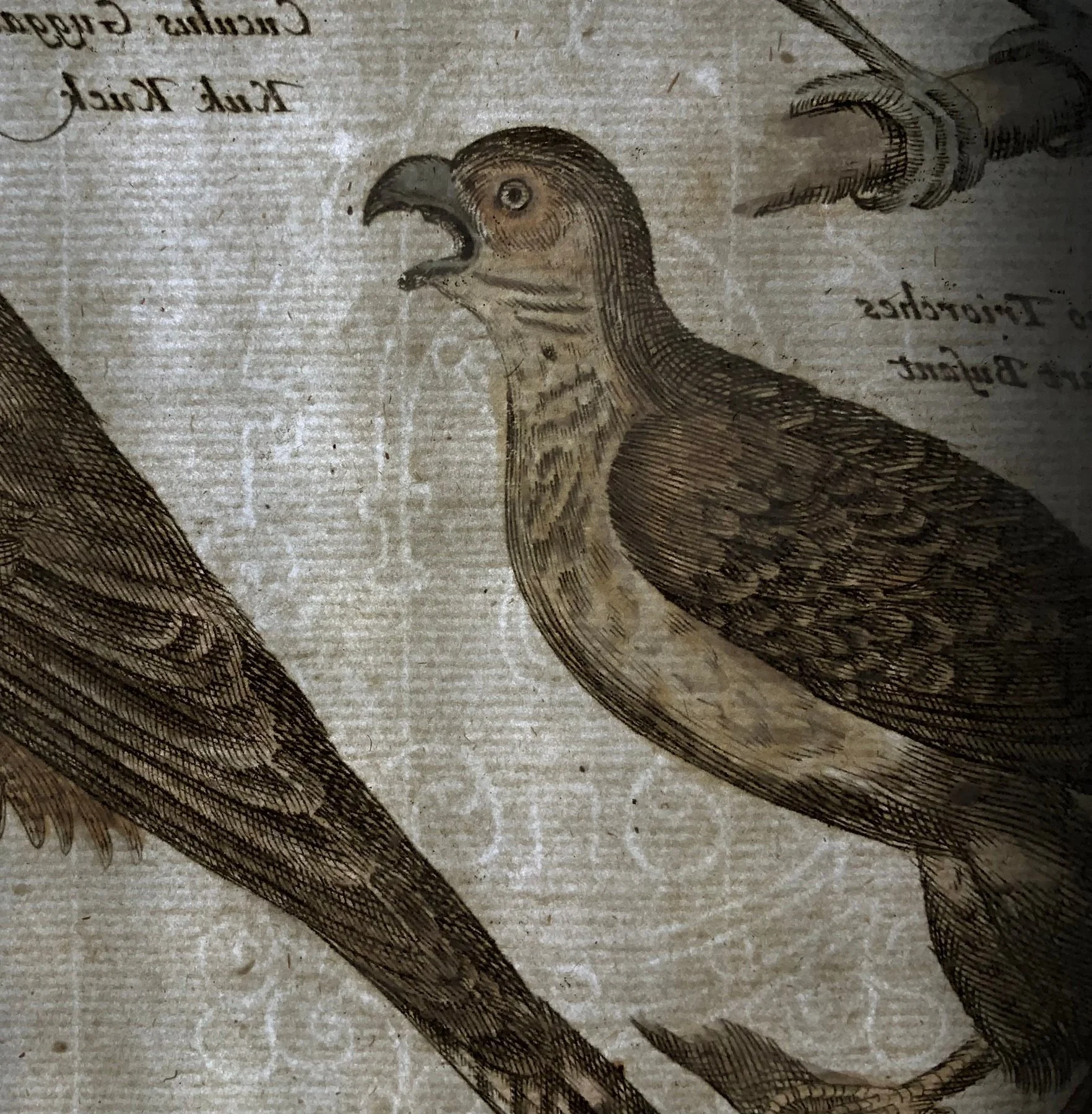 Image 4 of 6
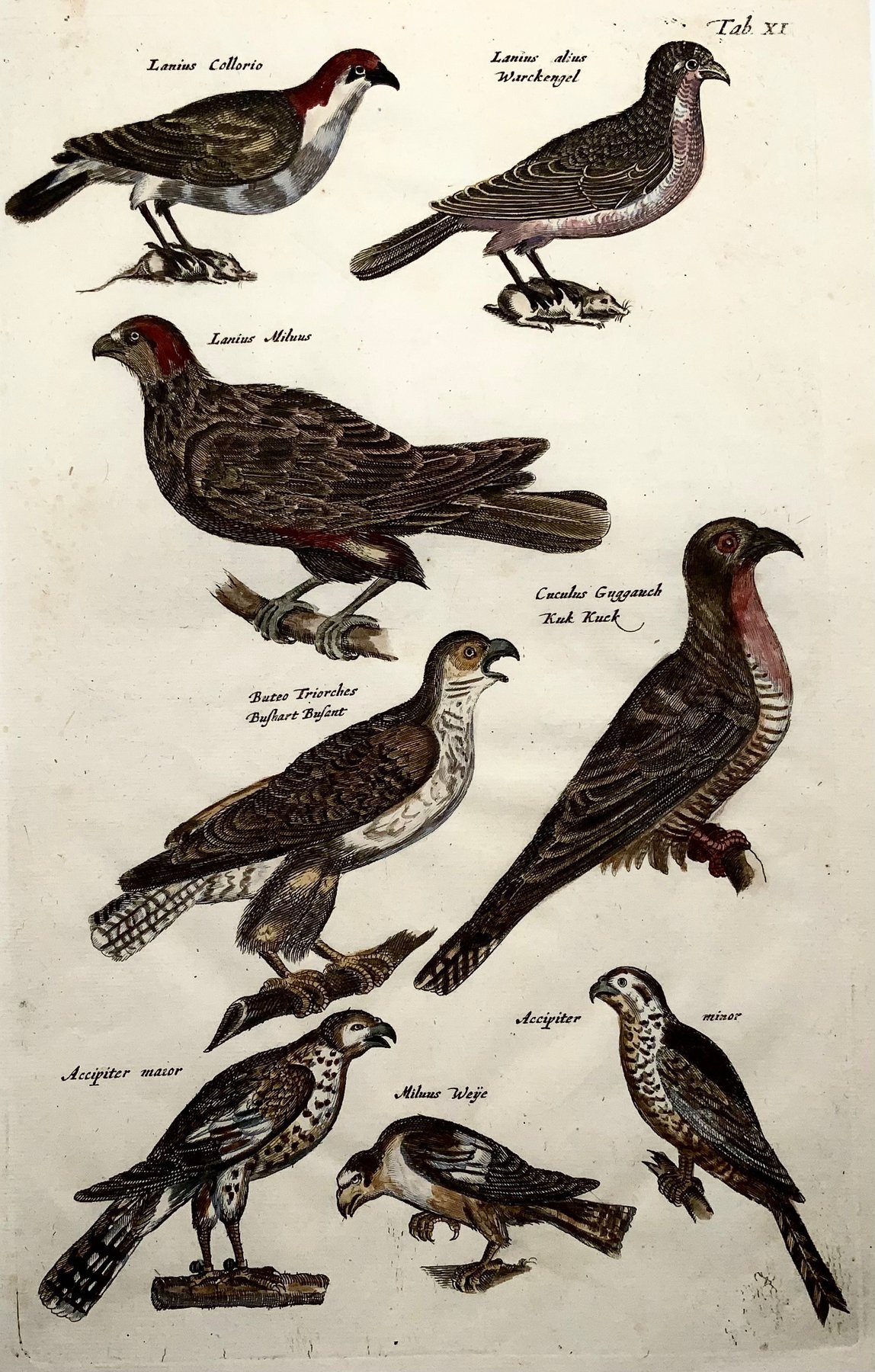 Image 5 of 6
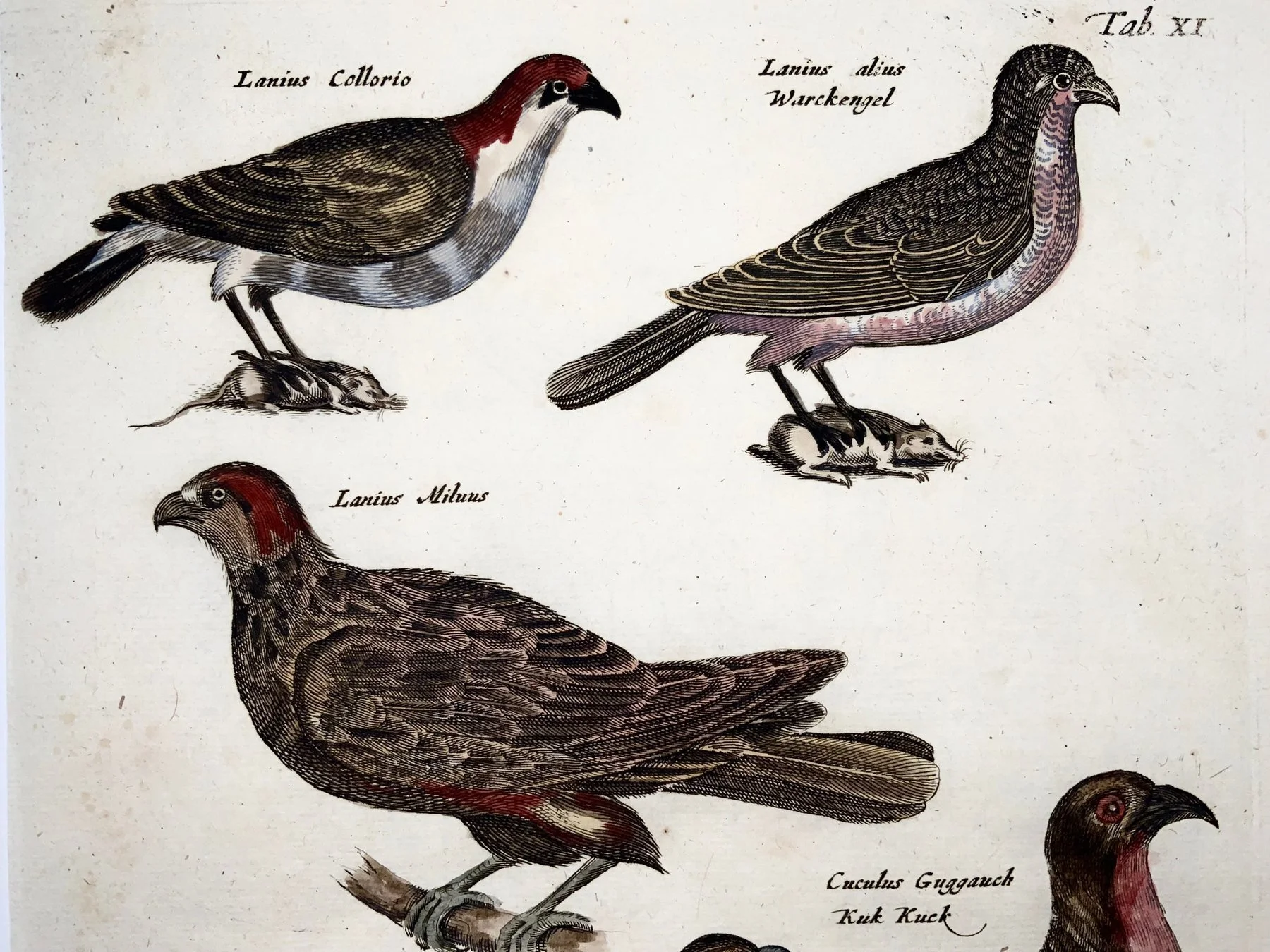 Image 6 of 6